Do you need a chiller for your reef tank? An honest guide to cooling options
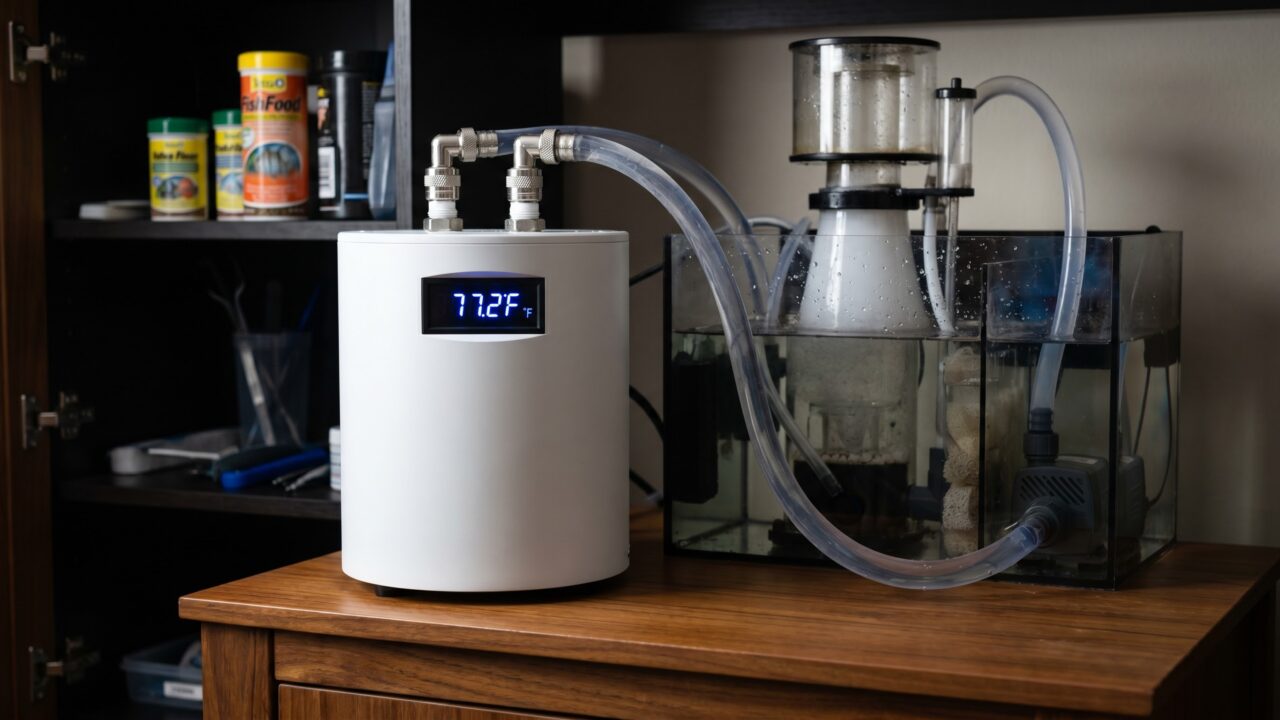
Most reef tanks in temperate climates - the UK, northern Europe, the Pacific Northwest, or any house with decent air conditioning - will never need a chiller. A quality fan and a removed lid often hold a 75-78°F target all summer without spending $1,000 on refrigeration hardware. That said, there are genuine situations where a chiller is the only reliable answer, and running a tank too warm for too long is one of the fastest ways to lose corals. This guide walks through both realities.
Why temperature matters more than most beginners expect
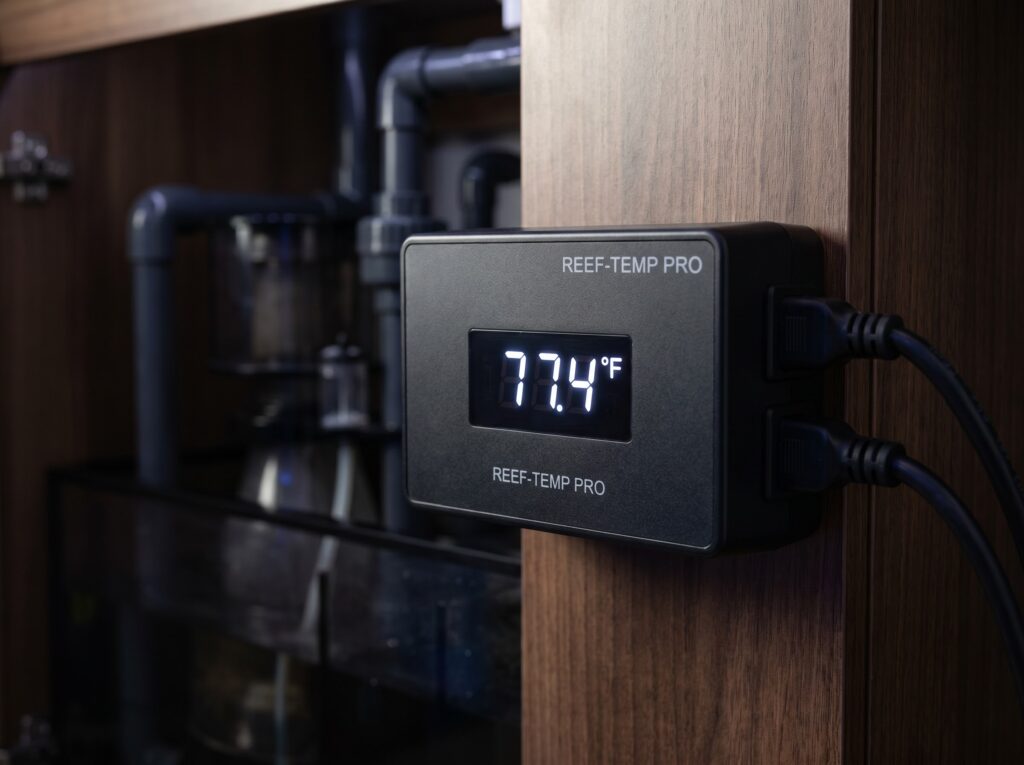
Reef corals depend on symbiotic algae called zooxanthellae living inside their tissue. These algae supply the coral with most of its energy through photosynthesis. When water temperature climbs above the coral's thermal threshold, the relationship breaks down. The coral expels the algae, turns pale or white, and stops feeding efficiently. NOAA researchers have established that even a 1-2°C (2-3°F) rise above the local maximum monthly average, sustained for a month or more, is enough to trigger bleaching.
In the aquarium, ATI North America's temperature guidance puts the sweet spot at 75-78°F and notes that fluctuations of just one or two degrees can stress corals enough to cause browning. That stability requirement is the key point. A tank that swings from 76°F at night to 82°F by mid-afternoon every day is more dangerous to sensitive SPS than one held at a steady 80°F. Chasing the right number matters less than eliminating the swing. For a deeper look at why stability is the primary lever, see our article on reef tank temperature.
The upper boundary most practitioners work with is 82°F as a routine ceiling, with anything above 84°F considered a stress zone. Research published in PLOS ONE found that zooxanthellae expulsion rates increased significantly at a sustained 30°C (86°F), matching real-world bleaching events. That is the scientific basis for the 82-84°F warning zone you will see repeated across serious reef-keeping resources.
Who actually needs a chiller
There are four situations where a chiller stops being optional.
Tropical or subtropical climate without AC. If your room reliably reaches 90°F in summer and you have no air conditioning running, fans alone cannot cool a tank below room temperature by more than a few degrees. Evaporative cooling across the water surface can pull temperatures down 3-7°F, but only when ambient humidity is low. In Singapore, coastal Florida, or any humid tropical location, that delta shrinks to almost nothing. A chiller becomes the primary temperature control.
Metal halide lighting. A 250-watt metal halide pendant transfers roughly 157 watts of thermal energy into your water - about 63% of its draw. A 400-watt fixture pushes that above 250 watts of heat load. Fans can offset some of this, but a densely lit SPS system with multiple pendants in a canopy will fight a losing battle without refrigeration. Modern LED fixtures are a much smaller problem; they transfer roughly 20-25% of their draw as heat, which is why the hobby's migration to LEDs reduced chiller demand substantially.
Sealed or poorly ventilated rooms. A garage tank in a hot climate, a tank in a server room, or a basement where summer air stagnates - these environments push ambient temperature high enough that even moderate equipment heat loads become unmanageable. The same tank in a breezy, air-conditioned living room would be fine.
Specialized coldwater species. Seahorses and certain coldwater invertebrates have lower thermal ceilings than typical reef fish and corals. Seahorses in particular require temperatures in the 70-74°F range in many setups, which is below what most homes stay year-round. Chillers are standard equipment for dedicated seahorse tanks.
The cooling escalation ladder
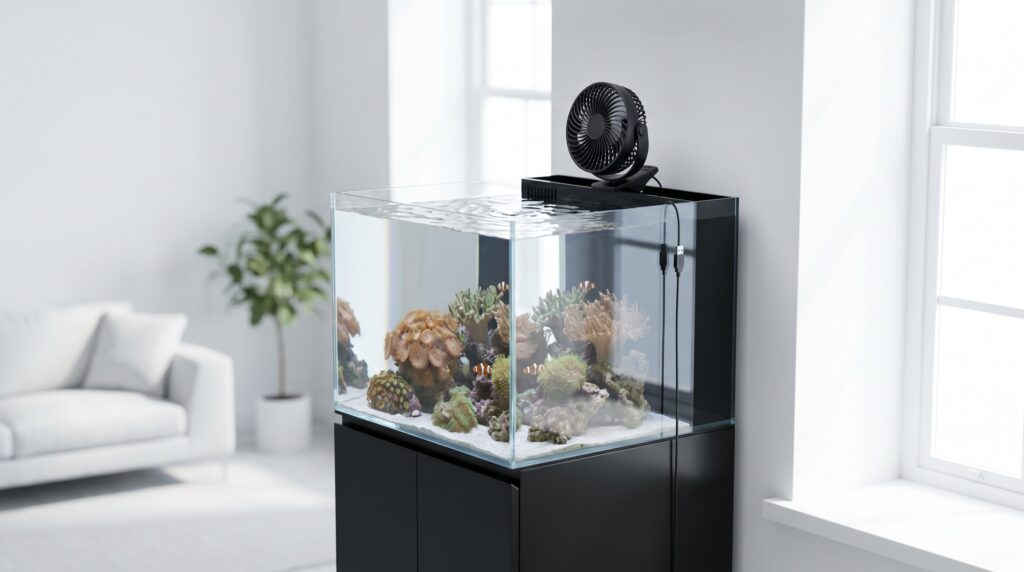
Before spending $800-$2,000 on a chiller, work through these steps in order. Most temperate-climate reef keepers stop at step two or three and never need to go further.
| Step | Method | Typical temperature reduction | When to move to the next step |
|---|---|---|---|
| 1 | Remove the lid / canopy; switch to open-top | 1-3°F from improved surface evaporation | Tank still peaks above 80°F on hot days |
| 2 | Aim a clip fan or USB clip fan across the water surface (or sump) | 2-5°F additional in low-humidity rooms; less in humid climates | Tank still peaks above 80°F, or you are topping off more than half a gallon daily |
| 3 | Run air conditioning in the tank room; keep room at 72-74°F | 3-6°F depending on tank equipment heat load | AC is unavailable, impractical, or tank still spikes above 82°F |
| 4 | Reduce lighting hours by 1-2 hours during peak heat; upgrade from metal halide to LED | 2-6°F for metal halide to LED swap; 1-2°F from shorter photo period | Already on LED, hours already minimal, temperature still problematic |
| 5 | Aquarium chiller (inline, on return line or sump) | 5-15°F reliably regardless of ambient conditions | This is the endpoint - size correctly and you are done |
The trigger temperature that moves you from one step to the next is 80°F as a daily high. If your tank holds below 80°F on the hottest days of your local summer with steps 1-2 in place, you probably do not need a chiller. If it consistently hits 82°F or climbs toward 84°F, keep escalating. Once you reach 84°F regularly, a chiller is the answer - nothing less expensive will reliably hold the temperature in a safe range.
One trade-off worth knowing: fans cool by accelerating evaporation from the water surface. That evaporation removes heat, but it also removes fresh water - and salinity climbs every time water leaves and salt stays behind. On a typical 60-gallon open-top reef with a fan running, expect to top off 0.5-1.5 gallons of RODI water per day. An auto top-off (ATO) handles this automatically and keeps salinity steady. Topping off manually once or twice a day works, but it is easy to miss on a busy week. See our guide on reef tank equipment for how ATOs fit into a complete system.
How to size a chiller if you need one
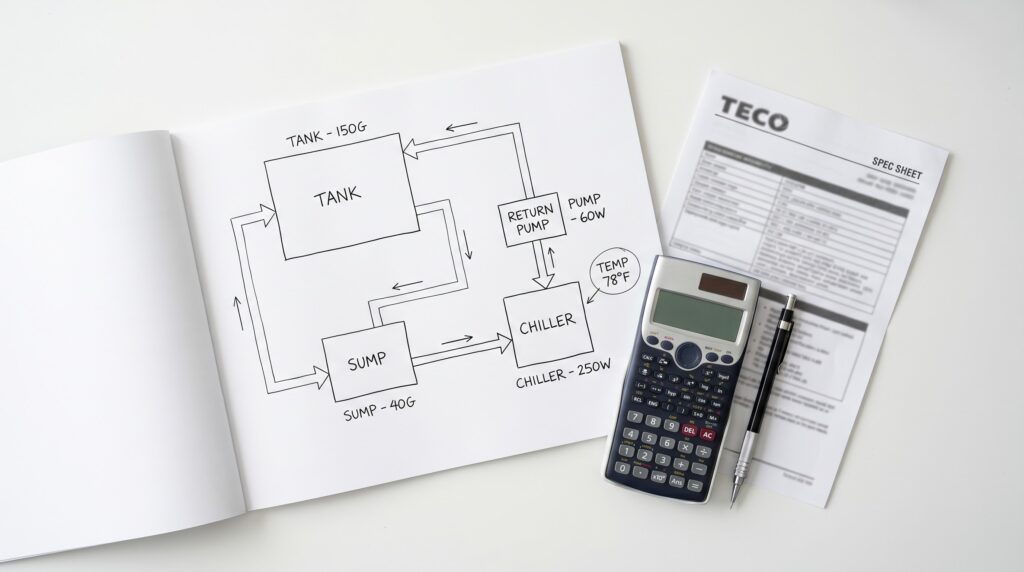
Chiller sizing is not just about total water volume. The three variables that actually determine what you need are: (1) total water volume in the system (tank plus sump), (2) how many degrees of cooling you need - the difference between your current summer peak temperature and your target, and (3) total equipment heat load.
Calculate your heat load first. Add up the wattage of all submersible equipment - return pump, powerheads, skimmer motor - because submersible devices transfer close to 100% of their electrical draw as heat. For metal halide lighting, multiply total wattage by 0.63. For LED, use 0.20-0.25. Convert to BTU by multiplying watts by 3.41. That total BTU per hour is what your chiller must remove, plus any ambient heat entering through the glass.
As a practical starting point, here are the TECO Tank series specs, which give a clear manufacturer-published reference:
| Model | HP | Rated tank volume | Cooling capacity | Realistic 9°F pull-down |
|---|---|---|---|---|
| TK-500 | 1/6 HP | Up to 120 gallons | 225 W draw | ~40-gallon system at 86°F ambient |
| TK-1000 | 1/4 HP | Up to 200 gallons | 315 W draw | ~60-80-gallon system at 86°F ambient (interpolated from adjacent models) |
| TK-2000 | 1/3 HP | 130-500 gallons | 440 W draw | ~530-gallon system at 86°F ambient |
Two sizing rules that practitioners learn the hard way: always size up one model if your room is consistently above 85°F, and never rely on a chiller's rated maximum gallon figure when your actual need is near that ceiling. A TK-500 rated at "up to 120 gallons" will struggle if your 100-gallon system has heavy metal halide lighting in a hot room. Size for the middle of the manufacturer's range, not the top.
Installation always goes on the return line after the sump, or inline on a dedicated feed from the sump. The chiller should be in a well-ventilated space - it exhausts considerable heat, and a hot-closet installation defeats the purpose. Titanium heat exchangers (standard on all quality aquarium chillers) are required for saltwater; aluminum models corrode rapidly.
For context on how a chiller fits alongside heaters in a full temperature management setup, see our guide to reef tank heaters. A chiller without a matching heater leaves you exposed to cold nights in winter, and most systems need both.
The real cost of a chiller
The purchase price ($800-$2,000 for a quality unit) is the obvious figure. The running cost surprises more people. A 1/4 HP chiller pulling 315 watts continuously adds roughly 227 kWh per month at full run time - around $27-45 per month at average US electricity rates, depending on how hard it has to work. A chiller that runs 40-50% duty cycle in a temperate climate might cost $12-20 per month. In a hot climate running near-continuous, that electricity bill climbs fast. Factor this into the decision before you buy.
Fans cost almost nothing to run. A small clip fan draws 5-15 watts. An AC unit running a whole room is more expensive than a chiller but serves multiple purposes. Running the escalation ladder from least to most expensive is not just a beginner's exercise - it is the rational approach for any budget-conscious reefer.
FAQ
Can I cool my reef tank with frozen water bottles?
Sealed frozen water bottles floated in the tank can drop temperature 2-4°F in a pinch, but the temperature bounces back once they melt. Aqueon's guidance is to avoid dropping temperature more than 2-3°F within four hours, so lower it slowly if you use this method. It buys time in a power outage or heat spike, but it is not a substitute for a sustainable cooling solution.
My tank hits 80°F in summer. Do I need a chiller?
Probably not immediately, but the margin is thin. Most reef livestock handles 80°F if it is stable. The problem is an 80°F baseline during a heat wave where the tank climbs to 83-84°F. Try a fan first. If the daily peak stays below 82°F with a fan running, you are likely fine. If it regularly pushes past 82°F for days at a time, consider a chiller or stronger AC.
Can I run a chiller without a sump?
Yes, but it requires more plumbing work. The chiller needs a pump to drive water through its heat exchanger at the manufacturer's specified flow rate (typically 100-200 GPH for smaller units). A dedicated small pump works - the chiller just needs to be inline on a water loop. A sump makes this much cleaner to set up.
Do LED lights mean I don't need a chiller?
LEDs substantially reduce the heat load compared to metal halide - roughly 20-25% heat transfer versus 63% for MH. For many tanks, switching to LED eliminates the need for refrigeration entirely. But LEDs are not zero heat, and in a tropical climate or poorly ventilated room, you may still need a chiller regardless of light type.