Corals for a reef tank: how to choose, place, feed, and keep them alive
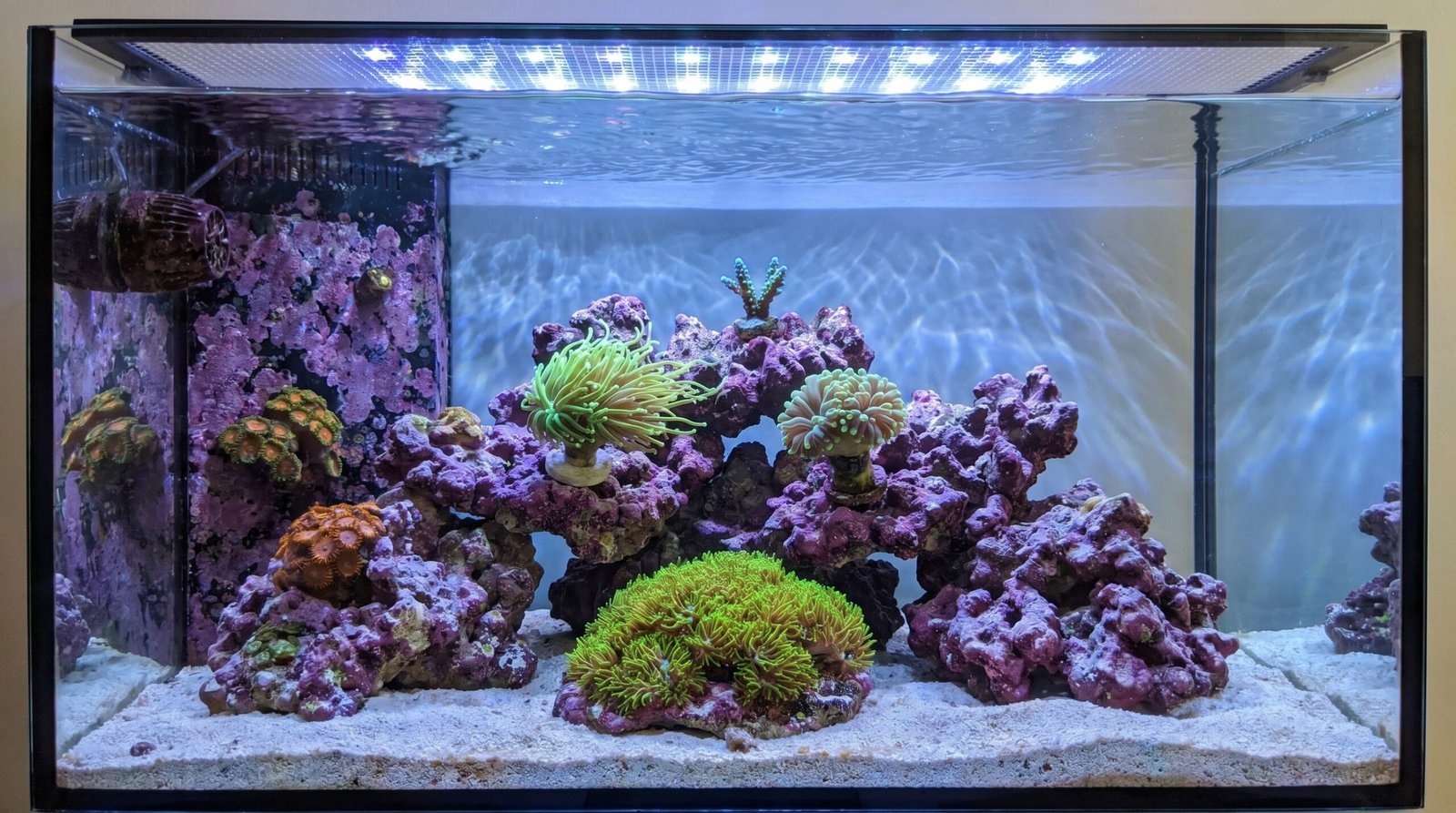
Start with soft corals, spend a year getting your water chemistry rock-solid, then step up to LPS. Save SPS for when your tank practically runs itself. That three-stage progression is not arbitrary caution. It reflects how sensitive each group is to the parameter swings that happen constantly in a young tank. A mushroom coral shrugs off a brief alkalinity dip that would leave an Acropora colony browning for months.
This guide walks you through each stage: what corals actually are, what the three coral groups need, how to buy and handle frags safely, where to place them, how to feed them, and what realistic growth looks like in year one. A full demands table covers every major beginner species at a glance.
What corals actually are, and why that changes how you keep them
Corals are animals, not plants. Each coral colony is made of individual polyps (tiny creatures related to sea anemones) that use tentacles to capture food from the water. NOAA describes them as “sessile animals” that permanently attach to substrate and spend their lives filter-feeding and secreting calcium carbonate skeletons (in the case of stony corals).
Most reef-keeping corals also host symbiotic algae called zooxanthellae inside their tissues. These microscopic algae perform photosynthesis, and according to peer-reviewed research published in the Journal of Experimental Biology, they translocate up to 95% of the resulting organic carbon directly to the coral host for growth and energy. That single fact explains almost every care decision: corals need strong, appropriate light because their internal “solar panels” drive most of their nutrition. When stress causes a coral to expel its zooxanthellae, it bleaches (loses color and energy), though Manta Systems notes that corals can recolonize with zooxanthellae if conditions stabilize in time.
The three groups you will encounter in the hobby differ mainly in skeleton type, polyp size, and how much stability they require:
- Soft corals – no calcium carbonate skeleton; flexible, often plant-like in appearance; most forgiving group
- LPS (large polyp stony) – hard calcium carbonate skeleton; large, fleshy polyps; moderately demanding
- SPS (small polyp stony) – hard skeleton; tiny polyps; requires near-perfect, stable water
The three-stage progression: soft corals first, SPS last
Stage 1: Soft corals (months 1-6)
Soft corals are the right place to start because, as Extreme Corals puts it, they are “less susceptible to any small fluctuations that happen” in water chemistry. A new tank is not stable. Alkalinity climbs and drops as the rock cures, temperature swings between water changes, and your dosing routine is still being dialed in. Soft corals forgive this learning curve; LPS and SPS do not.
Good first choices include mushroom corals (Discosoma and Rhodactis), zoanthids, toadstool leather (Sarcophyton), Kenya tree, and green star polyps (GSP). Each of these will grow in low-to-moderate light (50-150 PAR for mushrooms and zoanthids; 100-150 PAR for leather corals) and tolerate indirect, moderate flow. Read more about your options in our soft corals for beginners guide.
One caution worth knowing early: leather corals like Sarcophyton release allelopathic compounds, chemicals that inhibit nearby stony corals. Manta Systems notes these chemicals “can inhibit the growth of stony corals (SPS and LPS) nearby.” Running a small bag of activated carbon in your sump handles this well enough when your tank is mostly softies, and it becomes more important as you add stony corals later.
GSP deserves a separate warning. It is one of the easiest corals in the hobby, with an acceptable PAR range of 50-350 and a growth rate that borders on aggressive. ReefBay’s care guide is direct: “Don’t place on your main rockwork unless you want it everywhere.” Give GSP its own isolated frag plug or rock island away from your main aquascape, or you will spend years peeling it back.
Stage 2: LPS corals (months 5-12)
Once your tank has run stably for five to seven months (meaning alkalinity, calcium, and temperature hold steady week over week), you are ready for LPS. Extreme Corals recommends waiting at least that long before introducing large polyp stony corals, and the reasoning is simple: stony corals are building calcium carbonate skeletons constantly, so they consume alkalinity and calcium from your water. A tank that has not reached stability will see those numbers swing, and swings stress LPS tissue.
The most popular LPS for beginners are Euphyllia corals (torch, hammer, frogspawn), Duncan, brain corals, and Blastomussa. Torch and frogspawn are centerpiece corals that move beautifully in gentle current. Reefco Aquariums’ PAR guide puts Euphyllia (hammer, torch, frogspawn) in the 100-250 PAR range, with moderate, indirect flow – not blasting the polyp directly. Extreme Corals makes this point clearly: “strong direct current can whip fleshy tissue, prevent expansion, and create long-term irritation.”
Spacing matters more with LPS than most beginners realize. Euphyllia corals deploy sweeper tentacles (extensions tipped with nematocysts) that can extend several inches at night and sting neighboring corals. Tidal Gardens notes the white tips “contain a concentration of nematocysts that can damage more delicate tank mates.” Plan for at least 4-6 inches of clearance around any Euphyllia coral, and more as the colony grows.
For a deeper look at specific LPS species, their PAR requirements, and which ones suit smaller tanks, see our LPS corals for beginners guide.
Stage 3: SPS corals (12+ months)
SPS corals (primarily Acropora, Montipora, Pocillopora, and Stylophora) are the most demanding group in home reefing. Tidal Gardens is unambiguous: “I cannot recommend Acropora for a beginning hobbyist.” These corals evolved in the high-energy, high-clarity sections of natural reefs, and they expect stable, pristine water every single day.
The key difference between SPS and everything below it is the consequence of instability. Tidal Gardens documents this precisely: “If alkalinity dips, they may take on a brown coloration and stay that way for months even if the alkalinity level is corrected.” A brief parameter swing does not just cause temporary stress. It can lock the coral’s appearance and growth for a season.
Acropora thrive at around 300 PAR and require strong, turbulent flow. The ReefBay guide specifies 50-100x tank volume per hour turnover, with colliding currents creating the chaotic patterns these corals experience on natural reefs. They sit in the upper third of the tank, catching the most light. Most hobbyists working with SPS test alkalinity two to three times per week and often run automated dosing to prevent the swings that brown or bleach these corals.
Before adding your first SPS piece, read our full SPS corals: are you ready assessment.
Demands and difficulty table: soft, LPS, and SPS at a glance
The table below covers the most common beginner species across all three groups. PAR ranges reflect typical published targets for each species; the flow column describes the type of current the coral prefers, not raw turnover. Difficulty ratings are relative to other reef corals, not to freshwater fishkeeping.
| Coral | Type | PAR range (µmol/m²/s) | Flow | Feeding | Min. tank age | Difficulty |
|---|---|---|---|---|---|---|
| Mushroom (Discosoma / Rhodactis) | Soft | 50-150 | Low to moderate, indirect | Photosynthetic; supplemental optional | 1-2 months | Beginner |
| Zoanthids / Palythoa | Soft | 50-150 | Low to moderate, indirect | Photosynthetic; supplemental optional | 1-2 months | Beginner |
| Toadstool leather (Sarcophyton) | Soft | 100-150 | Moderate, indirect | Photosynthetic; phyto/zooplankton optional | 2-3 months | Beginner |
| Green star polyps (GSP) | Soft | 50-350 (optimal 100-250) | Moderate to strong | Photosynthetic; undemanding | 1-2 months | Beginner (spread warning) |
| Kenya tree (Capnella) | Soft | 80-250 | Moderate, indirect | Photosynthetic; undemanding | 2-3 months | Beginner |
| Xenia | Soft | 100-150 | Moderate | Photosynthetic; may decline in low nutrients | 2-3 months | Beginner (spread warning) |
| Hammer / torch / frogspawn (Euphyllia) | LPS | 100-250 | Moderate, indirect | Benefits from Mysis 2-3×/week; sweeper tentacles active at night | 5-7 months | Beginner-Intermediate |
| Duncan (Duncanopsammia) | LPS | 50-200 | Moderate, indirect | Responds well to target feeding 2-3×/week | 5-7 months | Beginner |
| Blastomussa | LPS | 75-125 | Low to moderate, indirect | Photosynthetic; occasional target feeding | 5-7 months | Beginner |
| Brain coral (Trachyphyllia open brain; Favia/Favites closed brain) | LPS | 50-150 | Low to moderate, indirect | Benefits from target feeding 1-2×/week | 5-7 months | Beginner-Intermediate |
| Lobophyllia | LPS | 80-200 | Low to moderate, indirect | Occasional target feeding | 5-7 months | Intermediate |
| Acanthastrea (Micromussa) | LPS | 100-250 | Moderate, indirect | Benefits from target feeding 2×/week | 5-7 months | Beginner-Intermediate |
| Montipora (Montipora capricornis / encrusting) | SPS | 200-300 | Moderate to strong, random | Photosynthetic; dissolved organics; amino acids | 9-12 months | Intermediate |
| Pocillopora | SPS | 250-350 | Strong, turbulent | Photosynthetic; dissolved organics | 9-12 months | Intermediate-Advanced |
| Stylophora | SPS | 300-400 | Strong, turbulent | Photosynthetic; dissolved organics | 9-12 months | Intermediate-Advanced |
| Acropora | SPS | 200-300 (up to 500+) | Strong, turbulent (50-100× turnover) | Amino acids; zooplankton; fish presence helps | 12+ months | Advanced |
For a broader overview of all coral categories and where each fits into a reef build, see our types of coral for a reef tank overview.
What every coral needs: light, flow, and the big three parameters
Light
Light is the most important variable in coral health because it drives zooxanthellae photosynthesis. The unit of measurement is PAR (photosynthetically active radiation, measured in µmol/m²/s). Soft corals and low-light LPS sit comfortably at 50-150 PAR. Most Euphyllia and mid-range LPS want 100-250 PAR. SPS starts at 200 and most Acropora peaks around 300, though some colonies adapt to 500 or more over time.
The most dangerous mistake with new corals is overexposure. Tidal Gardens’ guidance is direct: “More damage is caused by overexposure to light intensity than not providing enough light.” When you add a new frag, start it lower in the tank or at the shadowed edge of your aquascape, then move it toward its target position gradually over several weeks. A coral bleached by sudden high-light exposure can take months to recover, sometimes longer than it would have taken to acclimate it properly.
Learn how to measure PAR accurately and how to set a schedule that works for your specific fixture in our reef tank lighting guide.
Water flow
Flow does three things for corals: it delivers dissolved food particles and oxygen to polyps, removes metabolic waste from coral surfaces, and prevents detritus from smothering tissue. Each coral group needs a different kind of flow, and the type matters as much as the volume.
- Soft corals – 20-30× tank volume per hour, gentle and indirect; laminar flow bounced off glass or rockwork
- LPS – 30-40× turnover; moderate and indirect; tentacles should wave gently but not collapse
- SPS – 50-100× or higher; strong and turbulent; colliding currents from multiple directions are ideal
The practical way to create the right flow for mixed systems is to run multiple smaller wavemakers at opposite ends of the tank on alternating or random pulse modes, rather than a single large powerhead pointed at one wall. This creates the random, crashing-wave movement that benefits SPS while allowing LPS to find calmer pockets near rockwork. For more on positioning and turnover calculations, see our wavemakers and powerheads guide.
The big three: alkalinity, calcium, and magnesium
Stony corals build their skeletons by pulling calcium carbonate out of your water. That process depends on three parameters working together: alkalinity, calcium, and magnesium. All three need to be stable as much as they need to be at the right number.
Target ranges used by experienced reefers and confirmed by ATI North America and Charterhouse Aquatics:
- Alkalinity – 8-11 dKH (the most important of the three; the fastest to drop; tests 2-3× per week in coral-heavy tanks)
- Calcium – 400-450 ppm (consumed alongside alkalinity; weekly testing sufficient in early tanks)
- Magnesium – 1250-1350 ppm (stabilizes calcium and alkalinity; every 2-3 weeks is usually enough once in range)
Hanna Instruments describes alkalinity’s role in hard coral systems precisely: it “provides the carbonate ion concentration required for skeletal formation and growth of many coral, but also acts as a pH buffer against large changes in acidity.” They are equally direct about phosphate: “Excessive phosphate levels can prevent calcification, skeletal formation, and growth of many coral species, particularly those referred to as SPS.” Keep phosphate between 0.03 and 0.10 ppm: present, but controlled. Zero-phosphate tanks starve corals and often trigger dinoflagellate outbreaks. You can read the full parameter picture in our water parameters guide.
ATI’s reef chemistry guidance captures the mindset that separates successful reefers from frustrated ones: “Stability is key to grow and color up coral.” A tank running steady at 8.5 dKH every week will outperform one that swings between 7 and 10 dKH chasing a “perfect” number.
Buying frags: what healthy looks like, and what to do before the frag hits your tank
Choosing a healthy frag
A healthy coral frag shows tissue covering the entire skeleton with no white exposed areas. Polyps should extend or at least appear plump. Good color (bright or richly pigmented for the species) is a positive sign. Avoid frags with bleached or translucent tissue, algae growing on the skeleton, slimy brown patches, or any areas where tissue is visibly pulling away from bone.
New growth is the best sign of all: slightly lighter-colored tips or encrusting edges indicate the frag is actively building skeleton and thriving rather than just surviving. For Acropora and other branching SPS, white growing tips are normal and healthy; white areas moving back from the tips are tissue recession and a red flag.
Dipping every frag before it enters your tank
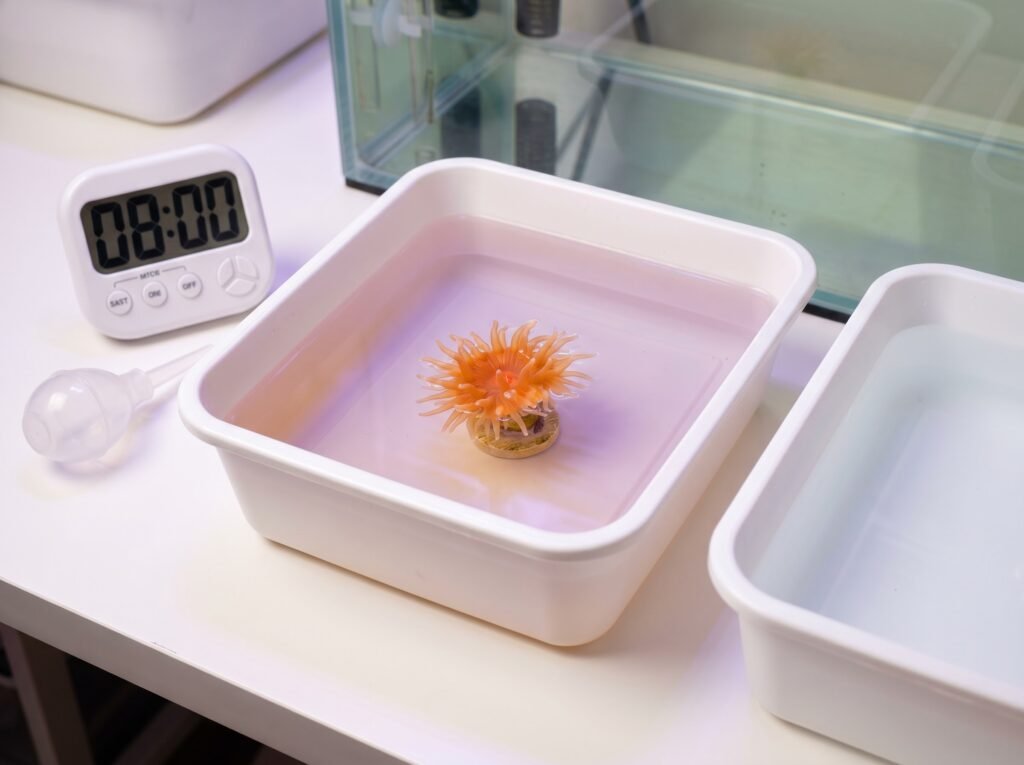
Every coral that comes into your system, regardless of how clean it looks, should be dipped in a dedicated coral dip solution before touching your display tank. Manta Systems is clear on this: “Pests are not always visible to the naked eye, and dipping provides an added layer of protection.”
The two most widely used commercial dips are Coral Rx (a blend of essential oils described as “gentle on corals, effective for a broad range of pests”) and Revive Coral Cleaner (plant-extract based, “less harsh on corals”). Both are effective for removing flatworms, nudibranchs, and parasitic worms before they spread through your system.
Dipping times from Manta Systems by coral type: soft corals 5-10 minutes, LPS 8-12 minutes, SPS 5-7 minutes. Watch the coral throughout the dip. The guide states clearly: “If corals show signs of stress, such as color fading, slime production, or tissue retraction, remove them from the dip immediately.”
After the dip, gently agitate the container; this dislodges pests that the solution has stunned. Rinse the coral in a separate container of clean tank-temperature saltwater before placing it in your display. Manta Systems recommends a 4-6 week quarantine period for highest biosecurity, though most hobbyists working with reputable vendors dip and observe closely rather than maintaining a separate quarantine tank.
Placement: matching the right coral to the right spot
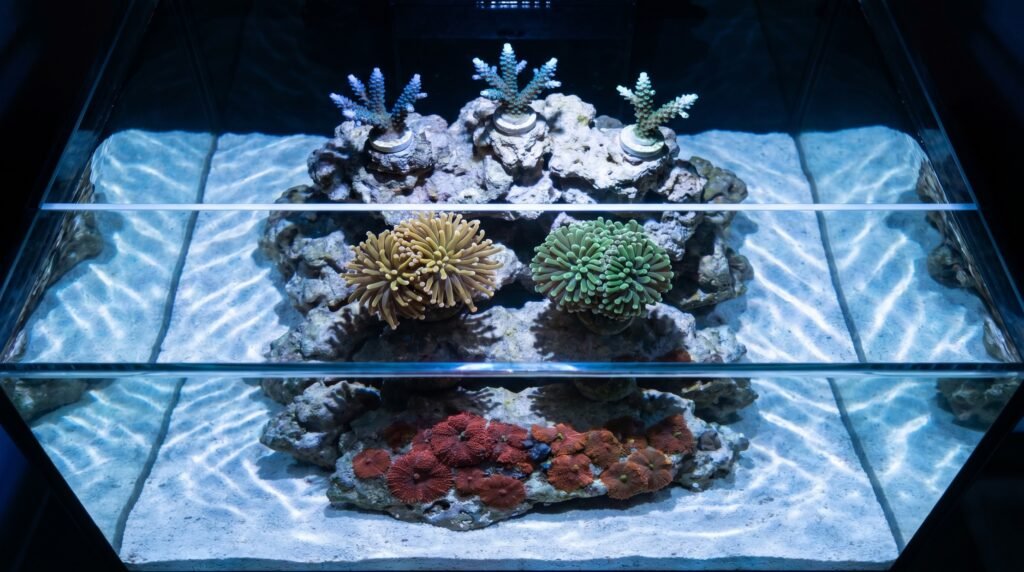
Placement is where light, flow, and aggression management come together. The general rule is that high-light SPS corals go in the upper third of the tank where PAR is highest; mid-light LPS occupies the middle and sides of rockwork; low-light soft corals and shade-tolerant LPS go lower and into shadowed overhangs.
But placement is also about keeping the peace. Corals attack each other. They use two main weapons: sweeper tentacles (long extensions deployed at night, tipped with stinging cells) and allelopathic chemicals released into the water. Aggressive corals include all Euphyllia species: torch, hammer, and frogspawn all carry sweeper tentacles that can reach several inches beyond the visible polyp. Galaxea is another notorious aggressor. Keep these corals well away from neighbors, and check at night with a dim flashlight to see how far their tentacles actually extend.
When you are uncertain where to place a new addition, start it low and in good flow, observe it for two weeks, and move it toward its target zone if the coral responds well. Moving a coral that is stressed mid-acclimation adds another stressor. Patience here costs nothing. For detailed placement guidance by species and zone, our coral placement: light and flow article covers the full decision process.
Feeding corals: what, how, and how often
All photosynthetic corals get most of their energy from light. Supplemental feeding adds protein and accelerates growth, but it is not a substitute for proper PAR levels, and overfeeding is genuinely dangerous. Excess nutrients raise nitrate and phosphate, which drives algae blooms and can inhibit coral calcification.
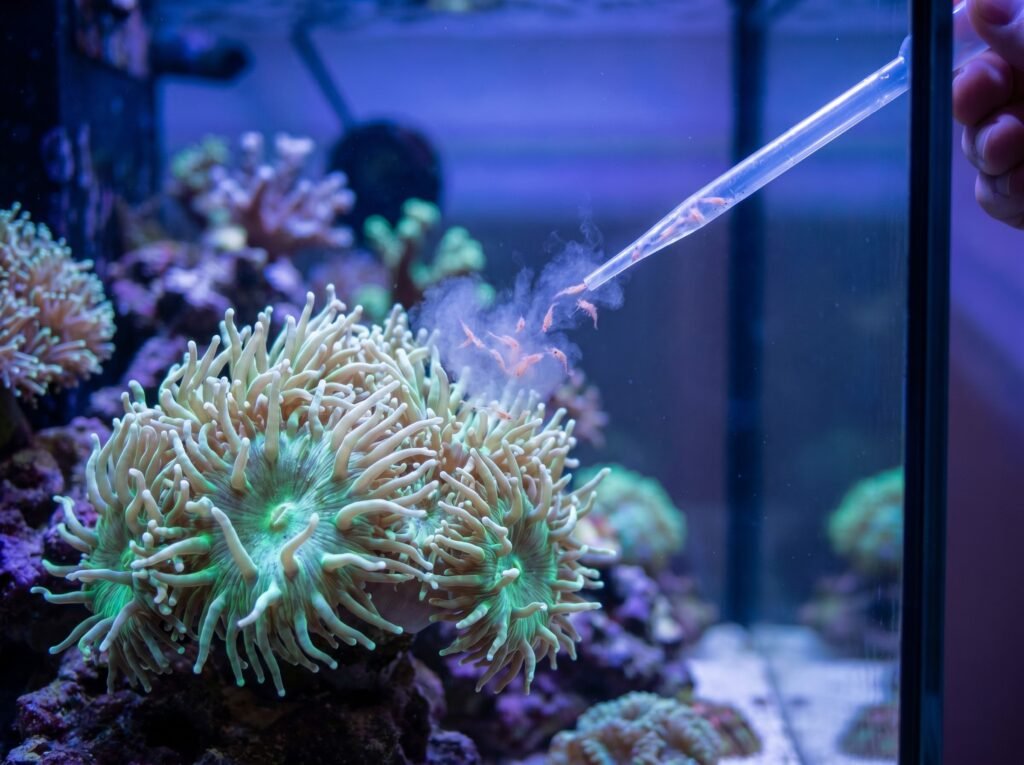
Soft corals are the least demanding feeders. Most are content with what drifts past their polyps during normal tank flow, and many reefers never target-feed their softies at all. LPS corals actively hunt. Their polyps extend toward food, and target feeding two to three times per week with Mysis shrimp, rotifers, or quality reef pellets will visibly increase growth rate and polyp size. Extreme Corals recommends Mysis and other “small meaty foods” for LPS, at that 2-3x weekly rhythm.
For broadcast feeding (distributing food throughout the tank rather than targeting individual corals), the Red Sea method works well: turn off the protein skimmer and main return pump, pour the food near the wavemakers so it distributes through the water column, wait 30 minutes, then restart the system. This ensures the skimmer does not immediately remove food before corals can capture it. Red Sea’s guidance specifies leaving the wavemakers running during the feeding window so food reaches corals tucked into the rockwork.
SPS corals are largely photosynthetic and feed mainly on dissolved organics, amino acids, and very fine suspended particles. Many hobbyists dose amino acid supplements for SPS-heavy systems. Experienced SPS keepers also note that fish presence in an Acropora tank is genuinely beneficial: fish waste and the microfauna that accompany a healthy fish load contribute measurable dissolved nutrition that branching corals absorb passively.
Growth expectations in year one
Realistic growth expectations prevent both disappointment and costly moves. Soft corals are the fastest growers. GSP and Xenia can double their footprint in a few months under good conditions, faster than most beginners expect. Kenya tree and toadstool leather grow visibly within the first year. Manta Systems notes that “fast-growing soft corals like Xenia can overtake a tank quickly,” which is why placement on isolated rock is important from the start.
LPS growth is measurable but slower. A Euphyllia frag that starts as a single head can add one to two additional heads in a year under good feeding and stable parameters. Brain corals and Blastomussa expand as encrusting sheets; progress is visible but incremental. Expect months of settling before a new LPS frag looks established; frag attachment alone takes “a few days to a few weeks” depending on species and how it is secured.
SPS growth is highly dependent on parameters and lighting. Under ideal conditions, encrusting Montipora species grow quickly; branching Acropora more slowly. Year-one growth for a beginner-placed Acropora frag in a tank that is still learning stability tends to be modest. If the coral is extending polyps daily and maintaining good color, it is doing well. Focus on that rather than measuring branches.
For a curated short list of the best beginner corals across all three groups, with notes on hardiness and where to place each one first, see our best beginner corals guide.
Frequently asked questions
How long before I can add corals to a new reef tank?
Wait until the nitrogen cycle is fully complete and parameters have been stable for at least two to four weeks. Start with soft corals then. LPS requires a tank that has been running five to seven months with stable alkalinity and calcium. SPS generally should wait until the 9-12 month mark at minimum, with full-time dosing in place.
Can I mix soft corals and SPS in the same tank?
Yes, but with management. Leather corals release allelopathic chemicals that inhibit nearby stony corals. Running activated carbon continuously and doing regular water changes reduces this chemical load significantly. Keep softies and SPS well separated spatially, and watch stony corals near leather colonies for signs of retraction or browning.
My coral closed up and won’t open. What’s wrong?
Closed polyps usually indicate water quality stress, flow that is too strong or too direct, a pest on or near the coral, or a recent parameter change. Check alkalinity and salinity first, as these are the fastest to shift. Inspect the coral with a magnifying glass and a flashlight for flatworms or nudibranchs. If flow seems aggressive, move the coral to a calmer spot and observe for 48 hours before drawing conclusions.
Do all corals need to be fed, or does light cover it?
Light covers most of the energy budget for photosynthetic corals, but target feeding accelerates LPS growth measurably. Soft corals rarely need supplemental feeding. SPS feed mainly on dissolved organics and fine particulates. For LPS, two to three Mysis or reef-food feedings per week are genuinely worthwhile; more than that raises nutrient loading without proportional benefit.
What is the cheapest coral to start with?
Mushroom corals and zoanthids are almost always the least expensive frags in any coral sale or swap, often available for a few dollars per polyp or plug. They are also among the hardiest. GSP is similarly cheap and grows fast, but needs its own rock island from day one to prevent it from overrunning your aquascape.
The SteadyReef team
We write calm, plain-English reef-keeping guides. Every claim is checked against the marine-science and manufacturer sources listed above before publishing.