Reef tank water parameters: the complete guide with target ranges
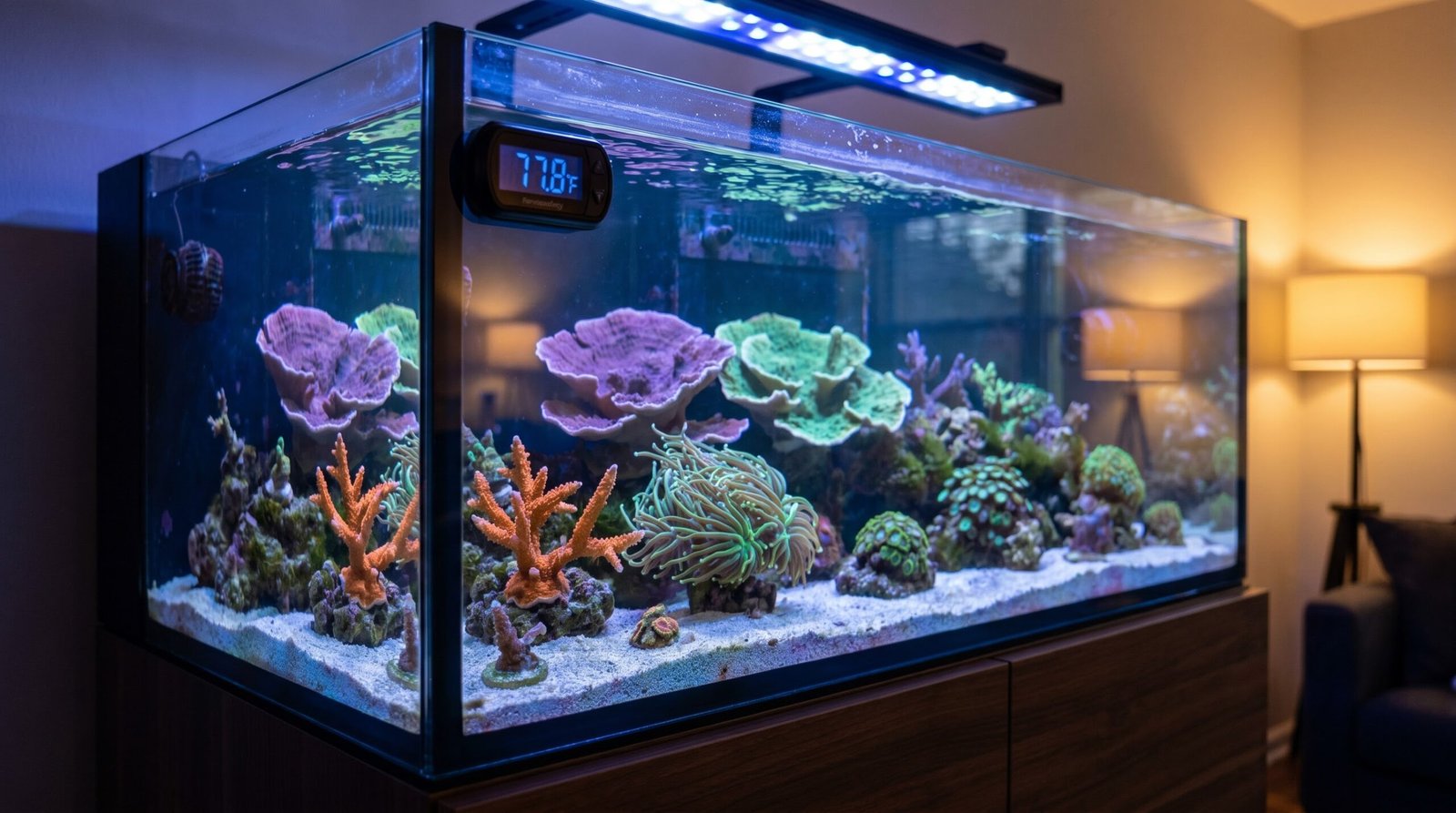
Every reef tank parameter you need to know lives in one place on this page. The master table below covers salinity, temperature, alkalinity, calcium, magnesium, pH, nitrate, phosphate, ammonia, and nitrite – with target ranges, testing frequency, and direct links to the how-to-fix guides. Bookmark it and come back every time you pull out a test kit.
The single most important concept in reef chemistry is this: stability beats chasing a perfect number. A tank holding a steady alkalinity of 8.5 dKH will outperform a tank swinging between 7.5 and 10.0 dKH every week – even though 8.5 is technically inside the same target band. Corals adapt to a wide range of conditions, but they cannot adapt to constant change. Keep reading for the full picture on what to measure, when, and why it matters.
The master reef tank parameter table
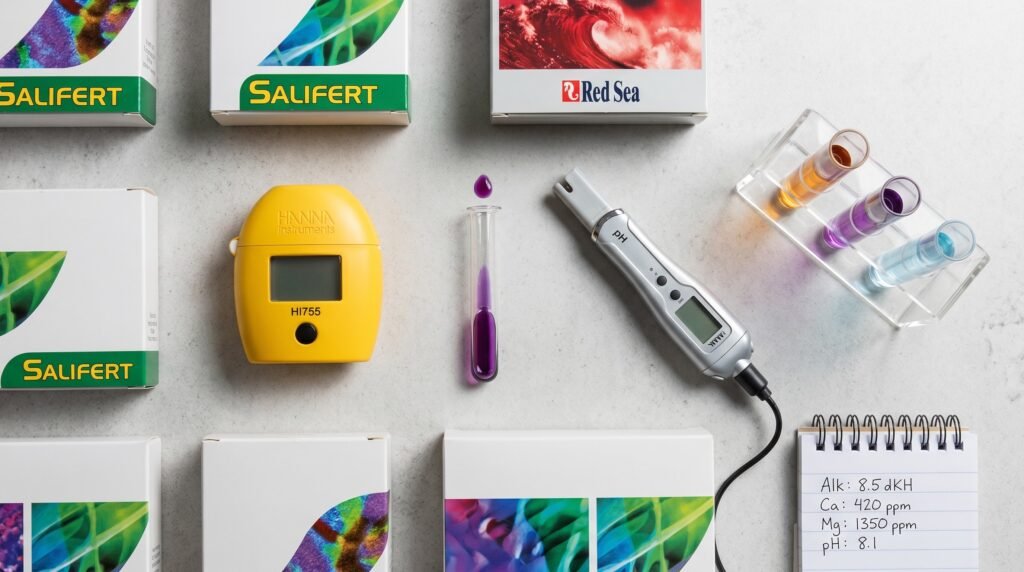
Most reef guides bury this kind of quick-scan reference inside a PDF or spread it across six separate articles. Every parameter the SteadyReef team covers in depth has a link to its dedicated guide in the “Fix guide” column. Use those links when a test result falls outside range.
| Parameter | Target range | Test frequency | Preferred method | Fix guide |
|---|---|---|---|---|
| Salinity | 1.025-1.026 SG / 35 ppt | Weekly + after every top-off | ATC refractometer or digital meter | Reef tank salinity guide |
| Temperature | 76-78°F (24.4-25.6°C) | Daily (use a digital thermometer with min/max memory) | Digital thermometer | Reef tank temperature guide |
| Alkalinity (dKH) | 8-11 dKH | 1-2× per week | Hanna HI755 checker or Salifert kit | Reef tank alkalinity guide |
| Calcium | 400-450 ppm | Weekly | Salifert or Red Sea Pro kit | Calcium in a reef tank |
| Magnesium | 1,250-1,350 ppm | Every 2 weeks | Salifert or Red Sea Mg kit | Magnesium in a reef tank |
| pH | 7.9-8.4 (daily swing of 0.2-0.5 is normal) | Weekly (or continuous with a probe) | Calibrated digital pH meter or controller | Reef tank pH guide |
| Nitrate (NO3) | 1-10 ppm | Weekly | Red Sea Nitrate Pro kit | Nitrates in a reef tank |
| Phosphate (PO4) | 0.03-0.10 ppm | Weekly | Hanna HI713 or ATI kit | Phosphates in a reef tank |
| Ammonia (NH3/NH4) | 0 ppm | Daily during cycling; monthly after | API Saltwater kit or Salifert | See nitrogen cycle section below |
| Nitrite (NO2) | 0 ppm | Daily during cycling; monthly after | API Saltwater kit or Salifert | See nitrogen cycle section below |
A note on test kits: liquid drop kits work, but a colorimetric reader like the Hanna HI755 for alkalinity removes the guesswork of comparing color swatches under artificial light. For an in-depth comparison of the options, see the best reef tank test kits guide.
Salinity: the foundation of everything else
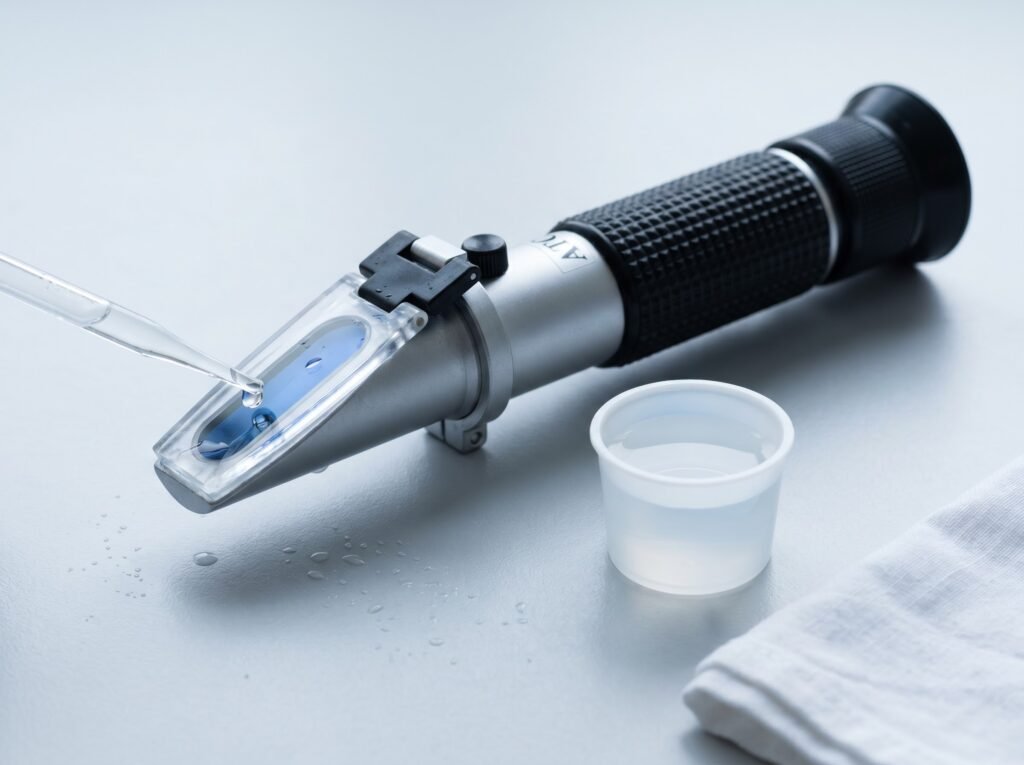
Natural ocean water at a coral reef measures about 35 ppt (parts per thousand), which corresponds to a specific gravity of approximately 1.025-1.026 at 25°C. That is the target for a reef tank. Running lower than about 31 ppt stresses or kills corals; higher than 38 ppt causes soft coral tissue to melt and hard coral to peel.
One calibration trap catches many beginners: a standard brine-calibrated optical refractometer reads roughly 36.5-36.8 ppt when you put 35 ppt natural seawater on the prism, because brine and seawater have different refractive indexes. A refractometer labeled “seawater-calibrated” or a digital salinity meter corrects for this automatically. Swing-arm plastic hydrometers are notoriously inaccurate and are not recommended for a reef tank. For everything about measuring, adjusting, and stabilizing salinity, see the reef tank salinity guide.
Temperature: small swings are the real threat
The target window is 76-78°F (about 24.4-25.6°C). Corals can tolerate temperatures up to around 81°F for short periods, but beyond that the risk of zooxanthellae expulsion – the symbiotic algae that give corals color and energy – rises sharply. That is the cellular mechanism behind coral bleaching.
The practical danger for home aquariums is usually not a single extreme reading. It is the daily swing: a tank that climbs to 80°F under the lights and drops to 76°F overnight is far more stressful than one that sits at a steady 78°F around the clock. A digital thermometer with min/max memory is inexpensive and worth using. The reef tank temperature guide covers chillers, heater controllers, and summer heat management.
Alkalinity, calcium, and magnesium: the “big three”
These three parameters interact as a system. Stony corals build their calcium carbonate skeletons by pulling both calcium and carbonate (measured indirectly as alkalinity) from the water. Magnesium’s job is to keep that calcium and carbonate dissolved long enough for the coral to use it.
Here is why magnesium matters so much: in the absence of magnesium, calcium carbonate precipitates out of solution within minutes. Natural seawater contains about three times as much magnesium as calcium – roughly 1,280 ppm versus 420 ppm. That ratio is what allows seawater to hold large amounts of dissolved calcium and alkalinity without instantly turning into scale on your heater and pump. When magnesium drops below about 1,200 ppm in a reef tank, calcium and alkalinity become difficult to maintain regardless of how much you dose, because they keep precipitating out before corals can use them.
Alkalinity
The target range is 8-11 dKH. Alkalinity measures the water’s buffering capacity – its ability to resist sudden pH swings – and it is the raw material corals use to build skeletal carbonate. Low alkalinity (below about 7 dKH) slows coral growth and, in sensitive small polyp stony (SPS) corals, can trigger bleaching. High alkalinity (above 12 dKH) can burn the growing tips of SPS corals and cause tissue recession in large polyp stony (LPS) species. Test 1-2 times per week in an established tank, and more often when you are actively dialing in a dosing routine. Full details are in the reef tank alkalinity guide.
Calcium
Keep calcium between 400 and 450 ppm. Below about 380 ppm, calcification rates slow visibly. Well above 450 ppm, the water approaches a saturation point where calcium and carbonate start to drop out of solution together, which can actually drag alkalinity down with it. Test weekly. The calcium guide explains two-part dosing, calcium reactors, and kalkwasser as the main supplementation methods.
Magnesium
Target 1,250-1,350 ppm. Magnesium depletes more slowly than calcium or alkalinity, so testing every two weeks is usually enough in a mature tank. If you are fighting calcium or alkalinity levels that refuse to hold steady, check magnesium first – it is often the root cause. The magnesium guide walks through dosing calculations and why correction should be gradual (no more than about 50-100 ppm per day).
pH: the daily cycle is normal
The healthy pH range for a reef tank is 7.9-8.4. A daily swing of 0.2-0.5 units is completely normal and expected. Here is why: during the day, corals and coralline algae photosynthesize, pulling carbon dioxide out of the water and pushing pH upward. At night, everything in the tank – fish, corals, bacteria – respires, adding CO2 back and pushing pH down. The lowest reading of the day comes just before the lights come on in the morning.
The number that matters most is stability, not the peak reading. A tank that holds a steady 8.1 around the clock is in better shape than one that climbs to 8.4 at midday and crashes to 7.8 by dawn, even though 8.1 sits in the lower part of the target range. Liquid test kits can be imprecise for pH; a calibrated digital pH meter gives a more reliable reading. The reef tank pH guide covers refugiums, CO2 scrubbers, and the other tools hobbyists use to raise a low pH floor.
Nitrate and phosphate: why zero is the wrong target
This is one of the most counterintuitive concepts in reef keeping. Both nitrate and phosphate are nutrients. Corals need them, along with their zooxanthellae, to fuel basic metabolic processes. Chasing zero on either parameter causes real harm.
When phosphate drops to undetectable levels, corals begin to show signs of nutrient starvation: faded or “pastel” coloration, poor polyp extension, and increased vulnerability to pests and disease. The tissue thins. When both nitrate and phosphate simultaneously approach zero, dinoflagellates – a particularly stubborn tank pest – gain a competitive advantage over other organisms and can take over rock surfaces and sand beds. Dinoflagellates thrive in ultralow-nutrient conditions where they have less competition.
Nitrate
Target 1-10 ppm. SPS-dominant tanks often run toward the lower end of that range; LPS and mixed reefs can run a bit higher. The old advice to drive nitrate to zero came from a generation of fishkeeping before reef chemistry was well understood. Some coral species – Acropora in particular – tend to do well around 5 ppm. The nitrate guide covers skimmers, refugiums, and deep sand beds as the main management tools.
Phosphate
Target 0.03-0.10 ppm, with the lower end of that range (around 0.03-0.05 ppm) typical for mixed and SPS-heavy tanks. Phosphate above roughly 0.10 ppm has been associated with inhibited calcification at the coral skeleton surface – peer-reviewed research documents clear inhibition at concentrations around 0.15 ppm – and elevated phosphate also fuels green hair algae and cyanobacteria blooms. Below 0.02 ppm, corals show the starvation signs described above. The phosphate guide covers granular ferric oxide (GFO), refugium macroalgae, and feeding adjustments.
Ammonia and nitrite: the cycling parameters
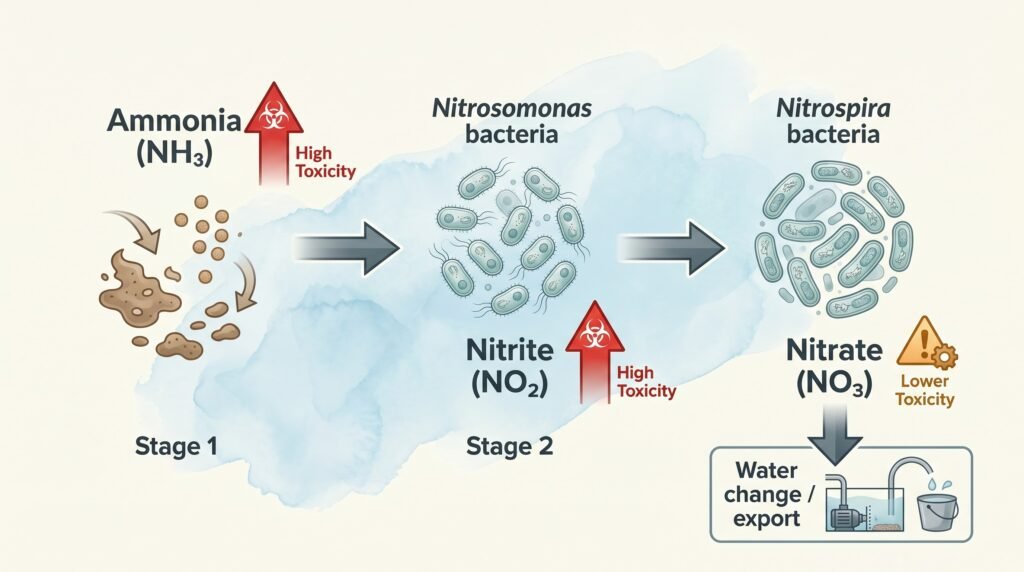
In a fully cycled reef tank, ammonia and nitrite both read zero. Full stop. Any detectable ammonia or nitrite in an established system is an emergency signal – an indication that the biological filter has been disrupted or is overwhelmed.
Both compounds are products of the nitrogen cycle, the bacterial process that converts fish waste and uneaten food into progressively less toxic compounds. Nitrosomonas bacteria oxidize ammonia into nitrite. Nitrospira bacteria then convert nitrite into nitrate. Cycling a new tank takes roughly four to six weeks. During that window you will see ammonia spike first, then nitrite, then nitrate. The tank is cycled when ammonia and nitrite both hit zero simultaneously and hold there for several consecutive days.
New tanks also go through a predictable cosmetic phase that hobbyists call the “ugly stage” – a temporary appearance of diatom film (brown, dusty), followed sometimes by cyanobacteria (red or green slime) or dinoflagellates (brown strings with bubbles). This is a normal part of tank maturation and does not mean something is wrong with your water chemistry.
Test ammonia and nitrite daily during cycling, then monthly once the tank is established. Always retest both when you add significant new livestock or notice a problem – any new spike indicates something has stressed or crashed the bacterial population.
A practical note on water source
Always use reverse osmosis deionized (RODI) water for a reef tank – for top-off, for mixing salt, for everything. Tap water contains phosphate, nitrate, chlorine, chloramine, and heavy metals including copper. Even trace copper from household plumbing is dangerous: shrimp begin to show toxic effects at concentrations as low as 0.03 mg/L, and the therapeutic copper concentrations used to treat parasites in fish (0.15-0.25 ppm) are well above lethal thresholds for corals and all invertebrates. A RODI system produces water with essentially zero total dissolved solids, giving you a blank slate to which you add only a quality reef salt mix.
On the same note: copper-based medications must never enter a tank that contains corals, shrimp, snails, crabs, or any other invertebrate. Copper absorbs into live rock and sand and leaches back out slowly for weeks or months – a single treatment can render a tank permanently uninhabitable for invertebrates.
Putting it all together: the stability principle
A beginner’s instinct is often to obsess over hitting each number perfectly. The experienced reef keeper’s focus is different: test regularly, catch drift early, and correct gently. Abrupt corrections – dumping alkalinity up by 3 dKH overnight or letting salinity spike after forgetting a top-off for a week – cause more direct coral stress than parameters sitting a few points outside the target bands.
Practically, this means:
- Test alkalinity at least once a week, preferably twice when you are still learning your tank’s consumption rate.
- Top off with RODI water daily or use an auto top-off (ATO) unit to prevent salinity creep from evaporation.
- When a parameter is out of range, correct by no more than about 10-15% of the gap per day.
- Log every test result in a spreadsheet or app. Trends are far more useful than single data points.
Stability is built through routine, not through intensive intervention. Test, record, adjust gently, repeat.
Frequently asked questions
What is the most important water parameter in a reef tank?
Alkalinity has the most direct and immediate effect on coral health. It fuels skeletal growth and buffers pH. SPS corals are especially sensitive to alkalinity swings, even small ones. That said, all parameters in the master table above interact – none exists in isolation, and neglecting any of them eventually shows up in coral health.
How long does a new reef tank take to cycle?
Typically four to six weeks from the introduction of an ammonia source. Cycling is complete when ammonia and nitrite both read zero simultaneously after a deliberate ammonia dose and hold there for at least two to three days. Bacterial starter products can speed the process but are unlikely to cut it below three to four weeks; the baseline without starters is typically four to six weeks.
Can I use tap water for top-off if I add a dechlorinator?
No. Dechlorinators neutralize chlorine and chloramine but leave phosphate, nitrate, silicates, and heavy metals including copper intact. RODI water – with a TDS reading near zero – is the correct water source for a reef tank. It gives you control over exactly what goes into your system.
Why is my pH low at night?
A pH drop at night is completely normal. When lights go off, photosynthesis stops but respiration continues across the entire tank, adding carbon dioxide and lowering pH. The reading recovers as the lights come back on. A typical healthy tank swings 0.2-0.5 pH units through this daily cycle. Consistent readings below 7.9 even at peak afternoon suggest insufficient gas exchange or elevated indoor CO2.
Do I need to test every parameter every week?
Not necessarily. In a mature, stable tank, magnesium only needs testing every two weeks, and ammonia and nitrite only need monthly checks. Alkalinity deserves the most frequent attention – weekly at minimum, twice a week when fine-tuning dosing. Salinity should be checked whenever you do a water change or notice unusual evaporation.
The SteadyReef team
We write calm, plain-English reef-keeping guides. Every claim is checked against the marine-science and manufacturer sources listed above before publishing.