Reef tank fish: what reef-safe really means, stocking order, and building a healthy roster
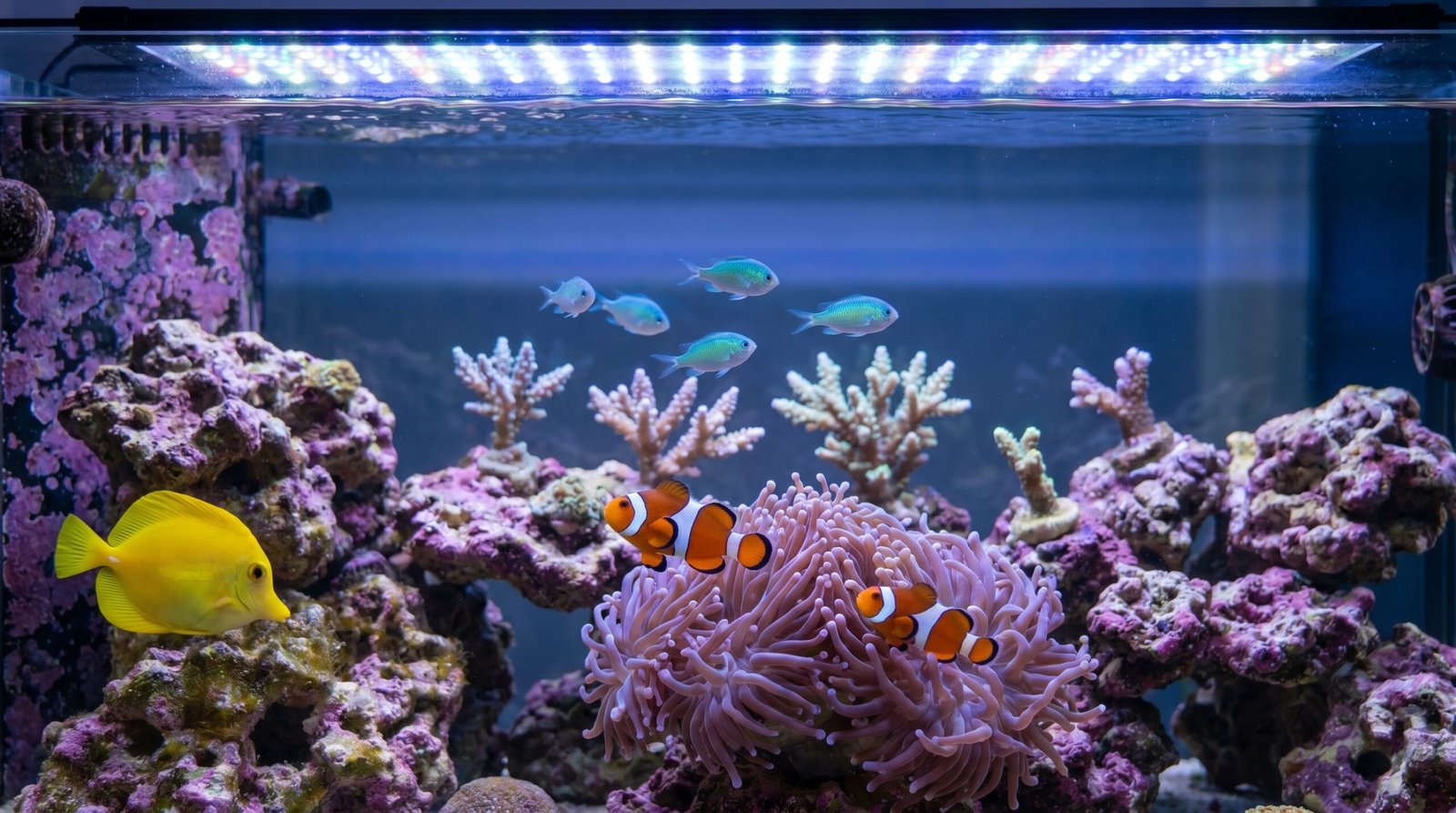
Every new reef keeper learns the term “reef-safe” within about a week of starting. Most also discover, a little later, that it comes with asterisks – and that the order you add fish matters almost as much as which fish you choose. Get both right and the tank runs smoothly. Get either wrong and you are rearranging furniture at midnight trying to stop a three-inch fish from terrorizing everything it shares a wall with.
This guide walks through what reef-safe actually means, which species wear that label cleanly and which wear it on probation, how to build a stocking list in the right sequence, how to think about bioload, and why quarantine is the one step that saves the most grief. It also links out to the size-specific stocking articles in this series when the details run deeper than one page can hold.
What “reef-safe” actually means
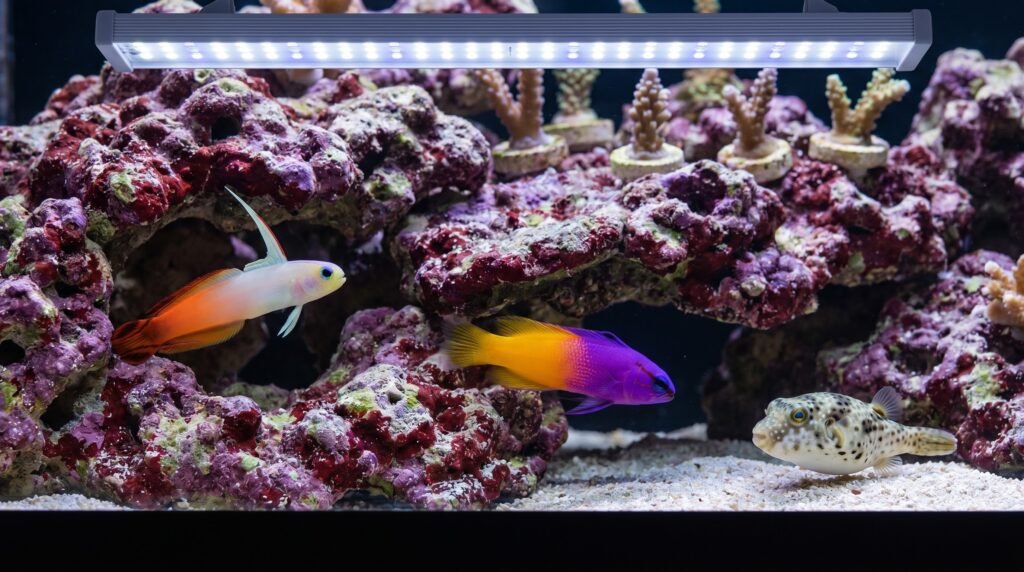
Reef-safe is a shorthand label, not a scientific certification. It signals that a fish is unlikely to eat coral polyps, nip at clam mantles, or systematically pick off the shrimp and snails you spent money on. That is the working definition, and it is genuinely useful as a first filter. The asterisks come in when you look at the edges.
A few species carry the label cleanly: firefish gobies, small planktivores like green chromis, and the royal gramma. The clownfish belongs here too – Amphiprion ocellaris tops the import charts as one of the most commonly kept marine fish, stays small at roughly 90 mm (3.5 in), and poses no real threat to coral or inverts. These are genuinely safe choices, with no meaningful caveats for a well-run tank.
Then there is a larger group that earns “reef-safe with caution.” Dwarf angelfish in the genus Centropyge are the textbook example. In the wild, angelfish probe reef surfaces eating algae, sponges, and microinvertebrates – behavior that can translate into nipping at LPS corals, zoanthids, or clam mantles in a closed system. Some individuals never nip. Others work through a coral colony in days. There is no reliable way to predict which one you are buying. Keeping them well fed and adding them last helps, but it does not eliminate the risk.
Dottybacks deserve a separate mention because their coloration looks peaceful and their size (most stay under 4 in) suggests harmless. Tropical Fish Hobbyist Magazine put it plainly: “A colorful and mellow visage hides the aggressive truth – these popular fishes are some of the biggest bullies out there.” They do not threaten coral, so they are technically reef-safe, but they will harry timid fish, stress planktivores, and, in smaller tanks, destabilize an entire stocking plan. The orchid dottyback (Pseudochromis fridmani) is the notable exception – it is the most community-friendly of the group and widely regarded as safe to keep with peaceful reef fish.
At the far end sits a category that is simply not reef-safe, regardless of how attractive it looks in a store tank:
- Obligate corallivore butterflyfishes – species like Chaetodon ornatissimus eat nothing but live coral polyps. Animal Diversity Web states it directly: “those that eat only coral are almost impossible to keep successfully.” They starve in aquaria that cannot provide continuous live coral.
- Pufferfish – the Waikiki Aquarium describes their fused beak as evolved to “scrape or crush prey like corals, sea squirts, sea urchins.” They will work through your cleanup crew and eventually your SPS frags.
- Most large angelfish – the full-size Pomacanthidae will nip corals and consume sponges reliably. They belong in fish-only or FOWLR systems, not reef tanks.
- Triggerfishes and large wrasses – same story: excellent fish, wrong system for corals and invertebrates.
The legend below is used across this site for all fish coverage. When a fish profile carries a “with caution” tag, it means individual behavior varies and you should watch closely during the first few weeks.
| Reef-safe rating | What it means | Examples | Action |
|---|---|---|---|
| Reef-safe | No meaningful risk to coral, inverts, or small fish | Clownfish, firefish, chromis, royal gramma, yellow tang | Stock freely within bioload limits |
| Reef-safe with caution | Individual behavior varies; may nip coral or harm small inverts | Dwarf angels (Centropyge), most dottybacks, some wrasses | Add last, feed heavily, monitor for two to four weeks |
| Not reef-safe | Will predictably damage coral, eat invertebrates, or destabilize the tank | Obligate corallivore butterflies, puffers, triggers, large angels | Do not add to a reef; consider a FOWLR build |
Stocking order: why it matters more than most beginners expect
Fish establish territory. Once a fish claims a zone – a cave, a coral head, a corner of the water column – it will defend that zone against newcomers. If you add your most aggressive fish first, every fish that follows arrives as an intruder into an established kingdom. The result is relentless harassment, stress, and sometimes deaths that look like disease but are actually bullying.
Tropical Fish Hobbyist Magazine frames the principle clearly: “if you introduce specimens starting with the most peaceful species, the more easy-going specimens will have a chance to settle in and establish territories before any bullies come along.” That single sentence is the foundation of every reef stocking plan.
In practice, this means building your roster in four rough stages:
- Cleanup crew first – snails, hermit crabs, and cleaner shrimp establish biological housekeeping before any fish arrive. They have no territorial behavior and set no precedents.
- Hardy, peaceful fish – clownfish, chromis, and firefish go in early. They are forgiving of minor parameter wobbles and low-aggression, so later additions do not face an entrenched bully. Wait at least three to four weeks between additions to let your bioload and bacterial colony adjust.
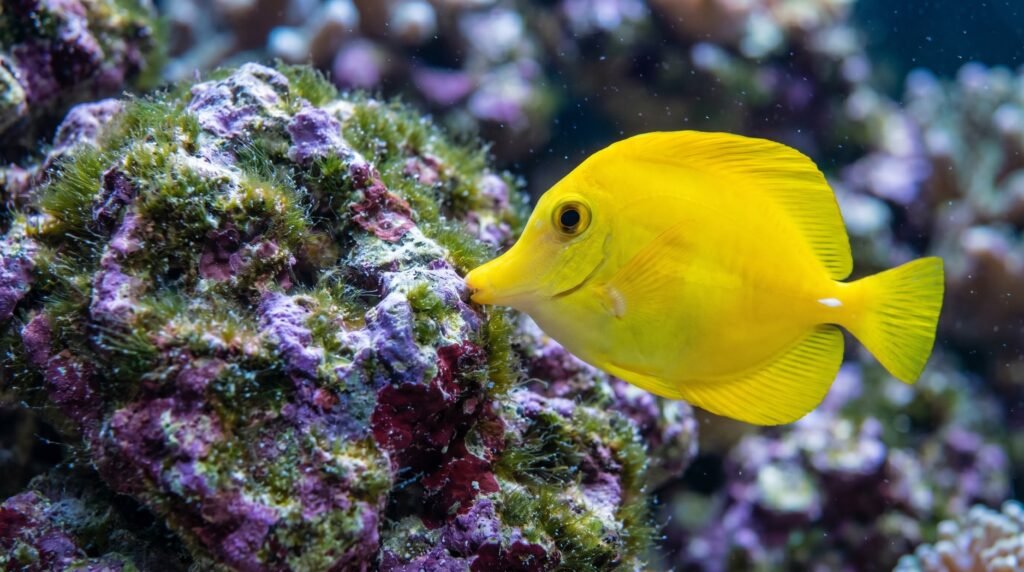
- Mid-tier additions – tangs, basslets, and gobies come next. Yellow tangs (Zebrasoma flavescens) are grazers that spend their day cropping filamentous and turf algae from the rockwork; Animal Diversity Web records their diet as “uncalcified and filamentous algae,” and NOAA’s coral reef research identifies herbivorous fish as essential for keeping algae “at levels that can control algae growth” so corals have room to develop. They add genuine function, not just color. They can be territorial toward other tangs, so most tanks should run one per system unless volume is large.
- Aggressive or “with caution” fish last – dottybacks, dwarf angels, and any other semi-aggressive species should always be the final additions. By the time they arrive, the existing fish are established, confident, and less likely to be run out of their own territory.
The full framework below is used across all stocking guides on this site. Print it, save it, or just keep it open when you are building a list.
| Stage | What to add | Minimum wait before next stage | Why |
|---|---|---|---|
| 0 – After full cycle | Cleanup crew (snails, hermits, shrimp) | 2 weeks | Establishes housekeeping; tests inverts’ tolerance of new parameters |
| 1 – First fish | Hardy, peaceful planktivores (clownfish, chromis, firefish) | 3-4 weeks per addition | Low bioload spike; gives biological filtration time to catch up |
| 2 – Mid-tier | Tangs, basslets, gobies, blennies | 3-4 weeks per addition | Herbivores add function; allow territories to settle before next addition |
| 3 – Final additions | Semi-aggressive fish, dwarf angels, dottybacks | Monitor 2-4 weeks after last addition | Adding aggressive fish into an established group reduces bullying of existing residents |
For size-specific stocking lists – what actually fits in a nano versus a 40-gallon build – see best beginner reef-safe fish and the full reef-safe fish list.
Bioload basics: why the “one inch per gallon” rule falls apart in salt water
You will encounter the one-inch-per-gallon rule early in your research. It has a kernel of logic and almost no accuracy in a reef context. LiveAquaria’s practical guidance lands at half an inch of fully grown fish per gallon as a more conservative saltwater starting point – and even that number needs caveats.
The real issue is that inch of fish is not a standard unit of waste. A two-inch chromis is a slim, fast-swimming planktivore producing modest ammonia. A two-inch blenny with a heavy body and a territory-defending personality produces considerably more waste per inch than that chromis does. Body mass, metabolism, and feeding behavior all drive bioload far more than length does.
What actually matters is the nitrogen cycle’s capacity on any given day. DrTim’s Aquatics describes nitrifying bacteria as “very slow growing so it can take 30 to 45 days (usually saltwater takes longer) for the bacteria to become naturally established.” Add three fish in a week and you may spike ammonia faster than your bacterial colony can process it – and at the slightly alkaline pH of a reef (8.0-8.4), ammonia is more toxic per unit than it is in freshwater, because a higher fraction exists in the un-ionized form that penetrates gill tissue. The answer is patience: one addition at a time, three to four weeks between additions, test before you add. The how many fish in a reef tank article goes deeper on sizing by system volume and filtration.
A few practical heuristics that hold up better than inch-counting:
- Research adult size before buying. A juvenile tang at 2 in may reach 7 in at maturity. Plan for the adult, not the juvenile.
- Heavy-bodied fish count double. A stocky 3-in fish stresses your system more than a slim 5-in one in many cases.
- Feeding frequency drives nutrient load as much as fish count. Overfeeding is the most common chronic cause of elevated nitrate and phosphate in otherwise well-filtered tanks.
- Your skimmer, sump volume, and live rock surface area all expand effective capacity – which is why two otherwise identical tanks can safely carry different bioloads.
Quarantine: the single step that protects everything else
Marine ich – Cryptocaryon irritans – is a ciliated protozoan parasite that cycles through four stages in your water. Wikipedia’s entry on the species describes the visible phase: “The characteristic white spots occur in the Trophont stage, where C. irritans finds a host fish to attach to.” The parasite feeds for days, drops off, then “enters the Tomont stage and begins to reproduce asexually, this may last from 3 to 72 days.” That Tomont stage is the trap: the tank looks clear while hundreds of reproducing cysts sit on your substrate. A fish added directly from a shop bag can seed a display tank that will not show visible symptoms for weeks.
The standard treatment for ich uses copper. The University of Florida IFAS Extension is unambiguous: “Most invertebrates are highly sensitive to copper and will not survive a copper treatment.” The same document notes that copper binds to calcareous substrate and decorations and can leach back into the water column if pH drops – meaning a display tank treated with copper is not safe for invertebrates even after the copper is “gone.” A reef tank treated with copper is not easily recoverable.
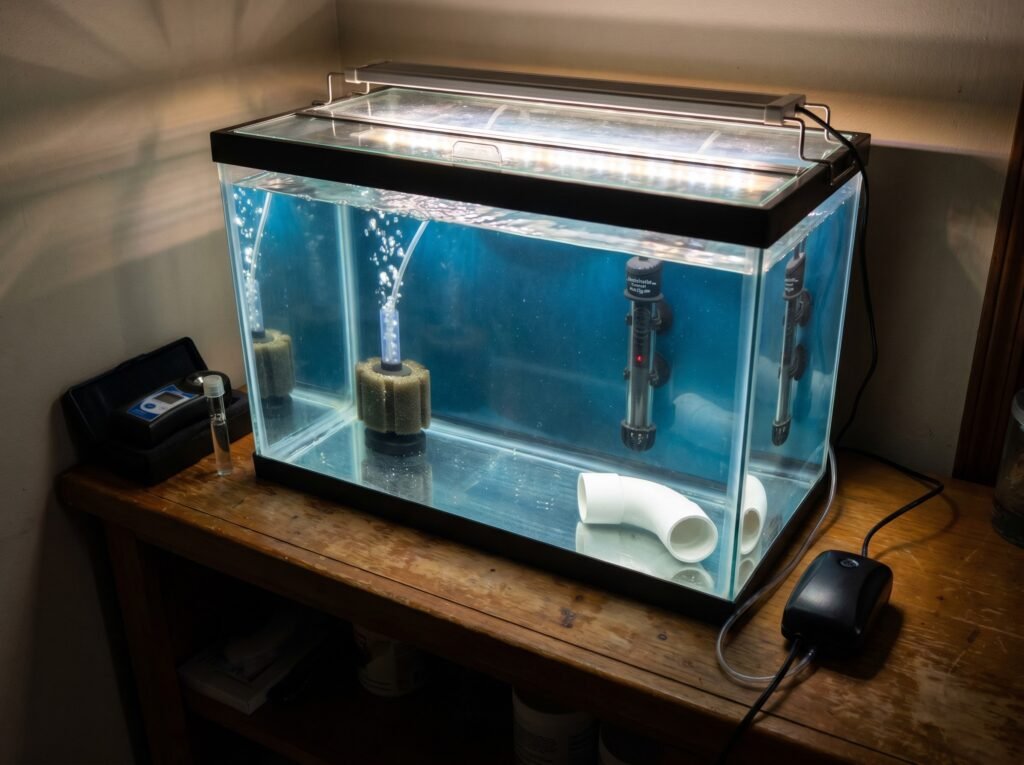
The alternative is to never let ich into the display tank in the first place. A basic quarantine setup is simple: a 10-to-20-gallon bare tank, a heater, a small sponge filter (matured in your sump beforehand if possible), a piece of PVC pipe for shelter, and a tight-fitting lid. Run new fish through it for a minimum of four weeks before transfer. Four weeks covers most of the Tomont cycle and gives enough time for latent bacterial or parasitic infections to surface while the fish is isolated, where treatment is safe. A fish that eats well and shows no symptoms at week four is a fish you can trust in the display tank.
Drip acclimation applies on both transfer points – bag to quarantine, and quarantine to display. Quality Marine describes the process as designed to “slowly mix the water from your aquarium with the water of the bag your fish came with until the two different waters match salinity and temperature.” Skipping it does not cause instant death in most cases, but it creates enough osmotic stress to suppress immune function right when a fish is already stressed from transport – exactly the moment you do not want a compromised immune system.
For a full protocol on identifying and treating ich if it does reach your display tank, see how to treat ich in a reef tank.
A few species worth knowing by name
Species profiles live in their own dedicated articles. The short version here covers the fish that come up most often in beginner conversations and illustrate the categories above.
Ocellaris clownfish (Amphiprion ocellaris) – the USGS documents them as “among the top aquarium fish imported by volume to the United States” and genuinely one of the most captive-bred marine fish available. Reef-safe, small, and hardy. They do not require a host anemone, though they will often adopt a torch coral or hammer coral as a surrogate. They form pair bonds as protandrous hermaphrodites – the larger fish of a pair will eventually become female. Add early in your stocking sequence. Full care detail is at clownfish care in a reef tank.
Royal gramma (Gramma loreto) – Wikipedia records the maximum size at 8 cm (3.1 in). A planktivore that eats zooplankton and crustaceans, and occasionally removes ectoparasites from other fish – a mild cleaning behavior. It orients itself to nearby surfaces, which is why you often see it swimming upside-down under a ledge. Reef-safe; some individuals will sample hermit crabs, so watch inverts during introduction. Aggressive toward its own species, so keep one per system.
Yellow tang (Zebrasoma flavescens) – Animal Diversity Web gives maximum length at 20 cm and wild lifespan up to 30 years (captive specimens average closer to 10). It grazes continuously on filamentous and turf algae – the same ecological function that NOAA’s coral reef research identifies as critical: herbivorous fish keep algae “at levels that can control algae growth” so corals have room to develop. A tang is not just ornamental; it does real maintenance work. LiveAquaria lists the minimum aquarium size at 100 gallons, and that figure holds – this is an active, continuous swimmer that needs room. Needs at least a 100-gallon system to range comfortably. Best in larger tanks with high flow and consistent feeding of nori strips in addition to the live algae it crops from the rockwork.
Firefish goby (Nemateleotris magnifica) – a planktivore that hovers at the water column’s mid-section and darts for cover when startled. Completely reef-safe, peaceful, and good for the first stocking wave. Notorious jumpers – a tight lid is mandatory. Best kept singly or as a confirmed pair; two unmatched specimens in a small tank will eventually turn on each other.
Green chromis (Chromis viridis) – a social schooling fish from Indo-Pacific reefs where it forms large aggregations over branching corals. Adds continuous movement, reef-safe, and one of the most forgiving beginner fish available. Keep at least six to help spread aggression across the group – published husbandry guides note that groups smaller than six result in the lowest-ranking fish being systematically harassed.
Before you finalize your list
Three questions to run through every candidate species before purchasing:
- What does the adult eat? – Look up diet, not juvenile behavior. A fish that eats coral polyps as an adult is not a candidate, regardless of what it does in the shop tank.
- What is the adult size? – A lot of fish sold as “nano-friendly” juveniles turn into large adults. The fish should fit your tank at maturity, not at purchase.
- Where does it fall in the aggression order? – Determine whether it should go in early (peaceful, hardy) or late (semi-aggressive). A fish added in the wrong order can unravel a tank that was otherwise running well.
A fish-only system running without corals operates under different rules, and many of the species excluded from reef tanks – large angels, puffers, triggers – are perfectly legitimate choices there. That comparison is covered at fish-only vs reef tank (FOWLR).
Frequently asked questions
Can I add two clownfish to a new reef tank?
Yes – a pair of ocellaris clownfish is one of the most sensible first additions to a new reef. They are hardy, peaceful toward other species, and produce modest bioload. Buy two juveniles together so they form a natural pair rather than introducing two established adults, which may fight over which one transitions to female.
Do I really need a quarantine tank, or can I just observe fish in the display tank?
Observation in the display tank only tells you a fish looks healthy today. It cannot stop the Tomont stage of Cryptocaryon already underway in the water. A four-week quarantine in an isolated system is the only reliable way to prevent ich from seeding a display where copper treatment would kill your invertebrates and corals.
How long should I wait between adding fish?
Three to four weeks is the practical minimum for most additions. Adding fish in quick succession spikes ammonia faster than nitrifying bacteria can scale up to handle it. Test ammonia and nitrite before each new addition; both should read zero for at least a week before you proceed.
My tang is nipping at my clownfish – is this normal?
Tangs are generally not aggressive toward unrelated species, but individual fish vary. Check whether the clownfish is wandering near the tang’s preferred territory. Rearranging the rockwork briefly can reset territorial boundaries and reduce the behavior. If nipping persists, the tang was likely added before the clownfish had time to establish a stable territory – add future aggressive fish last to prevent this.
Are dwarf angelfish ever truly safe in a reef?
Some individuals keep a Centropyge species for years without a single incidence of coral nipping. Others see damage within days. There is no reliable predictor. If you accept that risk and want to try one, add it as the last fish, feed it generously two to three times daily, and keep SPS corals toward the top of the tank where the angel is less likely to browse.
Read next
The SteadyReef team
We write calm, plain-English reef-keeping guides. Every claim is checked against the marine-science and manufacturer sources listed above before publishing.