Diatoms vs dinoflagellates vs cyano: how to tell them apart in your reef tank
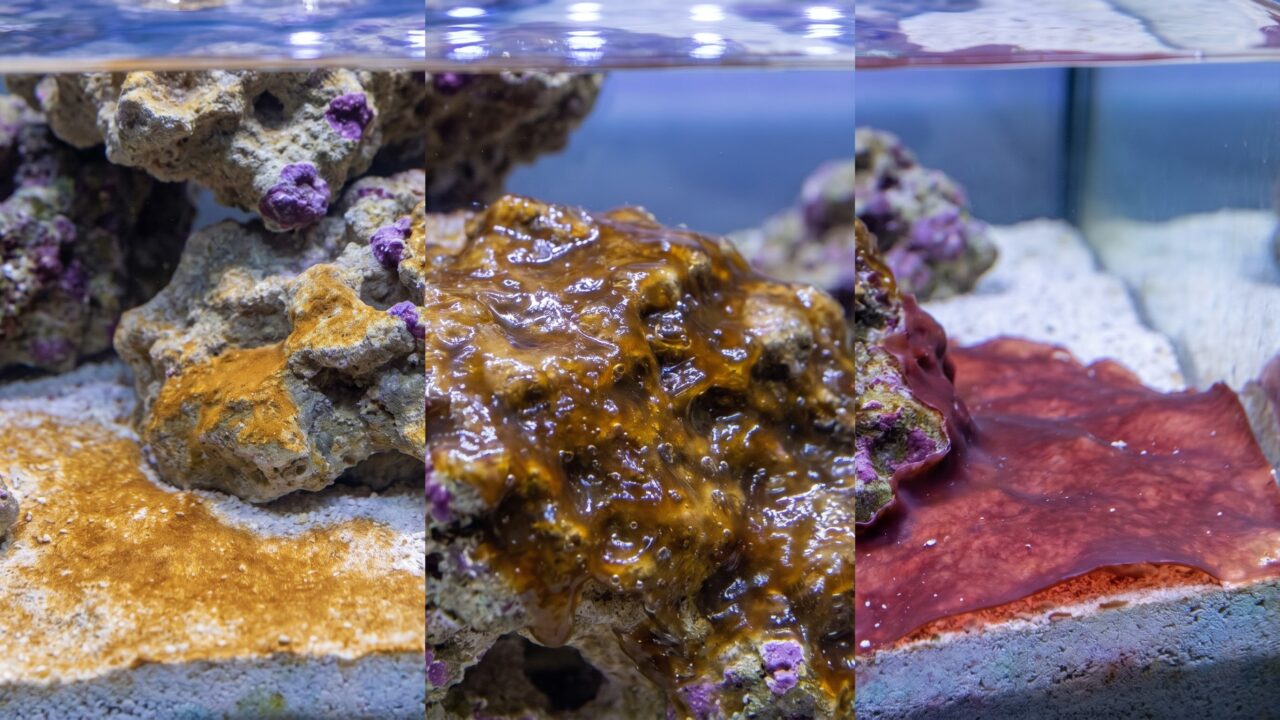
Three different organisms. Three different cures. One shared problem: they all show up as brownish or reddish gunk on your rockwork, sand, and glass, and if you mistake one for another, every treatment you try will either fail or make things worse. The good news is that each organism leaves behind a specific set of clues - color, texture, smell, and behavior under flow - that let you pin down the culprit with confidence before you do anything else.
Below you will find a side-by-side comparison table, a four-question identification guide, and a plain-English breakdown of what each organism is, why it appeared, and how to address it. Links to the full deep-dive articles on each subject are woven in where you need more detail.
The 3-column comparison at a glance
This table covers the seven variables that matter most when you are staring into a tank trying to figure out what you have.
| Diatoms | Dinoflagellates | Cyanobacteria (cyano) | |
|---|---|---|---|
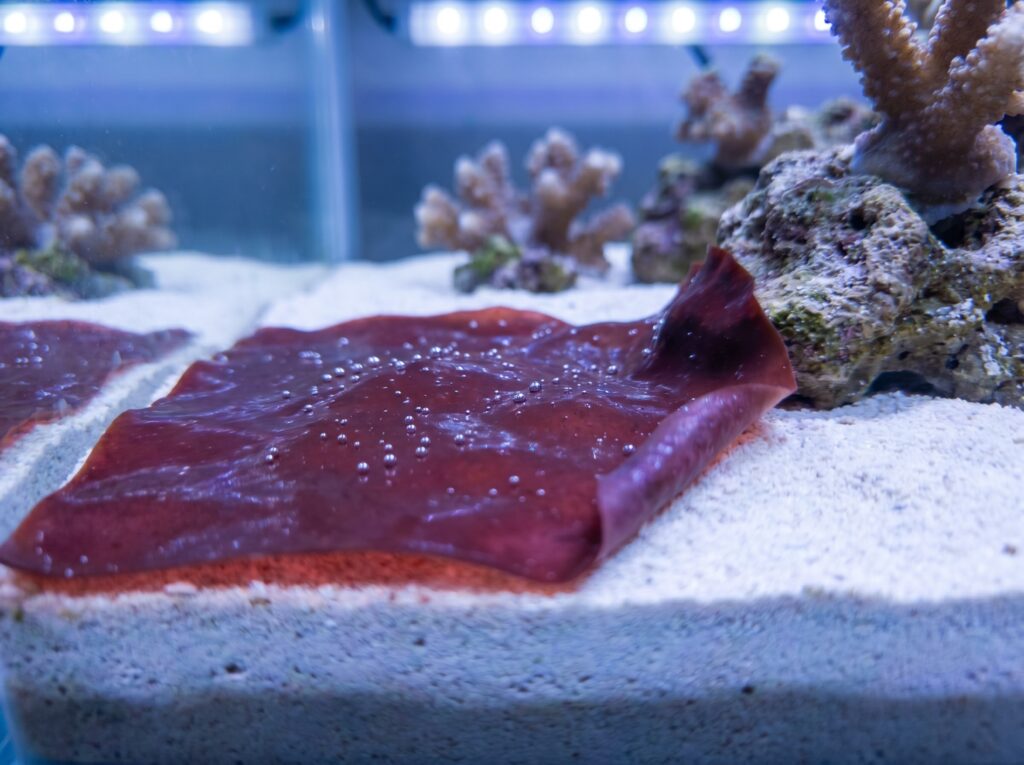
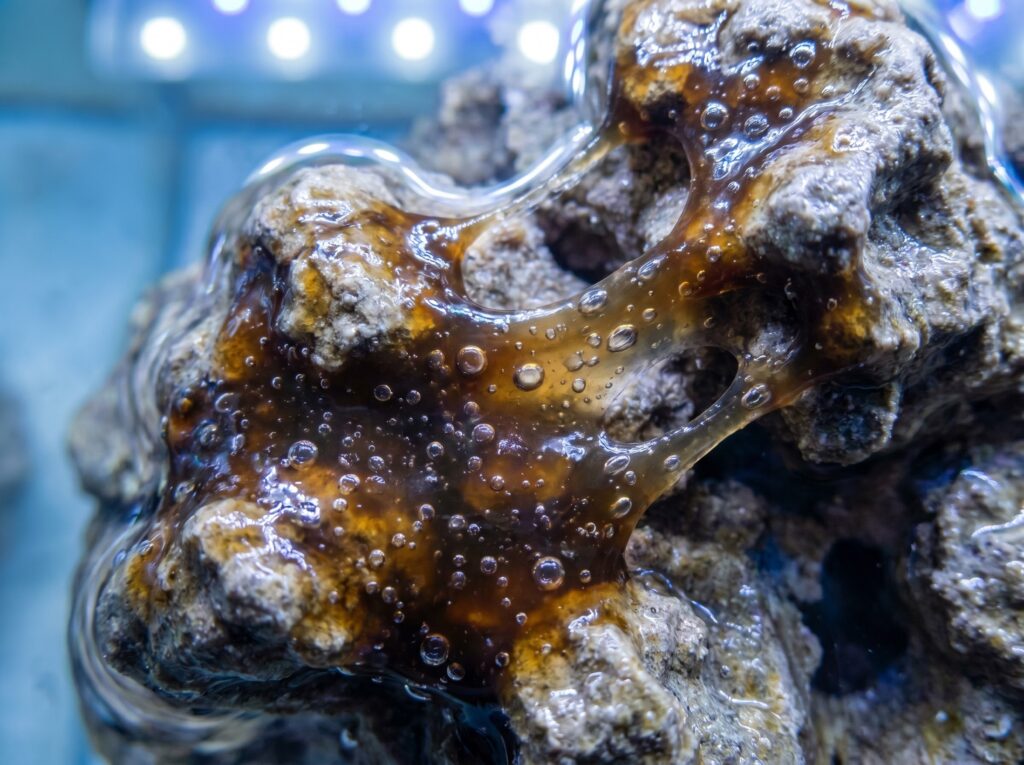
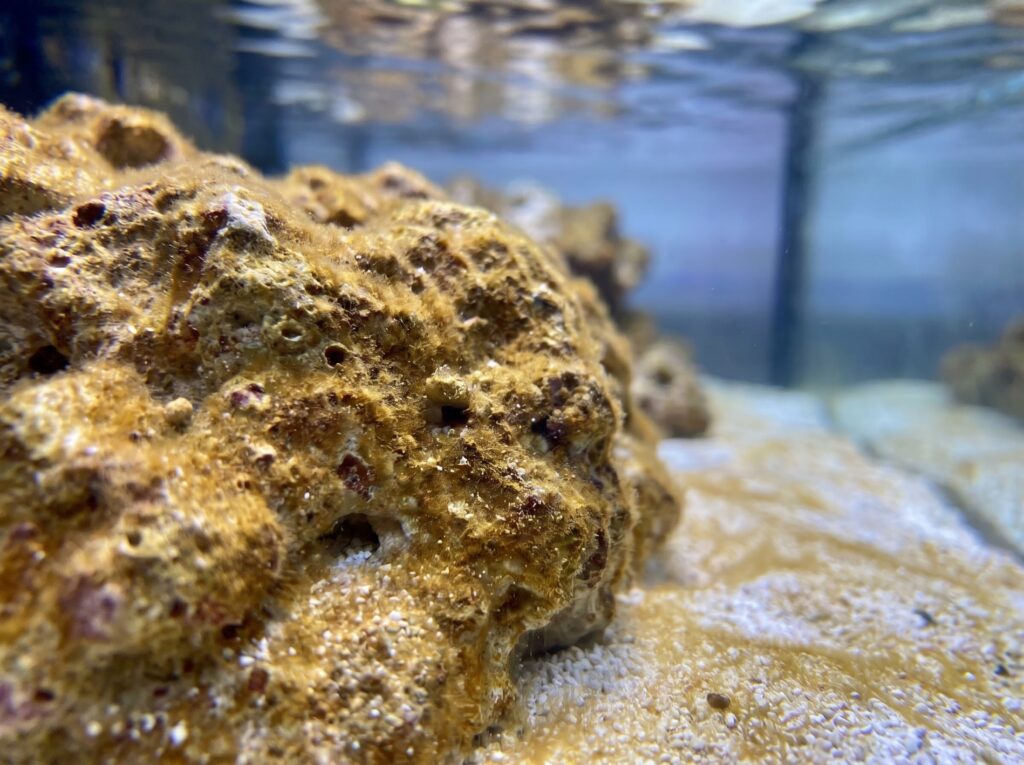
| Appearance | Thin, powdery, golden-brown or rust-brown film; flat and uniform; no filaments | Brown to amber slime, often mucous-like or stringy; can look like wet snot on rocks | Smooth, rubbery mat; color ranges from red-burgundy to deep green or blue-black; sheet-like |
| Bubbles? | No | Yes - Ostreopsis type traps oxygen bubbles in mucus; visible "snot bubbles" especially during lights-on | Yes - small bubbles lift off the mat surface during the photoperiod as cyano photosynthesizes |
| Blows away with flow? | Yes - a gentle blast from a turkey baster clears it instantly; wipes off with zero effort | Partially - mucous strands wave in current but the base layer clings; comes back quickly | Partially - sheets can be siphoned or blasted off, but cyano reattaches within hours in the same low-flow spot |
| Smell when disturbed? | Mild to none | Mild to none | Distinct earthy, musty, or swampy odor - often the most reliable single clue |
| Nutrient level when worst | New tank with elevated silicates, nitrates, and phosphates | Ultra-low nutrients (near-zero nitrate and phosphate) - the opposite of what most people expect | High phosphates and nitrates, low water movement, or an immature microbiome - but can persist even at moderate nutrient levels |
| Danger level | Low - temporary; can smother corals if very dense, but rarely causes lasting damage | High - Ostreopsis produces palytoxin-class compounds; can kill corals and invertebrates; handle with caution | Moderate - can smother corals and deplete oxygen overnight; some species release toxins, though aquarium strains rarely do so at harmful levels |
| Cure direction | Wait it out; use RODI water to cut silicates; add a cleanup crew; it fades on its own | Raise nutrients to measurable levels; add copepods; run UV; address root cause (usually over-skimming or too much carbon dosing) | Increase flow in dead spots; reduce nutrients (especially phosphate); improve microbiome; manual removal plus Chemiclean if needed |
The 4-question ID guide
Work through these in order. You should have a solid answer by question three in most cases.
Question 1 - Does it smell?
Pick up a small amount on your finger (wash your hands immediately after, and wear a glove if you are unsure what you have). If there is a noticeable earthy or swampy odor, you almost certainly have cyanobacteria. Diatoms and dinoflagellates produce little to no detectable smell. A positive result here ends the search.
Question 2 - Are there visible bubbles in or under the growth during lights-on hours?
No bubbles: strong vote for diatoms. Bubbles present but the growth looks flat and rubbery: lean toward cyanobacteria. Bubbles trapped inside a mucous or stringy film: very likely an Ostreopsis or similar dinoflagellate. Dinoflagellate mucus traps oxygen produced by photosynthesis into visible pockets; cyanobacteria lift smaller bubbles from the mat surface. Both produce bubbles, but the texture of the growth around them is different.
Question 3 - What does it feel like when you wipe it?
Diatoms wipe off a glass panel with almost no friction - they feel like fine dust under a cloth. Cyanobacteria feels slippery and rubbery, almost like a wet membrane. Dinoflagellate films feel snotty or slimy and tend to stick in strings. If you cannot bring yourself to touch it, direct a turkey baster blast at it: diatoms vanish, cyano and dinos cling.
Question 4 - How old is the tank and what do the nutrient tests show?
Tank under three months old plus elevated silicates (from substrate or tap water) and detectable nitrate: almost certainly diatoms as part of the normal cycling process, described in detail on our reef tank ugly stage guide. Tank running low nutrients (nitrate near zero, phosphate undetectable) with good-looking water otherwise: the paradox points toward dinoflagellates, which thrive when other organisms starve. Tank with sluggish flow in certain corners, high phosphates, or an immature bacterial community: cyanobacteria fits the profile.
What each organism actually is
Understanding the biology behind each nuisance saves a lot of wasted effort.
Diatoms
Diatoms are single-celled algae enclosed in a glass-like shell called a frustule, made of hydrated silicon dioxide (silica). Their characteristic golden-brown color comes from a pigment called fucoxanthin, which masks their chlorophyll. Carolina Biological Supply describes the frustule as consisting of "two interlocking halves, much like a petri dish or a gelatin capsule" - two valves nested together. These shells are what you see coating your sandbed and rocks in the first weeks of a new tank.
Diatoms account for an estimated 20-25% of global photosynthesis and form the base of marine food webs worldwide. In your aquarium, they are opportunistic colonizers that explode into visibility whenever dissolved silica (from substrate, live rock, or tap water) is available alongside nitrogen and phosphorus. They are almost always a sign of a tank in its normal cycling phase, not a sign that something is wrong. Full detail is at our diatoms in a reef tank guide.
Dinoflagellates
Dinoflagellates are a wildly diverse group of single-celled organisms. NOAA's Ocean Service notes that some blooms "discolor the water different shades of red and brown and a few are bioluminescent." In reef tanks, the species you are most likely to encounter are benthic (surface-dwelling) rather than planktonic, and most fall into four genera: Ostreopsis, Amphidinium, Prorocentrum, and Coolia.
The behavior that sets dinoflagellates apart from the others in this list is their relationship with nutrients. While most algae and bacteria thrive in higher-nutrient water, dinoflagellates can bloom in tanks with near-zero nitrate and phosphate - conditions created by aggressive skimming, heavy carbon dosing, or very efficient refugiums. With beneficial bacteria reduced by nutrient starvation, dinos fill the vacuum because they can photosynthesize, feed on organics, and produce dormant cysts that wait out unfavorable conditions. NOAA describes those cysts as "capable of living through harsh conditions" and ready to "populate the water column with a new generation of photosynthetically active cells" when favorable conditions return.
The toxicity risk is real and worth taking seriously. Ostreopsis-type dinoflagellates produce palytoxin-class compounds. A peer-reviewed case study documented a family of three - all of whom required hospital evaluation - after the aquarist cleaned a Zoantharia coral at home without protective equipment. The primary patient spent time in ICU care and required supplemental oxygen for a month post-discharge. You do not need to panic about every brown patch, but if you suspect Ostreopsis, gloves and minimal splashing matter. The dinoflagellates in a reef tank article covers identification, species differences, and step-by-step treatment.
Cyanobacteria
Cyanobacteria is not algae at all. It is a photosynthetic bacterium - aquariumscience.org makes the point plainly: "common green algae is more closely related to humans than it is related to blue-green algae, which is actually a bacteria." That distinction matters for treatment: things that kill algae often do nothing to cyano, and the tools that work on cyano (antibiotics, Chemiclean's oxidizing approach) can harm other tank inhabitants if misused.
In a reef tank, cyano appears most often as a flat, rubbery mat that spreads across sandbed surfaces and low-flow zones. The color is variable - it can be deep red or burgundy (which gives rise to the common nickname "red slime algae"), but also green, blue-green, or nearly black, depending on the strain and the lighting spectrum. The earthy smell when you disturb it comes from volatile organic compounds - the same class of molecules (including geosmin, best known from freshwater cyanobacteria and soil bacteria) responsible for the smell of soil after rain; the precise compounds vary by strain, but the earthy character is consistent enough to be a reliable field ID clue.
Cyano can also bloom in tanks where nitrogen is technically low, because many strains can fix dissolved atmospheric nitrogen directly from the water - a metabolic trick most competitors cannot pull off. This means cutting nitrate alone will not always clear a cyano outbreak. Phosphate control, water movement, and a healthy competing microbiome matter more. The cyanobacteria in a reef tank guide goes through every cause and removal method in detail.
Why these three are so easy to confuse
All three thrive under light. All three can coat the same surfaces - glass, rocks, sand. All three tend to appear during the first few months of a reef tank's life, because new tanks offer ideal conditions for each: abundant silicates for diatoms, an immature microbiome for cyano, and fluctuating or bottomed-out nutrients that can inadvertently favor dinos.
The confusion deepens because tanks often host more than one at the same time. A new tank cycling through its ugly stage might carry diatoms on the sandbed and a thin cyano patch in a stagnant corner simultaneously. The way to avoid misidentification is to slow down and assess each patch individually - texture, smell, bubble pattern - rather than treating the whole tank for whatever you read about first.
If you want a broader picture of what else can grow in a reef tank, our reef tank algae types article covers the full spectrum, from coralline to hair algae to bubble algae.
Nutrient ranges and how they shift the balance
Nutrient levels are the clearest lever for predicting which organism is likely to dominate, so it is worth spelling out the ranges plainly.
Diatoms peak when silicates are elevated (common in new tanks using dry substrate or tap-water top-offs instead of RODI), with nitrate above roughly 5-10 ppm and phosphate also measurable. As silicates are consumed or diluted through water changes, diatoms fade on their own. They are almost never a chemical-treatment problem.
Dinoflagellates are the paradox case. The PodYourReef identification guide puts it directly: "very clean water can favor dinos. Tanks run with ultra-low nitrate and phosphate often report dino problems." Maintaining nitrate at roughly 1-5 ppm and phosphate at roughly 0.03-0.10 ppm gives competing organisms enough nutrition to keep dinos suppressed. Zero nutrients is not a reef goal - it is a dinoflagellate invitation. Our phosphates in a reef tank and nitrates in a reef tank articles explain target ranges in full.
Cyanobacteria responds most strongly to phosphate. Elevated phosphate - persistently above the healthy reef ceiling of roughly 0.10 ppm - is frequently cited as a trigger, and nitrate above 5 ppm adds fuel. But cyano also blooms in tanks with technically acceptable nutrients when water movement is poor, because stagnant zones allow the bacteria to settle undisturbed. Directing a powerhead at the spot where cyano keeps returning is often the single most effective non-chemical intervention.
When to act urgently and when to wait
Diatoms almost never require urgent intervention. They are a normal phase of a cycling tank and will fade as the tank matures and silicates deplete - typically within four to eight weeks in a new system. Siphon the worst patches, wipe glass, and let the cleanup crew do the rest. Rushing in with chemicals at this stage is one of the most common beginner mistakes.
Cyano warrants faster action. Left alone, thick mats can smother coral tissue by blocking light and restricting water movement across the coral's surface. Manual removal first, followed by flow adjustments, is the standard approach. Chemical treatments like Chemiclean work reliably on stubborn outbreaks, but running extra aeration during and after treatment is important because the die-off consumes oxygen. Avoid antibiotics in a reef tank unless you have exhausted other options - they disrupt the beneficial bacterial community that underpins the nitrogen cycle.
Dinoflagellates require the most careful response, and also the most counterintuitive one. Blacking out the tank or doing massive water changes to strip nutrients - two instinctive responses - can make things worse by creating the very low-nutrient, low-competition conditions where dinos thrive. Raising nutrients deliberately, adding a copepod population, and running UV sterilization to eliminate planktonic cells are the approaches with the best track record.
Frequently asked questions
Can I have diatoms and cyano in the same tank at the same time?
Yes, and it is common in new tanks. Diatoms dominate on well-lit substrate while cyano colonizes a low-flow corner simultaneously. Treat each patch individually based on its characteristics - smell, texture, bubble pattern - rather than applying one blanket treatment for the whole tank.
My brown growth has bubbles but no smell. Is it dinos or cyano?
Bubbles plus no smell points toward dinoflagellates - specifically the Ostreopsis type, which traps photosynthesis oxygen inside mucus. Cyano bubbles tend to be smaller and lift off a flat mat. Check whether the growth feels snotty and stringy (dinos) or rubbery and sheet-like (cyano). Also check your nutrient levels: near-zero nitrate and phosphate support the dinoflagellate diagnosis.
Do snails eat any of these?
Cerith and nassarius snails will graze diatoms off the sandbed, and many hobbyists find diatoms clear faster when a cleanup crew is in place. Most snails ignore cyanobacteria. Dinoflagellates are generally avoided by most cleanup crew members because of their toxins. Copepods are the biological tool most often recommended against dinoflagellates; Tisbe species are generally the most practical choice for reef display tanks because they establish in rockwork and substrate where dino films originate, while Tigriopus, though nutritionally valuable, are more prone to fish predation and less effective as a sustained dino-control population.
My tank is three years old. Can diatoms come back after all this time?
Yes. Diatoms can reappear after a major substrate disturbance, a large batch of new live rock, or a switch from RODI to tap water for top-offs. Any event that reintroduces silicates triggers a temporary return. The mechanism is the same as in a new tank; it will pass again as silicates are consumed.