Diatoms in a new reef tank: why they appear and how long they last
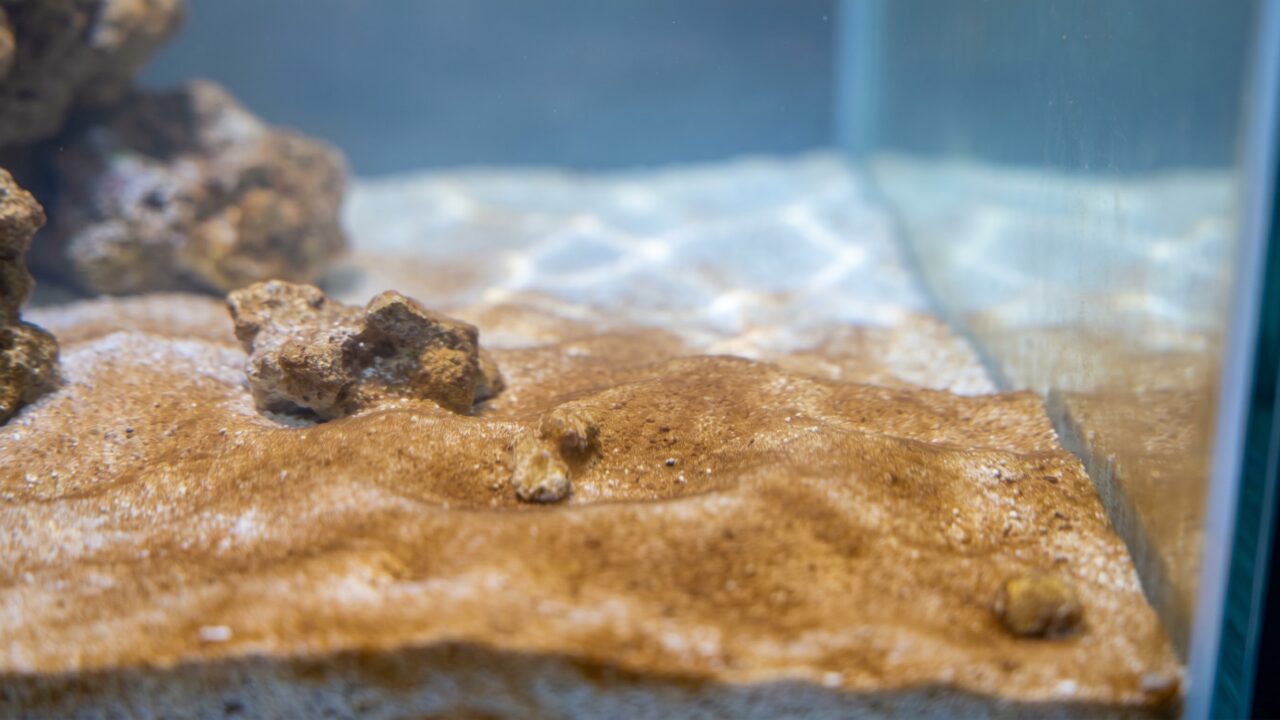
By week two or three, most new reef tanks look like someone dusted every surface with brown talcum powder. The sand bed goes from bright white to a muddy tan, a thin rust-colored film creeps across the glass, and even the live rock gets coated. If this is your first tank, the instinct is to panic. It is not a sign that something has gone wrong. It is one of the most predictable events in reef-keeping, and it has a name: the diatom bloom.
Diatoms are single-celled algae in the phylum Bacillariophyta. They are genuinely ancient organisms (confirmed fossil records extend back roughly 125 million years, with molecular evidence suggesting origins closer to 200 million years ago) and they are ecologically critical, accounting for roughly 20-25% of all carbon fixation on Earth and producing nearly one-fifth of the planet's oxygen, according to the MarineBio Conservation Society. In the ocean they are essential. In your brand-new tank they are an inconvenience. Understanding why they show up, and what actually drives them away, makes the ugly early weeks much easier to sit through.
Why diatoms always appear in new tanks
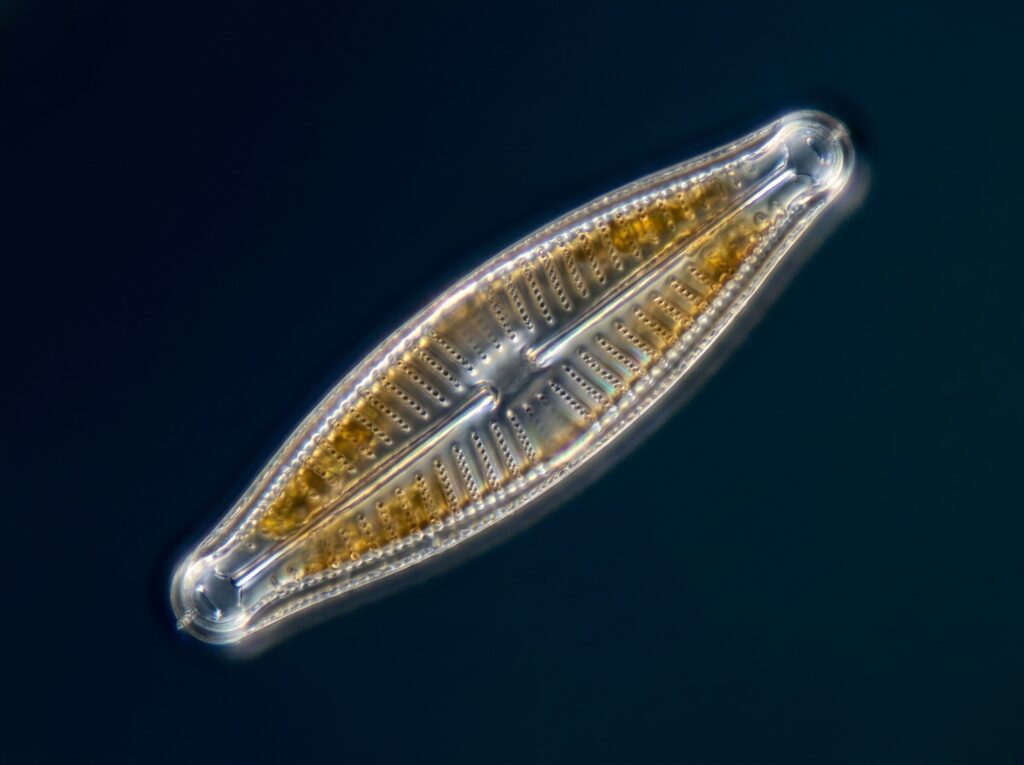
Every diatom cell is encased in a two-piece silica shell called a frustule. Building that shell requires dissolved silicic acid from the water. New tanks supply it in abundance.
When you set up a reef for the first time, the rock, sand, and the aquarium glass itself all release small amounts of dissolved silicate into the water. Silica-based play sand is particularly potent: independent testing has shown it can leach roughly 0.1 ppm SiO2 into saltwater within 48 hours, rising to around 0.3 ppm after two weeks. Aragonite sand releases about ten times less, which is one of the practical reasons reef-keepers favor it. Even small amounts, though, are enough to feed a bloom when competition from other algae and microbes is essentially zero.
Silicate is only part of the picture. Nitrate and phosphate from the cycling process give diatoms a full nutrient package to grow on. Established tanks keep diatoms in check through competition: mature biofilms, coralline algae, and a diverse microbial community all outcompete them for resources. In a new tank, none of that competition exists yet. Diatoms are early colonizers, perfectly suited to fill the gap.
The brown film you see is not purely diatoms, either. Aquarium Science's research database notes that the biofilm coating new surfaces is roughly half porous detritus and organic slime, with the other half being a mixture of diatoms, other algae, cyanobacteria, bacteria, and various single-celled organisms. Diatoms tend to dominate in the first weeks simply because the silicate supply is highest and competition lowest.
Is this what I actually have?
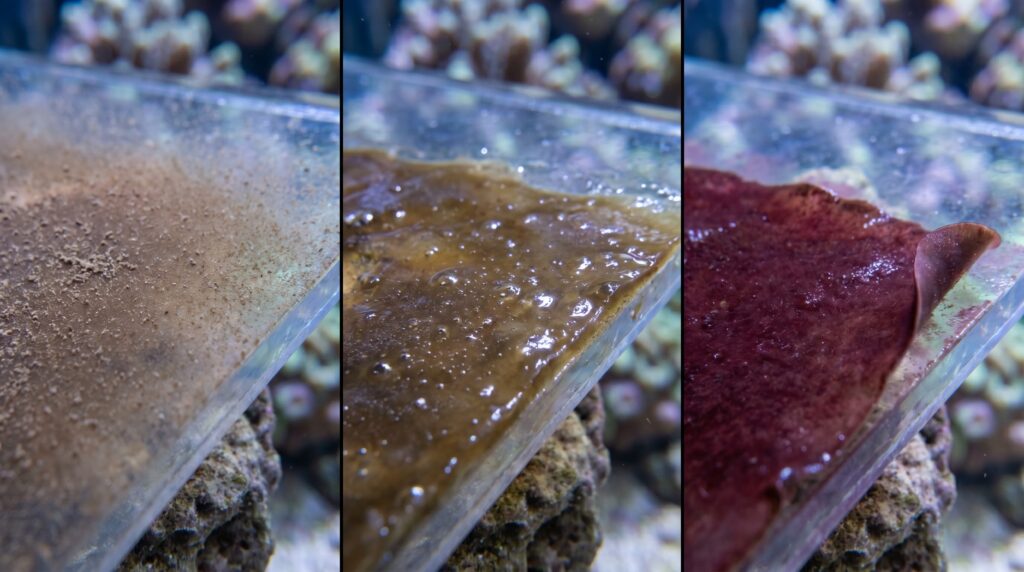
Before assuming it is a standard diatom bloom, a quick identification check is worth doing, because the management approach differs depending on what organism is involved.
Diatoms coat surfaces as a dusty, powdery brown film. Blow a turkey baster at the sand bed and the cloud disperses like fine particles; it does not come off in strings or sheets. Some hobbyists notice the film on the sandbed shifts slightly after lights go off, because certain pennate diatoms do migrate within substrate sediment - but do not count on the glass film visibly disappearing overnight as a reliable ID test.
Two other organisms produce similar-looking brown or reddish coatings in new tanks. Dinoflagellates look slimier, form mucus strands, trap visible air bubbles, and clump together rather than dispersing when disturbed. Cyanobacteria (cyano) tends to be a deeper red or purple-green, lifts off in sheets or mats, and persists after lights out rather than fading. If your tank is cycling and it looks like a powdery tan dust, diatoms are almost certainly the correct diagnosis.
Also part of what experienced reef-keepers call the ugly stage, diatoms are usually the first wave; cyano or green film algae may follow as the tank continues maturing. Each has different causes and different fixes, so identifying them correctly matters.
How long do diatoms actually last?
The table below reflects the normal progression in tanks that use RODI water and aragonite sand, with no persistent silicate source. If your situation differs (silica sand, tap water, or exhausted RODI resin), the timeline extends.
| Week | What you will typically see | Normal? |
|---|---|---|
| 1-2 | Sand and glass take on a light tan or rust-colored dusting; easy to wipe off glass | Yes |
| 2-4 | Peak coverage; sand bed looks brown, rock surfaces coated, film reappears quickly after wiping | Yes |
| 4-6 | Bloom starts thinning; patches clear first on glass, then sand; coralline algae may begin showing pink spots | Yes |
| 6-10 | Diatoms largely gone or reduced to minor film; other algae (green film, cyano) may take their place briefly; lingering traces can persist if a silicate source is still present | Yes if fading - investigate if still heavy |
| Still heavy after 8-10 weeks | Persistent bloom suggests a continuing silicate source (silica sand, tap water, spent DI resin) or elevated nutrients | Investigate the cause |
Most new tanks see the worst of it between weeks two and four. The bloom peaks, the available silicate gets consumed, competition builds in the biological film, and diatoms retreat on their own. You do not need to do anything dramatic to end the bloom - doing less is usually better than doing more. Waiting it out is not failure; it is how the system is supposed to work.
What actually helps (and what does not)
A few targeted actions speed the process without disrupting your cycle or stressing the tank.
Control your silicate source first
If you are using tap water, switch to RODI water immediately. Tap water often carries dissolved silicates that refuel the bloom with every water change or top-off. RODI removes them. One caveat: if your DI resin is exhausted, silicates will slip through even though your TDS meter reads zero. Silicates are non-conductive and invisible to TDS. Replace the DI resin if the bloom persists despite using "RODI" water.
If your sand bed is silica-based play sand rather than aragonite, expect a longer bloom. The silicate supply will trickle for weeks. You cannot cure this mid-cycle without a complete teardown; manage it with a cleanup crew and patience, and plan to use aragonite on future builds.
Reduce photoperiod temporarily
Diatoms are photosynthetic and grow faster with more light. Cutting your photoperiod to six to eight hours during the bloom phase reduces the energy available to them. Research confirms that diatom growth rate correlates directly with cumulative daily light exposure. Once the bloom clears, ramp back up to your normal schedule. This is not a cure on its own; it buys time and reduces severity while the silicate depletes.
Add your cleanup crew
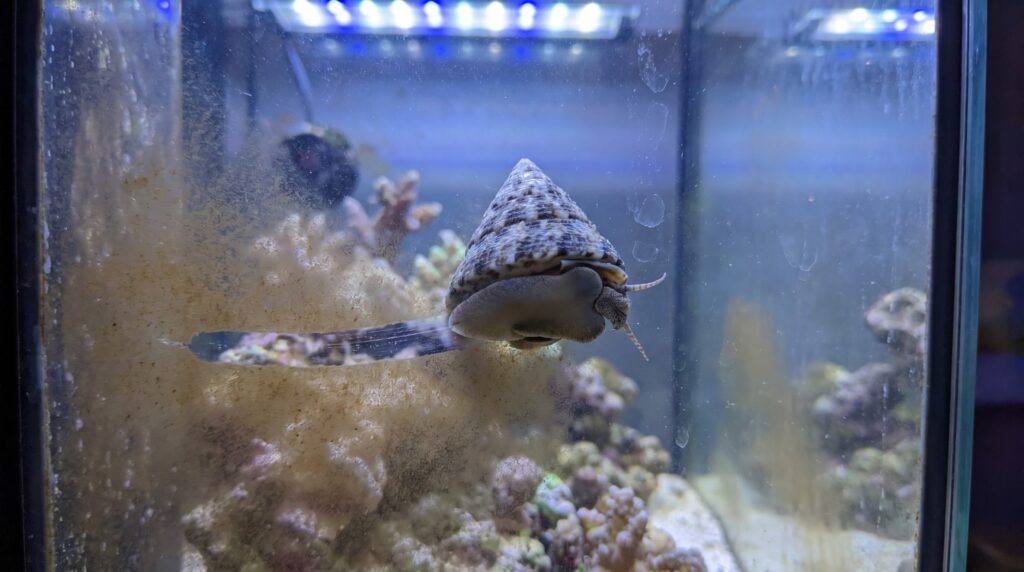
A well-chosen cleanup crew is the most satisfying intervention because the results are visible within 24 hours. Several snail species graze diatoms efficiently from different surfaces:
- Trochus snails: the top performers on rock and glass; they consume large amounts of diatoms and will right themselves if knocked over, unlike Astraea.
- Cerith snails: burrow through the sand bed while grazing, tackling diatom films on the substrate surface where Trochus cannot reach.
- Astraea snails: effective on rock and glass surfaces; smaller than Turbo, so suitable for nano tanks; cannot self-right if flipped.
- Turbo snails: powerful grazers that clear large areas of glass and rock quickly; Mexican Turbo (the most common species sold) grows to 3-4 inches and is generally recommended for tanks of 30 gallons or more - smaller turbo species exist but Mexican Turbos can knock over unsecured corals and quickly exhaust algae in smaller systems.
- Fighting conch: works the sand bed specifically, reducing visible brown film on the substrate surface.
Introduce the cleanup crew after your ammonia and nitrite have zeroed out and your cycle is confirmed complete. Adding them into an active cycle risks losing them to ammonia spikes.
Manual removal: when it is worth it and when it is not
Wiping the glass every few days keeps viewing panels clear and is always worth doing. Siphoning the sand bed is more of a judgment call. Disturbing the substrate during an active bloom can redistribute diatoms and temporarily worsen the appearance. Gentle spot-siphoning during water changes is fine; aggressive vacuuming of the entire sandbed usually is not necessary and can disrupt the developing bacterial bed.
Running a protein skimmer from day one and keeping feeding minimal during the cycling period both reduce the organic load that gives diatoms extra fuel. Neither is specific to diatoms; both are good habits for the whole life of the tank.
When to actually worry
Standard diatoms in weeks two through six are not a problem. They are a sign the tank is progressing normally. A few situations warrant closer attention:
- The bloom persists past eight to ten weeks with no sign of thinning. Check your water source (run it through a separate silicate test if possible), and confirm your RODI resin is fresh.
- The brown film is slimy rather than dusty, traps air bubbles, or clumps when disturbed. That points toward dinoflagellates, which have different management requirements.
- The coating persists equally through day and night, is deep red or purple, and peels away in sheets. That is most likely cyanobacteria, driven by different nutrient conditions than diatoms. Read the full comparison of diatoms, dinoflagellates, and cyano to confirm before treating.
Even a persistent diatom bloom, annoying as it looks, does not damage corals, fish, or inverts. It is an aesthetic problem, not a biological emergency. Keep your chemistry stable - salinity around 1.025 SG, temperature 76-78 F, nutrients at reasonable levels - and the tank will outgrow it on its own schedule.
Frequently asked questions
Can I add corals while diatoms are still present?
It is generally better to wait until the diatom phase has mostly passed and your parameters are stable. Diatoms themselves will not harm coral tissue, but the conditions that support them (elevated nutrients, unstable water chemistry) can stress corals. Most experienced reef-keepers wait until ammonia and nitrite are zero, nitrate is below 10 ppm, and the bloom is fading before adding the first coral frags.
Will diatoms come back after the initial bloom?
A minor return is common after large water changes that introduce fresh silicate, or if your RODI resin expires between changes. Each recurrence is typically shorter and lighter than the first bloom, because the tank's microbial community is more established. A persistent or worsening return suggests a silicate source you have not identified yet.
Do diatoms mean my cycle is finished?
Not automatically. Diatoms often appear while cycling is still in progress, not after. Confirm your cycle is complete by testing: ammonia should be 0 ppm, nitrite 0 ppm, and nitrate detectable. The nitrogen cycle completion test is the only reliable signal; diatom presence or absence is not a reliable indicator either way.
Should I run my lights on a timer during the diatom phase?
Yes, and a timer is good practice for the whole life of the tank regardless. During the bloom, a 6-8 hour photoperiod limits diatom growth without harming the tank. Inconsistent light schedules (sometimes 10 hours, sometimes 4) stress corals and give opportunistic algae an advantage. Set a timer from day one and adjust the duration, not the schedule.