Reef tank clean-up crew: the complete guide to building one that actually works
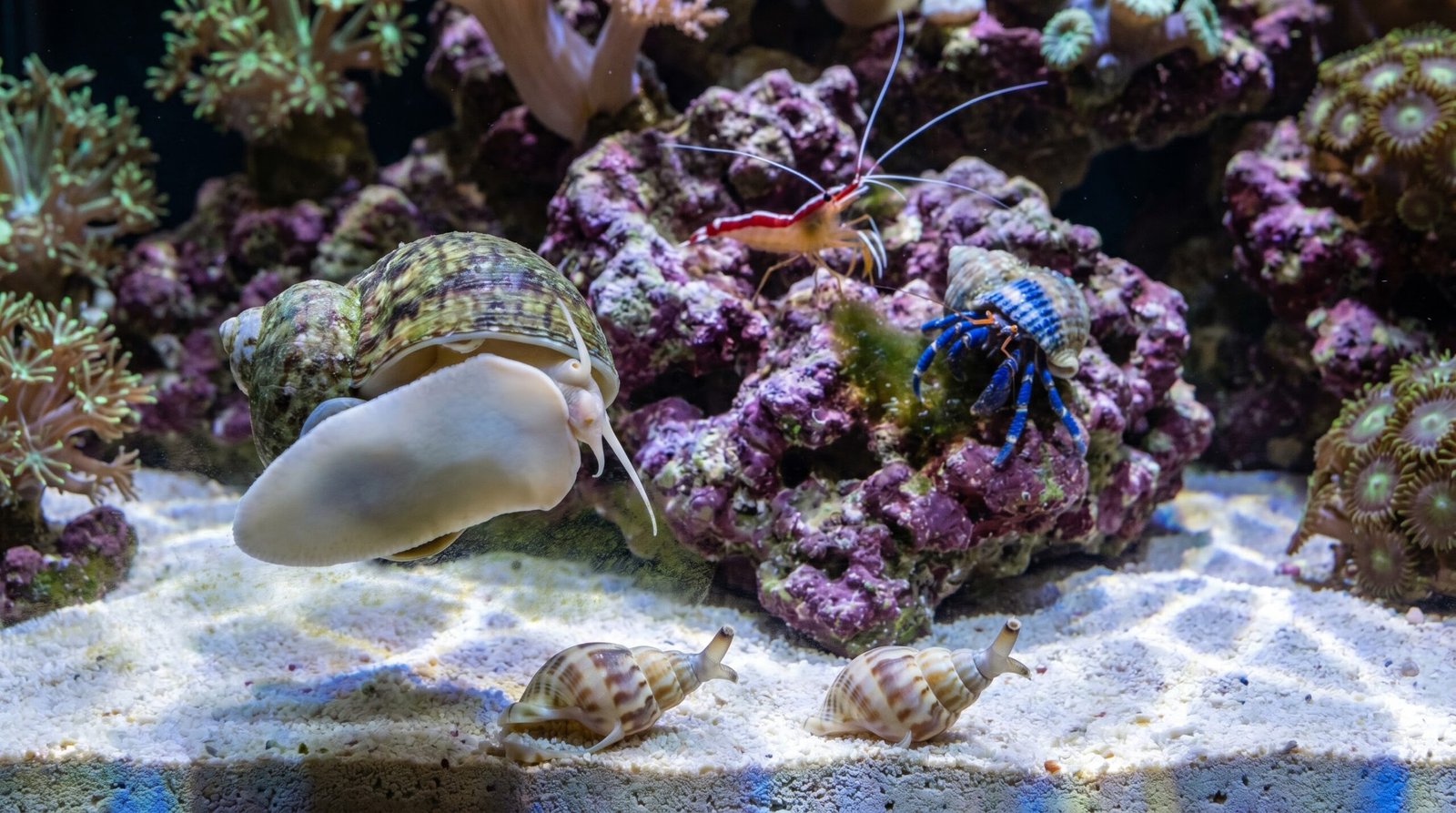
A reef tank is a productive place. Film algae coats the glass within days. Detritus settles into every crevice. Uneaten food softens under rock and starts the climb back up the nitrogen cycle. A clean-up crew – the shorthand for the mix of snails, crabs, shrimp, and echinoderms you deliberately stock – handles those jobs around the clock so you do not have to. Get the right animals in the right numbers and the tank looks better and runs cleaner. Get the wrong mix, add them too early, or skip acclimation, and you lose expensive inverts for no gain.
One thing to be clear about before buying anything: a CUC is a maintenance team, not a cure. It cannot undo overfeeding, fix a skimmer that is undersized, or rescue a tank with nitrates and phosphates running well above the acceptable reef ranges (roughly 1-10 ppm nitrate and 0.03-0.10 ppm phosphate). Algae outbreaks that a healthy crew can manage are symptom-level problems; the root cause is almost always excess nutrients. Fix the nutrient source first, then let your crew keep the tank tidy on an ongoing basis.
What each role actually covers
Different animals target different food sources. Stocking a tank with only one type – say, all snails – leaves sand and detritus untouched. Matching species to the specific waste type they evolved to eat is how a CUC earns its keep.
Film algae on hard surfaces
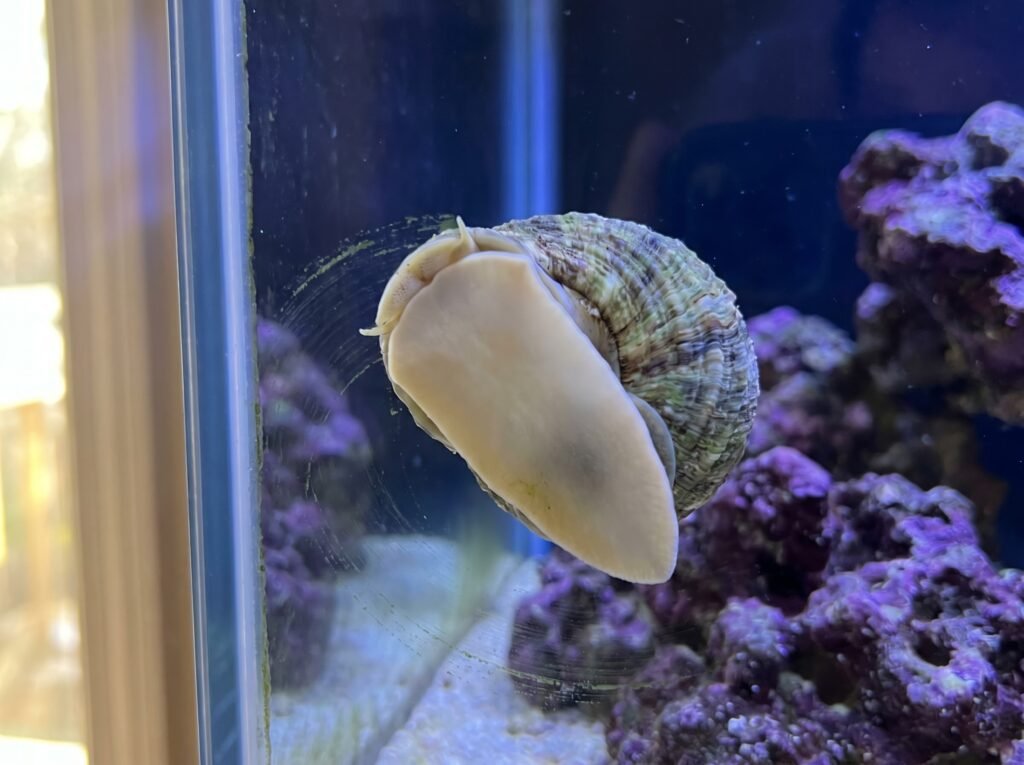
Turbo and astrea snails are the backbone of most CUC lists for good reason. A peer-reviewed comparison of three gastropod species sold for marine aquarium use found that Turbo bruneus showed 100% survival over 53 days and consumed algae-impregnated substrate at significantly higher rates than either of the competing species tested – one of which (Tectus fenestratus) saw near-complete mortality over the same period, while the other (Tegula eiseni) lost around 65% of individuals. Size matters here: heavier individuals consume proportionally more, so bigger turbo snails deliver noticeably more grazing output per animal. Turbo snails will also graze the back and sides of the tank, not just the front glass – they roam constantly at night.
Cerith snails fill a slightly different niche. Related cerith-family species are deposit feeders that consume benthic diatoms and plant detritus, partially burying themselves in sand as they move. They stay smaller than turbos and are less likely to knock over loose frags, making them a better fit for nano tanks.
For more on how many snails a given tank volume can actually support, see our guide on how many snails per gallon.
Sand bed maintenance
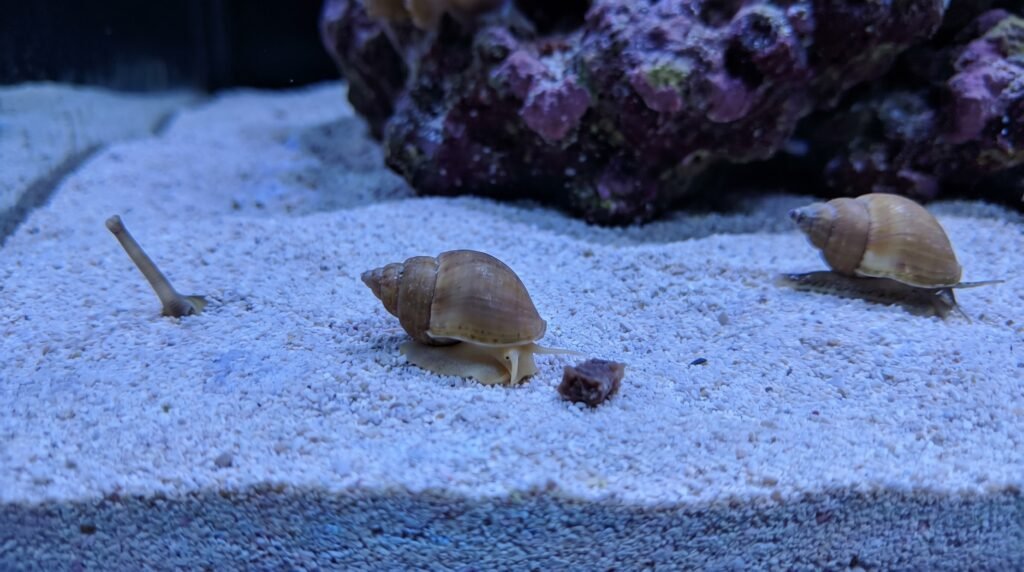
Sand that sits undisturbed compacts and develops anaerobic pockets. A few species are built to solve this. Nassarius snails, small scavengers typically under 50 mm in shell height, spend most of their time buried and surge to the surface when food hits the water. They stir upper sand layers as they travel and consume detritus, fish waste, and meaty food scraps. They do not graze algae, so they work alongside snails rather than replacing them.
For tanks with a deeper sand bed – three inches or more – a small conch is worth considering. Queen conch are benthic-grazing herbivores that feed on filamentous and epiphytic algae, diatoms, and organic material on the sediment surface. NOAA Fisheries describes them as feeding on “algal and plant material as well as diatomaceous films” and notes that juveniles are primarily associated with seagrass beds and sandy shallow habitat. In a home tank, a single small fighting conch keeps a surprising amount of sand turned and grazed. One caution: conchs need enough open sand to move freely; in a heavily aquascaped tank with little exposed substrate, they will stall.
Hair algae and macroalgae
Some algae grows faster than snails can graze it. Diadema urchins are the most efficient algae removers in the reef world – Smithsonian researchers have called Diadema antillarum “the janitor of the reef” because of how efficiently it scrapes surfaces clean using limestone-plate mouthparts on its underside. A controlled field study on the closely related Diadema savignyi measured algal cover at 95% with no urchins present, dropping to 47% at 8 urchins per square meter and 16% at 16 urchins per square meter over three months. One or two urchins in a home tank will not replicate field densities, but the mechanism is real: even modest urchin presence shifts the balance between algae and coral.
The trade-off in an aquarium is spine length and clumsiness. Long-spined urchins will knock frags, rearrange rubble, and dislodge anything not firmly attached. Smaller urchins – Mespilia (tuxedo urchins) or Echinometra – do much of the same grazing work with a smaller physical footprint.
For persistent hair algae specifically, emerald crabs (Mithraculus sculptus) are a targeted addition. Research has confirmed that these crabs consume macroalgae including chemically defended species like Halimeda, Dictyota, and Laurencia – exactly the kinds herbivorous fish tend to avoid. They are reef-safe by reputation, but watch them in small tanks with easy access to slow-moving inverts. For a full comparison of algae-eating species and their limitations, the reef tank algae eaters article covers the complete lineup.
More on which crabs to trust and which to skip is in the reef-safe crabs guide.
Detritus and leftover food
Brittle stars are underrated. They emerge at night, drape their arms across sand and rock, and process settled detritus, filamentous algae, and mucus – Smithsonian Ocean research describes epizoic brittle stars as feeding on exactly these materials, alongside scavenging. Most hobbyists never see them working; they tuck under rock by day and fan out once the lights drop. The organic material they break down is material that never becomes ammonia.
Cleaner shrimp like Lysmata amboinensis run cleaning stations that serve the fish directly, picking ectoparasites and dead tissue from clients that line up to be serviced. Researchers studying Lysmata amboinensis found that roughly 50% of the fish visiting a cleaning station are potential predators of the shrimp – yet the shrimp continue working, adjusting their behavior toward riskier clients. In the tank they add color, consume meaty waste, and reduce the parasite load on fish. Peppermint shrimp (Lysmata boggessi and close relatives) are a separate addition popular for eating aiptasia anemones.
For a deeper look at how shrimp species compare and which are genuinely reef-safe with coral, see cleaner shrimp and reef shrimp.
A note on copepods: they are a different category. Pods are not a clean-up crew in the traditional sense – they are a micro-fauna that processes detritus and serves as live food for finicky fish like mandarins. They deserve their own consideration, covered in copepods in a reef tank.
Species-to-job matrix
The table below maps common CUC species to their primary job, the surfaces they work, typical tank suitability, and the one thing each does not do well. Use it as a starting checklist, not a prescription – tank shape, flow, and livestock all affect which species will thrive in your specific setup.
| Species | Primary job | Works on | Tank fit | Does not cover |
|---|---|---|---|---|
| Turbo snail (Turbo spp.) | Film algae grazing | Glass, rock, back wall | 30 gal+ (can knock frags) | Sand, detritus, macroalgae |
| Astrea snail (Astrea spp.) | Film algae grazing | Glass, rock | All sizes; cannot right itself if flipped | Sand, detritus, hair algae |
| Cerith snail (Cerithium spp.) | Diatoms, detritus, sand surface | Sand, glass base, rock crevices | All sizes including nanos | Heavy film algae, macroalgae |
| Nassarius snail (Nassarius spp.) | Detritus, meaty waste, sand stirring | Sand bed (buried, then surfaces to feed) | All sizes | Algae of any kind |
| Fighting conch (Strombus / Lobatus spp.) | Sand grazing, diatoms, detritus | Sand surface and substrate | 40 gal+ with open sand | Glass, rock, macroalgae |
| Blue-leg hermit crab (Clibanarius tricolor) | Algae scraps, detritus, scavenging | Rock, substrate, sand | All sizes; needs spare shells | Hair algae, macroalgae |
| Emerald crab (Mithraculus sculptus) | Macroalgae, hair algae | Rock, rubble, bubble algae patches | 20 gal+; watch with slow inverts | Sand, glass film, detritus |
| Tuxedo urchin (Mespilia spp.) | Turf algae, coralline grazing | Rock, hard substrate | 30 gal+; avoid strong flow | Sand bed, detritus, macroalgae |
| Long-spined urchin (Diadema spp.) | Heavy macroalgae, turf | Rock, glass, substrate | 55 gal+; will move frags | Detritus, fine particulates |
| Brittle star (Ophiura / Ophioderma spp.) | Detritus, settled waste, sand | Sand bed, rock underside, sump | All sizes; mostly nocturnal | Algae grazing, pest control |
| Scarlet cleaner shrimp (Lysmata amboinensis) | Fish ectoparasites, meaty waste | Fish directly (cleaning station) | 20 gal+; needs caves to molt | Algae, sand, detritus on substrate |
| Peppermint shrimp (Lysmata boggessi and relatives) | Aiptasia anemones, meaty scraps | Rock, crevices | All sizes; check coral safety | Algae, sand bed, glass |
When to add your clean-up crew
The best window is after the nitrogen cycle completes but before fish go in. At that point ammonia and nitrite have zeroed out, nitrate has risen and started to fall, and the first film of diatoms is usually just appearing on the glass and sand. Snails and hermit crabs added now have something to eat and face no competition from fish that might nip or harass them.
Adding CUC members during the cycle itself is risky. Ammonia and nitrite at cycling levels will kill most inverts quickly. If you are not sure whether cycling is done, test: ammonia at 0 ppm, nitrite at 0 ppm, nitrate present but under control. If all three check out, you are in a good window. For a detailed walkthrough of the cycling process, how to cycle a reef tank covers every stage.
In an established tank that already has fish, add CUC species carefully. Aggressive fish – dottybacks, some damsels, larger wrasses – will target small snails and hermit crabs. Assess your livestock first. Urchins added to a tank with heavy hair algae may find so little food after eating it down that they start grazing coralline algae, which you want to keep. Match the crew size to the actual biological load.
How to drip-acclimate every invert
Marine invertebrates are the most sensitive livestock you will handle. Research on sea urchins found that 100% mortality occurred within 24 hours at salinities below 16 ppt, and even 21 ppt caused significant feeding suppression. The problem is not just salinity – it is the rate of change. A shipping bag that sat at a fish store may be warmer, lower in pH from CO2 buildup, and slightly different in salinity from your tank. All three need to equalize slowly.
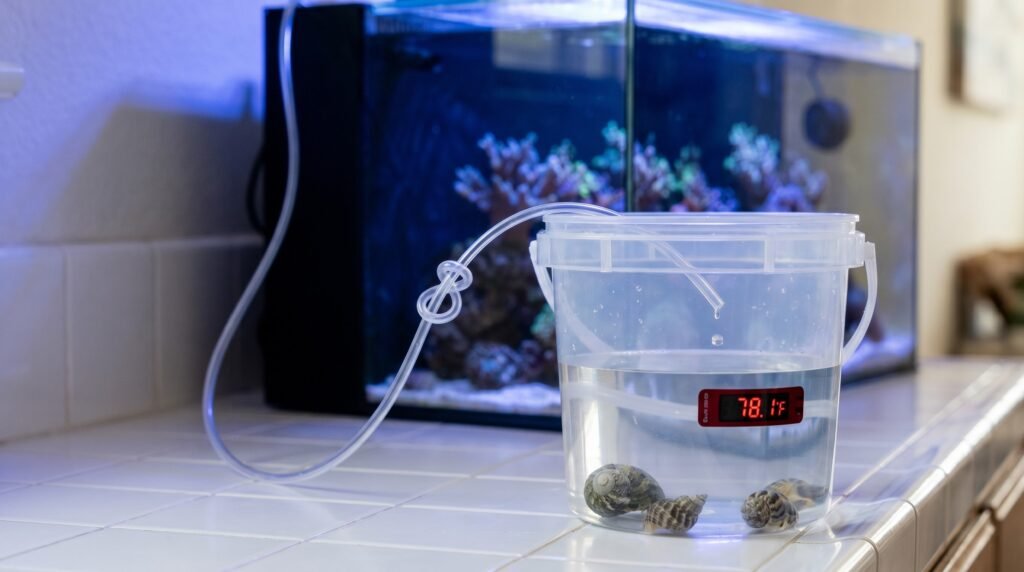
The drip method remains the standard. Here is a reliable protocol:
- Float the sealed bag in your sump or display tank for 15 minutes to equalize temperature.
- Open the bag and pour the animal plus shipping water into a clean bucket or container. Do not use a container that has had soap in it.
- Using airline tubing and a small valve or loose knot, start a slow drip from your tank into the bucket – roughly 2 to 4 drips per second.
- Continue until the water volume in the bucket has roughly doubled. For most snails and hermit crabs this takes 30 to 45 minutes. For shrimp, urchins, and brittle stars, extend to 60 to 90 minutes – they are more sensitive to osmotic stress.
- Net the animal out of the bucket and transfer it to the tank. Discard the bucket water; do not add it to the display.
Two additional points that experience-based guidance consistently emphasizes: first, never let the bucket water temperature drop during acclimation (place the bucket somewhere warm, or put a heater wand in it). Second, keep the lights off or dim for a few hours after adding inverts. The stress of acclimation plus sudden bright light is often what pushes a marginal animal over the edge.
One absolute rule that applies to every invert you will ever keep: copper-based medications must never contact a reef tank. A documented case study found that copper at just 33 micrograms per liter – a level that contaminated a system through brass pump components – caused mass mortality in a large marine invertebrate collection, with purple sea urchins dying at 15 to 50 micrograms per liter. If you ever need to treat fish for ich or other parasites, remove them to a separate quarantine tank. Even trace copper residue on equipment can harm an invert. See how to treat ich in a reef tank for a safe approach.
How big should a clean-up crew be?
Bigger is not automatically better. A CUC that outnumbers the food supply will starve. The animals that die decompose, and the resulting ammonia and phosphate spike can push a tank into a new algae outbreak – the opposite of what you wanted.
A rough starting point that many experienced reefers use: one mixed snail (turbo or astrea plus a cerith or two) per 2 to 3 gallons, a handful of nassarius for the sand bed, and a few hermit crabs. Then watch and adjust. If the glass is still clean three or four days after you wipe it, the crew is keeping up. If it films over within a day or two, add a few more snails. If the glass never develops algae and snails are looking noticeably thin, you may be overstocked for how much the tank actually produces – a starving snail is a dying snail.
CUC needs also shift as fish bioload increases. More fish mean more waste, which means more food for detritivores and more nutrients feeding algae. Reassess the crew every time you add a significant fish.
Frequently asked questions
Can I add a clean-up crew to a tank that is still cycling?
No. Cycling levels of ammonia and nitrite (often 2 to 5 ppm during peak) will kill most invertebrates within hours to days. Wait until ammonia and nitrite have both reached 0 ppm and held there for at least 48 hours before adding any CUC member.
Do hermit crabs kill snails to take their shells?
Sometimes. Hermit crabs need to move to larger shells as they grow, and in a tank with limited shell options they will evict and sometimes kill snails. Providing extra empty shells in a range of sizes – a common recommendation from public aquarium husbandry staff – reduces aggression considerably. Aim for two to three spare shells per hermit crab.
My turbo snail flipped upside down. Will it die?
Turbo snails can usually right themselves, but if they land in a dead spot with low flow they can suffocate before they manage it. Return the snail to the glass or rock. Astrea snails have a flatter shell that makes righting much harder; they need more help. Check flipped snails within a few hours.
How long do clean-up crew members usually live?
In stable conditions, turbo snails commonly survive two to five years in captivity. Nassarius snails are similar. Cleaner shrimp are generally comparable – most sources place them at two to four years in well-maintained tanks, though individual variation is wide. Urchins can be among the longer-lived CUC members; documented lifespans for wild Diadema species typically fall in the four to eight year range, with temperature and food availability both affecting longevity.
Will my clean-up crew eat coral?
Most common CUC species are reef-safe with healthy corals. Emerald crabs occasionally pick at fleshy LPS polyps in well-fed tanks – watch them if you keep open brains or elegance corals. Urchins grazing coralline algae can scrape near coral bases; keep the tank well-fed so they have other food. Large hermit crabs can be opportunistic; stick to smaller species like blue-legs around coral colonies.
The SteadyReef team
We write calm, plain-English reef-keeping guides. Every claim is checked against the marine-science and manufacturer sources listed above before publishing.