How to cycle a reef tank (and how to know when it is actually done)
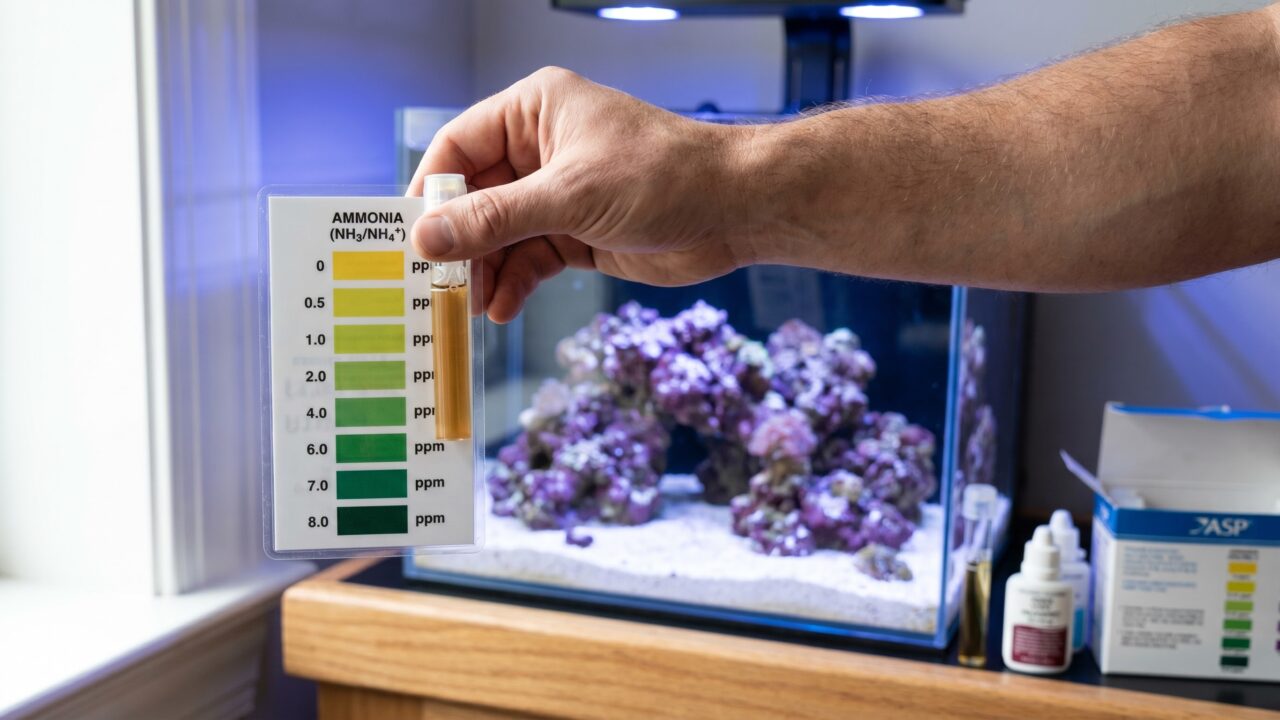
Before a single coral or fish goes into your new tank, the water needs a living colony of bacteria that converts waste into something safe. That process - cycling - typically takes four to eight weeks for a reef system, or as little as five days if you use a quality live-bacteria product with the right ammonia source. Either way, rushing it is the single most common reason a new reef crashes in its first month.
If you want to understand what the cycle actually is at a biological level, our nitrogen cycle guide covers the full chemistry. This article is purely practical: how to start a cycle, what to expect week by week, and the one test that tells you with confidence it is finished.
What you are actually building
The nitrogen cycle converts the ammonia produced by waste and decaying food through two bacterial steps. First, ammonia-oxidizing bacteria (in marine systems, primarily Nitrosococcus species) convert ammonia to nitrite. Then nitrite-oxidizing bacteria (primarily Nitrococcus species in saltwater) convert nitrite to the far less toxic end-product, nitrate. According to the University of Florida IFAS Extension, un-ionized ammonia begins damaging fish tissue above 0.05 mg/L, and sensitive species will die at 2.0 mg/L. Nitrite is toxic at levels as low as 0.10 mg/L. Neither of those bacteria colonies exists in a new tank - you have to grow them.
The good news is that once established they are self-sustaining as long as you keep feeding the system and do not wipe them out with chemicals or a crash. A peer-reviewed NIH study on aquarium biofilter bacteria confirmed that ammonia-oxidizing and nitrite-oxidizing bacteria grow significantly faster together than alone - meaning the sooner both types are present, the faster the whole cycle locks in.
Choosing an ammonia source
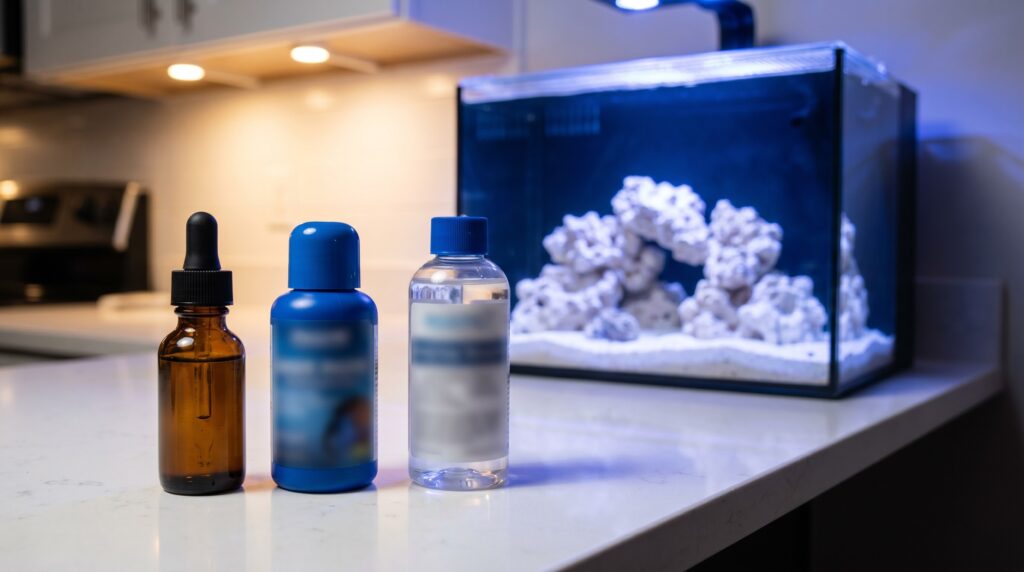
Nitrifying bacteria cannot establish without a steady ammonia supply. You have three realistic options, and they are not equally reliable.
Dosed pure ammonia (recommended)
Using a dedicated ammonium chloride solution such as DrTim's Aquatics ammonium chloride gives you exact, repeatable control. DrTim's protocol calls for 4 drops per gallon, which produces a starting concentration of 2 mg/L (ppm) of ammonia-nitrogen. That is the right target range: enough to feed bacterial growth without the inhibiting effects that kick in above 5 mg/L. You dose on day 1, then add smaller maintenance doses as ammonia drops. Because you are measuring what goes in, you always know what to expect on the test kit.
Ghost feeding
Ghost feeding means adding a pinch of dry food each day as if the tank were stocked, letting it decompose into ammonia. Seachem describes this as a valid approach for getting an ammonia source into the water without livestock. The honest limitation is that you cannot measure how much ammonia the food releases - some batches decompose faster, some slower, and the reading you get on day 5 is partly guesswork. Ghost feeding works, but the cycle tends to run less predictably and the "done" test (described below) is harder to interpret. It is a reasonable fallback if you do not want to order a separate ammonia product.
Bacterial starters (and why they still need ammonia)
Bottled live-bacteria products are the fastest route to a cycled tank, but they are not a replacement for an ammonia source - they are an accelerant. Fritz Aquatics is explicit on this point: their FritzZyme TurboStart 900 for saltwater "completely cycles aquariums in five days or less" but requires that you "introduce livestock or another ammonia source" for the bacteria to survive and establish. Without food (ammonia), the bacteria simply die off. Use a bottled product together with a dosed ammonia source for the fastest, most predictable result.
Two products worth knowing by name:
- FritzZyme TurboStart 900 (saltwater): dose 1 oz per 25 gallons; turn off UV sterilizers, protein skimmers, and fleece rollers for at least five days after dosing to let the bacteria attach to surfaces. The product has a four-month refrigerated shelf life, so check the expiration date before purchasing.
- Seachem Stability: dose 1 capful (5 mL) per 40 L (10 US gallons) on day one, then half that dose daily for seven days. It can be used alongside an ammonia source or ghost feeding.
The week-by-week cycle timeline
The table below shows what to expect when cycling without live-bacteria products - the natural baseline that runs four to eight weeks for a reef tank. Bacterial starters compress these phases significantly; the shaped pattern of the spike sequence remains the same.
| Period | Ammonia (NH3/NH4+) | Nitrite (NO2) | Nitrate (NO3) | What is happening |
|---|---|---|---|---|
| Days 1-7 | Rising to 2+ ppm | 0 | 0 | Ammonia accumulates; no significant bacterial colony yet |
| Days 8-14 | Begins to fall | Rising (0.25-1+ ppm) | Trace or 0 | Ammonia-oxidizing bacteria establishing; nitrite appearing |
| Days 14-21 | Falling toward 0 | Peak spike (often 1-5+ ppm) | Rising (5-20 ppm) | Nitrite spike; nitrite-oxidizing bacteria beginning to catch up |
| Days 21-35 | Near 0 most days | Falling | Climbing steadily | Both bacterial colonies growing; cycle nearing completion |
| Days 35-56+ | 0 after ammonia dose | 0 within 24h of dose | Elevated (20+ ppm) | Cycle complete; do the 24-hour confirmation test |
The nitrite spike in weeks two and three is the phase that surprises most new reefers. Nitrite can climb to 5 ppm or higher and sit there for days. That is normal - it simply means the ammonia-oxidizers are outpacing the nitrite-oxidizers, which establish more slowly. Hold steady, keep dosing ammonia in small amounts, and avoid doing large water changes that remove the nitrite the bacteria are actively feeding on.
Fritz Aquatics notes that naturally cycling a saltwater tank "may take up to 60 days" without bacterial supplementation. Tidal Gardens, a public coral propagation facility, cites roughly six weeks as the typical baseline. Plan for that range and treat anything faster as a bonus.
Testing cadence during the cycle
Test ammonia and nitrite every two to three days during the first three weeks. Once ammonia starts dropping and nitrite appears, test daily. You are looking for the crossover point where ammonia drops and nitrite peaks, then the second crossover where nitrite drops and nitrate climbs. Each crossover marks a stage of bacterial establishment.
A liquid drop test kit (API saltwater or freshwater ammonia and nitrite kits) is accurate enough for cycling. For greater precision, Hanna Instruments makes digital colorimeter checkers specifically for marine ammonia (HI784) and ultra-low nitrite (HI764). The digital readout removes the color-matching guesswork, which matters when you are trying to confirm 0.1 vs 0.2 ppm nitrite near the end of the cycle. Either approach works; what matters is that you test on schedule and record every reading. See our water parameters guide for full context on what these numbers mean in a running reef.
One practical note: keep your skimmer running during a natural cycle (no bottled bacteria). During cycling with a live-bacteria product, Fritz Aquatics recommends turning it off for at least five days to avoid skimming out the bacteria before they can attach to surfaces.
Seeding shortcuts that genuinely help
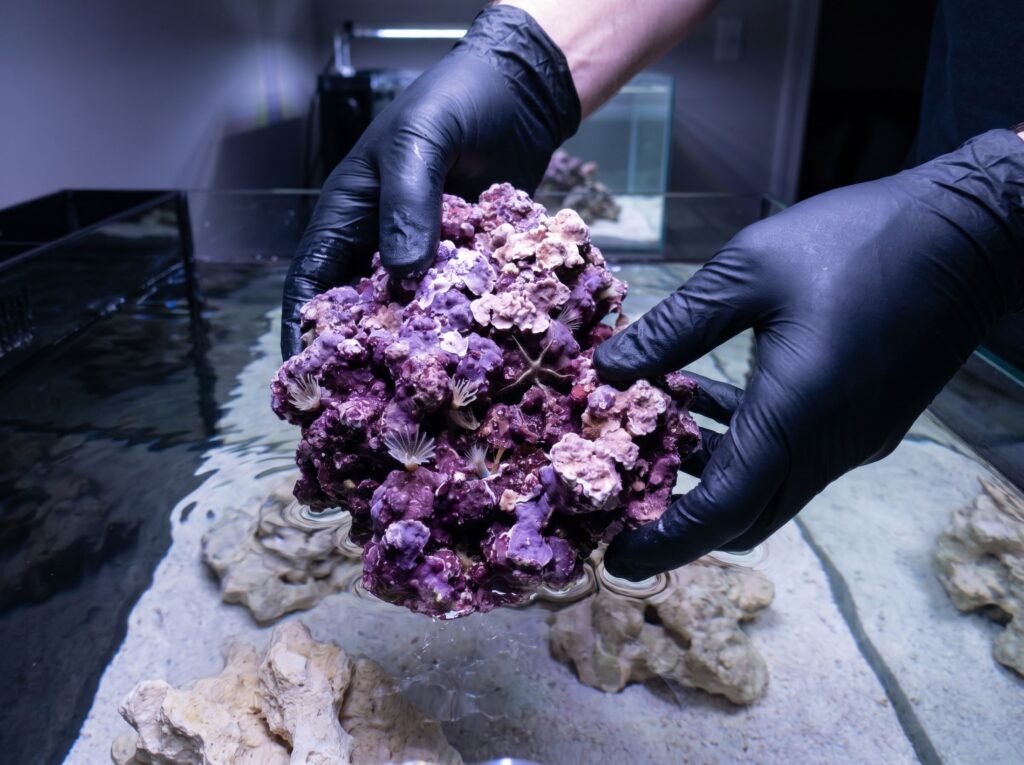
A bare, sterile new tank cycles slowly because there are few surfaces for bacteria to colonize and no existing population to seed from. Three shortcuts reliably compress the timeline:
- Live rock from an established system: A piece of cured live rock from a running reef carries established bacterial colonies. Even a single fist-sized piece in a 40-gallon tank can cut weeks off the cycle because you are importing bacteria directly. The bacteria need to be kept wet during transport - exposure to air kills them quickly.
- Used filter media: A sponge, ceramic ring, or biomedia block from an established, healthy tank is dense with nitrifying bacteria. Rinse it only in saltwater from the source tank, not tap water, and place it in your new sump or filter immediately. This is often the single fastest free shortcut available.
- Live sand: Adding a cup or two of substrate from an established system seeds the sandbed. It contributes less than live rock or used media, but it adds diversity to the microbial community, which matters long-term for a healthy reef bed.
Any of these can be combined with a bottled bacteria product. The more diverse the seed, the faster the bacterial community locks in. The article on live rock vs dry rock goes deeper on why live rock specifically gives the cycle a head start.
The done test - how to know with certainty
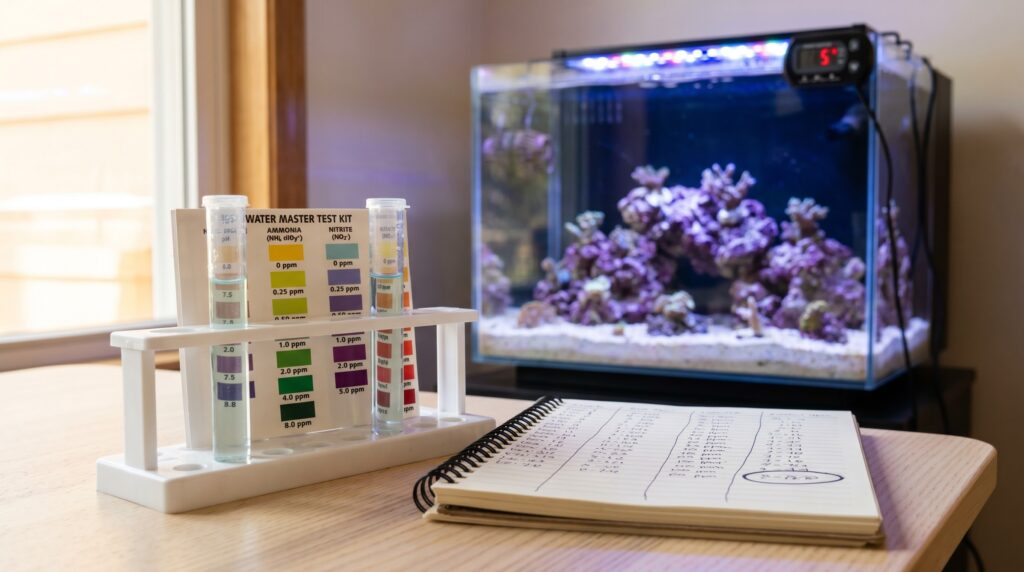
Seeing ammonia and nitrite both read zero one morning is not enough. A single zero reading can mean the bacteria just processed a dose; it does not confirm the colony is large enough to handle a stocked tank.
The proper completion test, per DrTim's Aquatics protocol: dose your tank to 2 ppm ammonia, then wait 24 hours. Test both ammonia and nitrite. If both are at or below 0.2 ppm, the cycle is done. The bacteria colony is large enough to process a full ammonia load overnight. DrTim's states this precisely: "When you can add 2 ppm ammonia and BOTH ammonia and nitrite are below 0.2 ppm the next day your tank is cycled."
If ammonia clears but nitrite is still elevated, the nitrite-oxidizing bacteria have not fully caught up. Give it more time and test again in two to three days. If both are still high, you likely have a stall - see the section below.
Once the 24-hour test passes, do a 30-50% water change to knock nitrate down before adding livestock. Nitrate will have climbed throughout the cycle, sometimes reaching 20-40 ppm. Reef corals generally tolerate 1-10 ppm nitrate as a working range; you want it in that window before anything goes in. See the nitrates in a reef tank guide for more on managing it long-term.
Why cycles stall (and what to do)
A cycle that stops progressing - ammonia or nitrite sitting unmoved for more than a week - almost always has one of these causes:
- pH too low: Nitrifying bacteria slow dramatically below pH 7. In a new reef system using properly made saltwater (1.025 SG, stable alkalinity), pH should not be an issue - but if you are using RO/DI water that is not fully buffered, or if you added too much ammonia and drove the pH down, check pH first. A 25-50% water change with properly buffered saltwater typically restores it and restarts progress.
- Ammonia overdose: DrTim's dosing guidance targets 2 ppm and caps at 4 drops per gallon precisely because high ammonia inhibits the bacteria you are trying to grow. If ammonia climbs above 5 ppm, stop dosing and let it drop before adding more.
- High nitrite inhibition: High nitrite can suppress nitrite-oxidizing bacteria and stall the cycle. If nitrite is locked high while ammonia has already dropped, a partial water change - 33-50%, without disturbing the substrate - reduces nitrite without removing the bacteria attached to rock and media.
- Temperature too low: Fritz Aquatics reports that nitrifying bacteria growth drops by 50% at 64F compared to the optimal 77-86F range. A reef tank sitting at 68F in a cold room will cycle, but slowly. Keep the heater set to at least 76F during the cycle.
- Insufficient surface area: Bacteria live on surfaces, not in open water. A bare tank with no rock, sand, or media has almost nowhere for colonies to anchor. Add live rock, biomedia, or at minimum a sponge filter to give bacteria a home.
- Chloramine in the water: If you used tap water instead of RODI, any residual chloramine kills bacteria. Always use RODI water for reef systems. If tap was used, do a full water change with properly prepared saltwater.
One note on the "ugly stage" many new tanks go through during and just after cycling: diatom blooms, cyanobacteria patches, and murky water are all normal. They happen because nutrients are elevated and the tank's biology is still establishing itself. If your water is cloudy during the cycle, our article on why reef tanks go cloudy explains which causes are harmless and which need attention. The full progression - including what comes after the cycle - is described in the reef tank ugly stage guide.
Parameters to have right before the cycle starts
Cycling does not happen in isolation. The bacteria need a stable environment to establish, which means your salt mix and basic water chemistry should be correct from day one:
- Salinity: 1.025 SG (35 ppt), measured with a refractometer
- Temperature: 76-78F, stable - run your heater and verify with a thermometer before adding any ammonia
- pH: 7.8-8.4 (properly made reef saltwater achieves this naturally)
- Alkalinity: 8-11 dKH - a buffered saltwater mix maintains this; check with a test kit
You do not need to chase precise calcium or magnesium during the cycle itself - those matter for corals, not for bacteria. But alkalinity and stable pH matter because they are what keeps nitrifying bacteria working at full speed. Everything you need to know about these parameters together is in our water parameters overview.
Frequently asked questions
Can I add fish to the tank before the cycle is finished?
Adding fish during an active cycle exposes them to ammonia and nitrite spikes that can kill or permanently damage them. Some hardy species are used in a "fish-in cycle," but this approach requires daily water testing and frequent partial water changes to keep levels survivable. For a reef tank with invertebrates, a fishless cycle is strongly preferred - invertebrates are far more sensitive to ammonia and nitrite than most fish.
Do live rock and live sand fully replace bottled bacteria?
Well-seeded live rock from a running reef system carries established nitrifying bacteria and can significantly shorten the cycle on its own. Dry rock and bagged "live sand" (which is often not actually live by the time it reaches you) carry far less biology. For a fully dry setup, a bottled live-bacteria product gives you a reliable bacterial seed that the rock and sand alone cannot provide in quantity.
Will running the protein skimmer slow down the cycle?
Running the skimmer during a natural fishless cycle is fine and recommended - it maintains oxygenation, which nitrifying bacteria need (dissolved oxygen must stay above 2-3 mg/L). However, if you dose a live-bacteria product, Fritz Aquatics recommends turning the skimmer off for five days after dosing to prevent the bacteria from being removed before they attach to surfaces.
How much nitrate is normal after cycling?
By the end of a four-to-eight week cycle, nitrate typically reaches 20-40 ppm or higher. That is expected - it is the accumulated end product of all the ammonia you dosed. Do a 30-50% water change before adding livestock to bring it down. In a running reef, the target range is 1-10 ppm. Zero nitrate can actually harm corals and trigger dinoflagellates, so the goal is a stable low level, not zero.