Dosing pumps explained: automate alkalinity, calcium, and magnesium in a reef tank
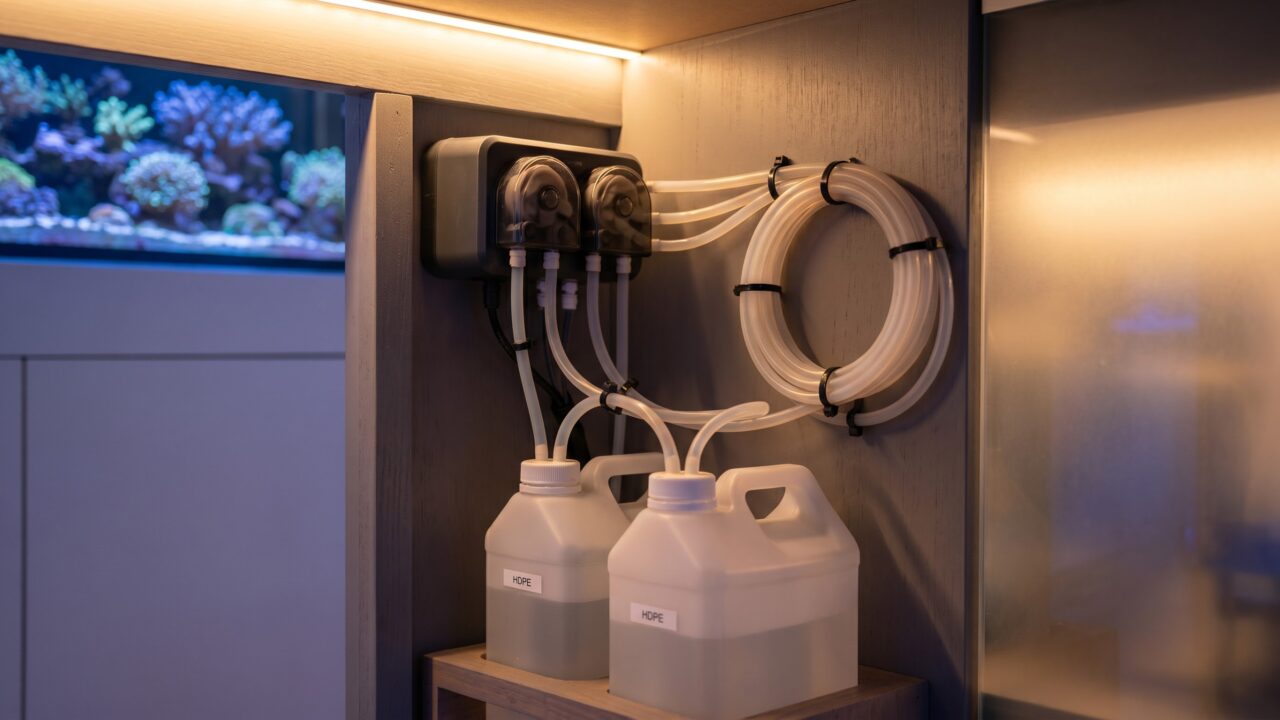
Your corals are quietly mining their own water. Every polyp that builds skeleton pulls calcium ions and carbonate alkalinity out of solution, all day and all night. In a lightly stocked tank the weekly water change replenishes enough to keep pace. But add a second frag rack, or watch your SPS colonies double in size, and that math quietly breaks down - parameters start dropping faster than top-offs and water changes can recover them. A dosing pump is the tool that closes that gap.
This guide covers what a doser actually does at the chemistry level, how to decide when you genuinely need one, how to set it up correctly, and the single non-negotiable rule that protects your tank once it is running.
What a dosing pump actually automates
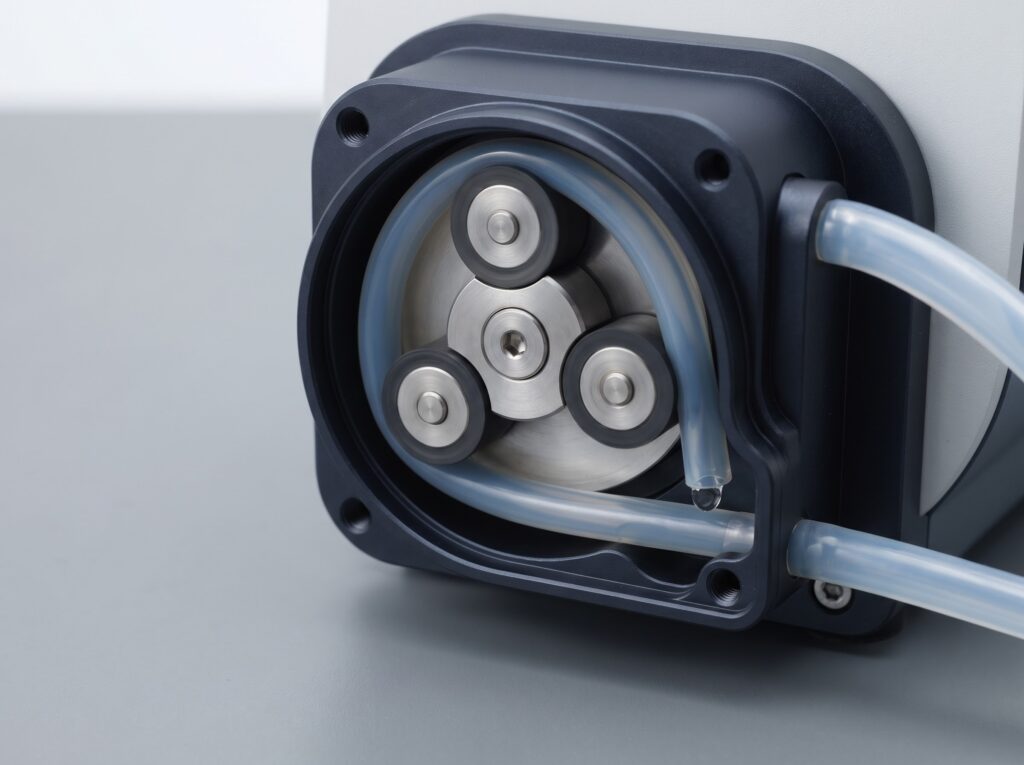
A dosing pump is a peristaltic metering device. Inside the pump head, a set of rollers rotates along a loop of flexible silicone tubing. Each roller pinches the tube as it passes, squeezing a discrete packet of liquid forward and creating a low-pressure vacuum that draws the next packet in from the reservoir. The result is a highly repeatable flow - programmable down to fractions of a milliliter per dose, spread across as many doses per day as you set.
To illustrate the scale: a 100-gallon reef with a growing coral load can deplete roughly 20 ppm of calcium and up to 2 dKH or more of alkalinity per day - figures that vary widely depending on coral species, colony size, and stocking density. For reef chemistry, that precision matters because of what happens when you dose irregularly. Dump 50 mL of alkalinity solution into a 75-gallon tank in one shot and you briefly spike the chemistry near the addition point. At that elevated local concentration, calcium and carbonate can combine and drop out as insoluble calcium carbonate before the water column mixes - essentially wasting the dose and momentarily stressing nearby corals. Spread the same 50 mL across 24 hourly micro-doses of roughly 2 mL each and the tank water never sees a spike. Parameters stay within a band so tight the corals cannot tell the difference between one hour and the next.
Stability, not the absolute number, is what corals respond to most. A tank sitting at a steady 8.5 dKH outperforms one that swings between 7.5 and 10 dKH, even though the average of the second tank looks fine on paper.
What a doser handles directly:
- Alkalinity (dKH) - the carbonate reservoir corals draw on to build aragonite skeleton. Most actively growing mixed reefs consume between 0.5 and 2 dKH per day; an SPS-heavy tank can exceed 2 dKH per day. See reef tank alkalinity for a full breakdown of targets and testing.
- Calcium (ppm) - consumed alongside alkalinity in roughly a 2:1 molar alkalinity-to-calcium ratio during calcification. Target 400-450 ppm. Details at calcium in a reef tank.
- Magnesium (ppm) - consumed more slowly, but critical: magnesium keeps calcium and carbonate in solution long enough for corals to use them. When magnesium drops below about 1,200 ppm, calcium and alkalinity begin precipitating almost as fast as you add them, making dosing the other two parameters essentially futile. Target 1,250-1,350 ppm. Full context at magnesium in a reef tank.
Two-part dosing (the most common beginner approach) uses two separate liquid solutions - one calcium-rich, one alkalinity-rich - dosed at different times. Read more about mixing and ratios in two-part dosing for beginners. A three-part system adds a dedicated magnesium solution, useful when a growing tank starts pulling magnesium down faster than water changes replenish it.
When to graduate from water changes to a doser
Water changes work. For a new tank, or one stocked mostly with soft corals and a handful of LPS frags, a weekly 10-15% water change with a quality salt mix that matches your target parameters replenishes calcium, alkalinity, and magnesium almost automatically. There is no dosing complexity, no equipment to calibrate, and no pump to fail at 2 a.m.
The moment to add a doser is when consumption outpaces replenishment - when you test your water two or three days after a water change and the parameters have already drifted noticeably downward. The decision gate below turns that into a concrete check you can run with a test kit and a notepad.
When-to-start-dosing decision gate
| Check | If yes | If no |
|---|---|---|
| Does alkalinity drop more than 0.5 dKH between water changes (tested 3-4 days apart)? | Consumption is measurable - keep going | Water changes likely sufficient for now |
| Are you doing water changes of at least 10% weekly with a balanced salt mix? | Drops are real depletion, not a skipped change | Fix the water change routine first |
| Does alkalinity drop more than 1 dKH per day on average? | Dosing strongly recommended | Low-frequency manual dosing may still work |
| Does calcium drop more than 10 ppm between water changes? | Calcium supplementation needed alongside alkalinity | Salt mix may be covering calcium alone |
| Are you keeping SPS corals, or planning to? | Budget for a doser now; SPS demand is high and grows with colony size | Mixed/soft coral tanks have lower urgency |
| Are you away from home for 2+ days at a stretch? | Automation removes the manual-dosing gap | Manual dosing remains an option |
If you answer yes to the first three checks, a doser is the right next step. If you answer yes only to the last two, a doser is still useful - but addressing consistency in your water change routine first is cheaper and simpler.
One important note on sequence: correct magnesium before you start dosing calcium and alkalinity. A tank running at 1,150 ppm magnesium while you add two-part solution is wasting product - the calcium and carbonate will precipitate rather than stay dissolved for corals to absorb. Get magnesium to 1,250 ppm or above first, confirm it with a test kit, then begin the two-part regimen.
How many pump heads do you actually need
Two-part dosing requires a minimum of two heads - one for your alkalinity solution, one for your calcium solution. A third head handles a separate magnesium solution if your consumption rate warrants it. Four-head units let you add a fourth channel for trace elements, amino acids, or a carbon source without buying a second pump.
For most beginner and intermediate reef keepers, a two-head pump covers everything needed to start. Four-head pumps cost modestly more and give headroom for a maturing, growing tank without having to upgrade hardware. The Red Sea ReefDose, for example, comes in two-head and four-head configurations; the four-head model has an accuracy of ±0.05 mL per dose (an average deviation of 0.5% over 10 mL) and a rated motor life of 10 years at 250 mL/day per head.
One rule that applies to every multi-head pump: calcium and alkalinity lines must stay completely separate from the reservoir all the way to the tank outlet. If the solutions contact each other in the tubing - even briefly - they react and form solid calcium carbonate that clogs the line and removes both ions from solution before any coral sees them. ATI's dosing guidelines recommend a simple interleaved schedule: alkalinity doses on even hours, calcium doses on odd hours.
Calibration: the step most beginners skip
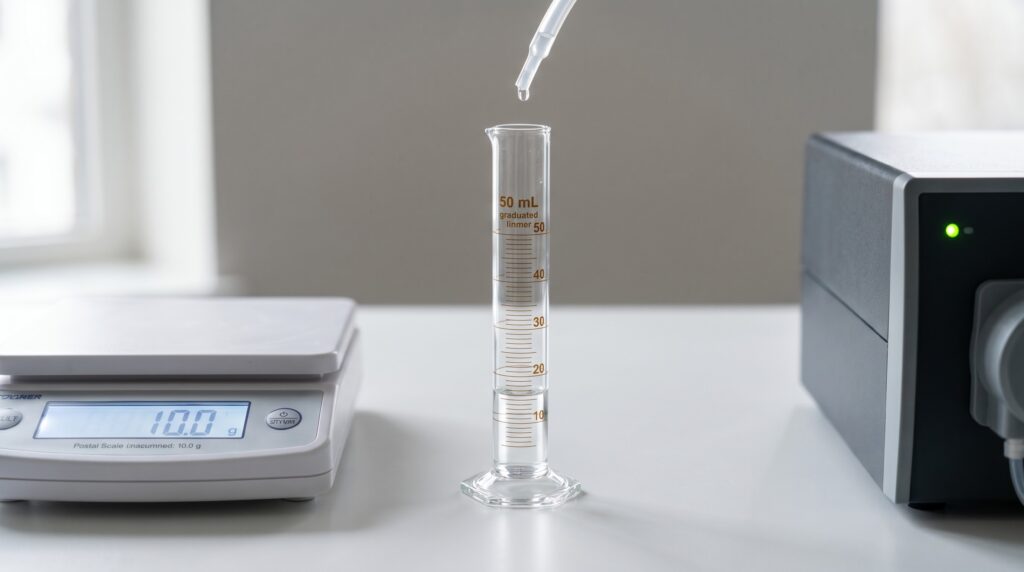
A dosing pump delivers what it is programmed to deliver only if it has been calibrated. Factory settings are a starting point. Tube diameter, tubing age, fluid viscosity, and even the vertical lift to the tank outlet all influence actual flow rate. Skip calibration and you may be dosing meaningfully more or less than intended - enough to cause slow parameter drift that looks like a mysterious tank problem for weeks.
Basic calibration procedure
- Fill the reservoir with RO/DI water (not your actual dosing solution - reserve that for real doses).
- Prime the tubing completely so there are no air bubbles; bubbles are the single biggest source of calibration error.
- Command the pump to dispense exactly 10 mL into a clean graduated cylinder or a syringe marked in 0.5 mL increments.
- Read the actual volume. If it shows 8.7 mL, the pump is delivering 87% of target - adjust the calibration value in the controller until the measured output matches 10 mL within 0.2 mL.
- Repeat the check after 24 hours of real operation to catch any settling-in drift.
Recalibrate every one to two months for DC peristaltic heads - ATI's official setup guide recommends monthly recalibration because silicone tubing stretches with repeated use - or immediately if you notice an unexplained drift in your parameters that tests cannot otherwise explain. Pumps with stepper motors - like the Neptune DOS - maintain calibration significantly better than DC peristaltic heads, which can drift meaningfully over several weeks of continuous use.
Verify calibration indirectly, too: track how much liquid you pull from each container per week. If your calculation says you should use 140 mL of alkalinity solution in seven days and the bottle shows you used 115 mL, the pump is under-delivering. That cross-check costs nothing and catches tubing wear before a parameter crash does.
Container hygiene: the overlooked maintenance task
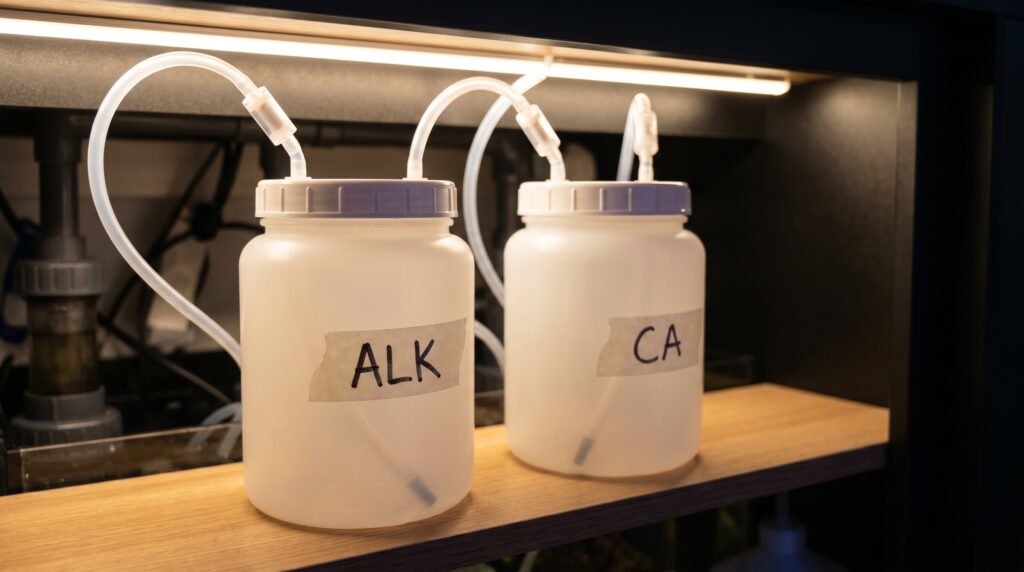
Dosing containers are warm, nutrient-adjacent, and lit - ideal conditions for bacterial films and, in alkalinity solution, for slow crystallization along the walls and tube inlet. Neither is catastrophic on its own, but both degrade over time.
Practical rules:
- Use opaque or light-blocking containers for any solution that sits for more than a few days. Clear containers allow light penetration that can encourage microbial growth.
- Never combine leftover alkalinity from one batch with fresh solution without cleaning the container first. Residue from the previous batch can seed crystallization in the new one.
- Inspect the outlet tube tip weekly. Dried chemical buildup - a white or grey crust - forms where the tube end is exposed to air between doses. A small amount is normal; heavier buildup narrows the outlet bore and causes under-dosing. Wipe or trim the tip as needed.
- Keep calcium and alkalinity containers physically separated. A spilled drop of one onto the inlet of the other is enough to start a clog.
- Replace silicone tubing every six to twelve months or when you notice it stiffening or cracking. Stiff tubing delivers inconsistent volume per roller rotation and accelerates calibration drift.
- If you mix your own two-part solutions from dry salts and RO/DI water, only mix what you will use within two to four weeks. Freshly mixed solutions are more predictable than aged ones.
ATI's dosing tips also flag a practical placement rule: position containers lower than the tank outlet of the dosing tube. If the container sits higher than the tubing exit point and the pump loses power, gravity can siphon the entire container into the tank overnight - a chemistry disaster. Check valves on the output line prevent back-siphon regardless of container position, and are worth adding to any setup.
The rule that holds the whole system together
Every dosing schedule is built on a test result. If the test is wrong - or absent - the dose is wrong. Adding alkalinity to a tank already sitting at 11 dKH because you assumed it dropped stresses corals just as badly as letting it fall to 6 dKH. Adding calcium to a tank where magnesium has quietly dropped to 1,100 ppm wastes the dose and scales your equipment.
The principle used across serious reef-keeping communities is straightforward: do not dose anything you are not actively measuring. That means:
- Test alkalinity before you start dosing and establish a true baseline. Test again 24 hours later to calculate actual daily consumption. Set your pump to replace that exact consumption - not more, not less. If alkalinity has drifted far below target, correct it manually in small steps - no more than about 1 dKH per day - rather than programming the pump to recover it all at once. A large single-day increase stresses corals more than a slightly low number does.
- Test calcium and alkalinity together at least weekly once the doser is running. They are consumed in a fixed ratio; a consistent divergence between them is the first sign that something in your system is off (a kalk drip, a different salt mix, or a changed coral load).
- Test magnesium monthly in a steady mixed reef, weekly in an SPS-heavy tank. Magnesium is consumed slowly but falls without obvious early signs.
- Any time you adjust dose volumes - adding corals, changing lighting intensity, upgrading flow - retest within two to three days to confirm your adjustment was correct.
This is not a formality. It is the mechanism by which a dosing pump stays safe. The pump does exactly what you tell it to. Testing is how you tell it the right thing.
Setup checklist before you dose the first drop
| # | Step | Why it matters |
|---|---|---|
| 1 | Test current alkalinity, calcium, and magnesium | Establish baseline before adding any automation |
| 2 | Correct magnesium to 1,250-1,350 ppm first if it is low | Low Mg causes Ca/Alk to precipitate; fix this before two-part |
| 3 | Bring alkalinity to target (8-11 dKH) by hand before starting the pump | Starting from in-range parameters simplifies dose calculation |
| 4 | Calculate daily consumption (test, wait 24 h, test again) | This number drives your entire dosing schedule |
| 5 | Prime all tubing; confirm zero air bubbles | Bubbles are the biggest calibration error source |
| 6 | Calibrate each head against a graduated cylinder using RO/DI water | Factory settings are not guaranteed to be accurate |
| 7 | Program alkalinity and calcium on offset schedules (e.g., alk on even hours, Ca on odd hours) | Prevents the two solutions meeting in the water column and precipitating |
| 8 | Set container check valves; confirm containers sit below tank outlet | Prevents gravity siphon if pump loses power |
| 9 | Test alkalinity and calcium 24 hours after first full day of dosing | Confirms dose volume matched actual consumption |
| 10 | Log container levels weekly; compare against expected consumption | Catches calibration drift early, before a parameter crash |
Running this checklist before the first dose takes 30-45 minutes. Skipping it and diagnosing the resulting parameter drift can take weeks.
Frequently asked questions
Can a dosing pump replace water changes entirely?
No - and this is a common misunderstanding worth clearing up. A doser replenishes calcium, alkalinity, and magnesium as corals consume them, but it does not remove nitrate, phosphate, or accumulated waste products. Water changes handle that export side. Most reefers running a doser still do a 5-10% water change every one to two weeks.
What happens if a dosing pump jams or runs dry?
A stalled pump stops dosing, and parameters drift downward over the following day or two. Most modern pumps include low-reservoir alerts and missed-dose notifications. The tank will not crash overnight, but check alerts daily and test parameters whenever you suspect a delivery problem. A sudden unexplained drop in alkalinity is usually the first measurable sign.
Do I need a doser if I only keep soft corals?
Probably not in the first year. Soft corals have much lower calcium and alkalinity demand than SPS or even most LPS. Regular water changes with a balanced salt mix typically cover their needs. Revisit the question when you add LPS or notice consistent parameter drift between changes.
How often should I recalibrate the pump?
Every one to two months for DC peristaltic motors. ATI's official pump setup guide recommends monthly recalibration because silicone tubing stretches with repeated use, which shifts actual delivery volume away from the programmed target. Stepper-motor pumps (Neptune DOS, Red Sea ReefDose) maintain calibration significantly better than DC heads but are still worth checking periodically. Any time you replace tubing, recalibrate immediately before resuming normal dosing.
Can I dose calcium and alkalinity through the same pump head at different times?
Technically yes, but it is not recommended. Even trace residue of alkalinity solution left in tubing will react with incoming calcium solution and vice versa, gradually forming a crust that narrows the tube bore and causes under-dosing. Dedicated heads for each solution are cleaner and more reliable.