Reef tank maintenance schedule: daily, weekly, monthly, and quarterly tasks
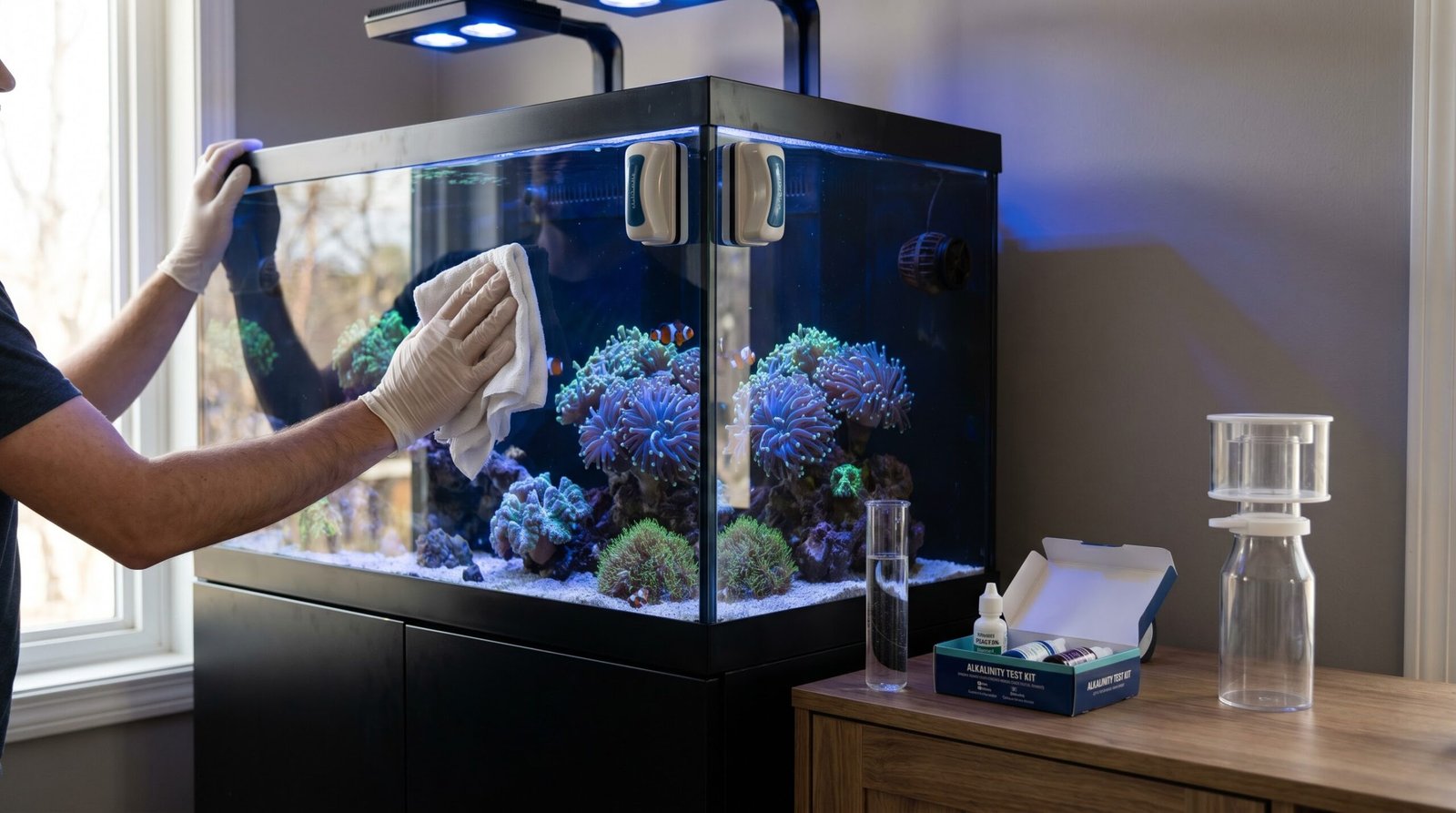
Thirty to sixty minutes a week is all a healthy 40-gallon reef tank asks of you. The secret is knowing which tasks belong on which day, so nothing gets skipped and nothing piles up. A simple, consistent routine protects your livestock better than any expensive piece of equipment ever could.
This page breaks the full routine into daily, weekly, biweekly or monthly, and quarterly blocks, then gives you a printable reference table you can stick on the wall above the tank. The time budgets below are realistic for a 40-gallon mixed reef with soft corals and LPS – a larger system or a heavily stocked sump adds time, but the structure stays the same.
Daily tasks: five minutes of looking and feeding
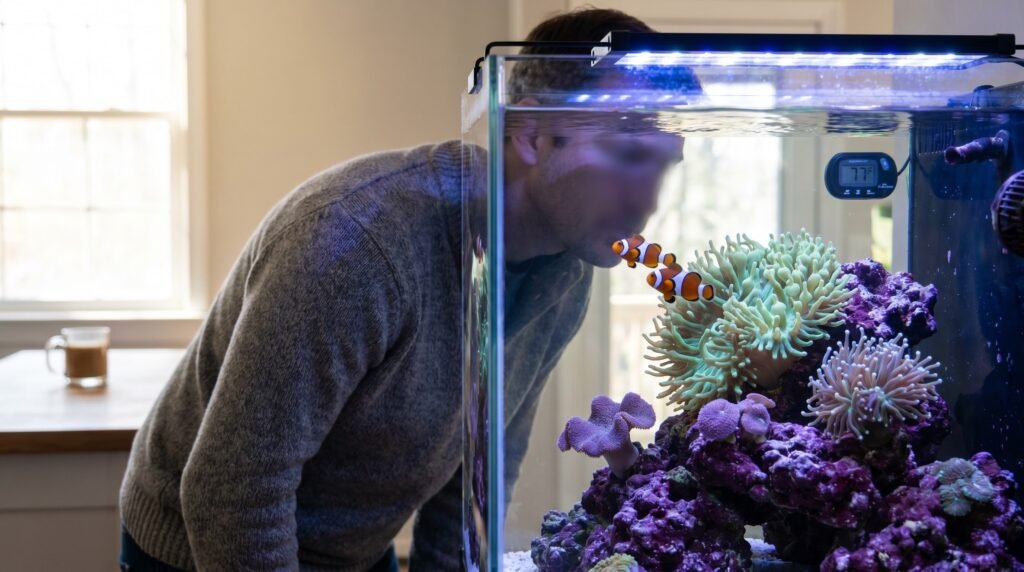
Most daily reef maintenance is observation, and that is intentional. Problems caught in five minutes of watching are problems solved quickly. Problems missed for three days become crashes.
Run through this each morning before the lights ramp up, and again briefly when feeding:
- Check all livestock. Every fish accounted for? Are corals open? Retracted polyps – especially on otherwise healthy colonies – signal stress before any test kit does. Closed LPS mouths or a clownfish hiding in a corner earns a closer look.
- Glance at the thermometer. The target range for a reef is 76-78°F (24-26°C), and stability matters as much as the number itself. A swing of more than 2°F (1°C) in 24 hours stresses corals. The thermometer is your heater’s report card.
- Confirm equipment is running. Skimmer bubbling? Return pump pushing flow? Lights on the right schedule? Thirty seconds of scanning saves you from coming home to a dead pump and a crashed tank.
- Top off evaporated water – or verify your ATO topped it off. Saltwater evaporates but leaves all the salt behind, so your salinity climbs every hour you ignore it. A manual top-off with RODI water takes 30 seconds; if you have an auto top-off (ATO) system, just confirm the reservoir still has water and the indicator light looks normal.
- Feed carefully. Overfeeding is the single fastest route to a nitrate spike. Feed what the fish consume in about two minutes, once or twice a day. Uneaten food starts breaking down within hours.
The whole routine takes under five minutes once it is habit. Think of it as a quick conversation with your tank rather than a chore.
Weekly tasks: the backbone of a healthy reef
This is where the real maintenance happens. One focused session per week – typically 30 to 45 minutes on a 40-gallon – covers glass, water chemistry, a water change, and the skimmer cup. Do these consistently and your tank will almost run itself.
Test alkalinity (and note the number)
Alkalinity is the single most important parameter to track weekly on a reef. It fuels coral skeleton growth, it depletes steadily as corals consume carbonate, and a swing of more than about 1.4 dKH in 24 hours stresses stony corals – Red Sea’s reef-chemistry guidance puts the safe maximum daily change at 0.5 meq/L, which works out to roughly 1.4 dKH. Keep it in the 8-11 dKH range. The Hanna HI772 colorimeter measures in 0.1 dKH increments and covers the full 0-20 dKH range, which makes weekly readings practical and precise.
Write the number down. A log tells you whether your alkalinity is creeping down between water changes, which means your corals are growing and you may need to start dosing. If it stays rock-steady, your weekly water change is replenishing what the tank consumes. If you dose two-part or use a calcium reactor, also test calcium weekly (target 400-450 ppm) – alkalinity and calcium move together, and tracking only one gives you half the picture. More on the full parameter picture at our water parameters guide.
Do a partial water change
A 10-15% water change each week is the most reliable maintenance task in reef keeping. It removes accumulated nitrate, phosphate, and dissolved organics while simultaneously restoring calcium, alkalinity, magnesium, and trace elements to something close to natural seawater. No dosing program fully replaces the broad-spectrum replenishment a good water change delivers. One note worth making here: you are not trying to drive nitrate and phosphate to zero. Corals need nutrients to survive – aim for nitrate in the 1-10 ppm range and phosphate around 0.03-0.10 ppm, not a sterile void.
Mix your saltwater at least 24 hours in advance, at the right salinity (1.025 SG / 35 ppt), and match the temperature before adding it to the tank. Our water change step-by-step covers the full process, including siphoning the sandbed during the change. For saltwater mixing technique, see how to mix saltwater.
Scrape the glass
Green film algae builds up on the inside glass quickly. Scrape it off weekly with a magnetic cleaner or a blade scraper before it becomes a thick mat that requires real effort. Work from top to bottom, stop before you reach the substrate (a grain of sand caught in the pad will scratch glass in a long streak), and use slow deliberate strokes on coralline patches rather than scrubbing hard. Clean outside glass too – salt spray and dried water spots make the tank look murky from two feet away.
Empty and rinse the protein skimmer cup
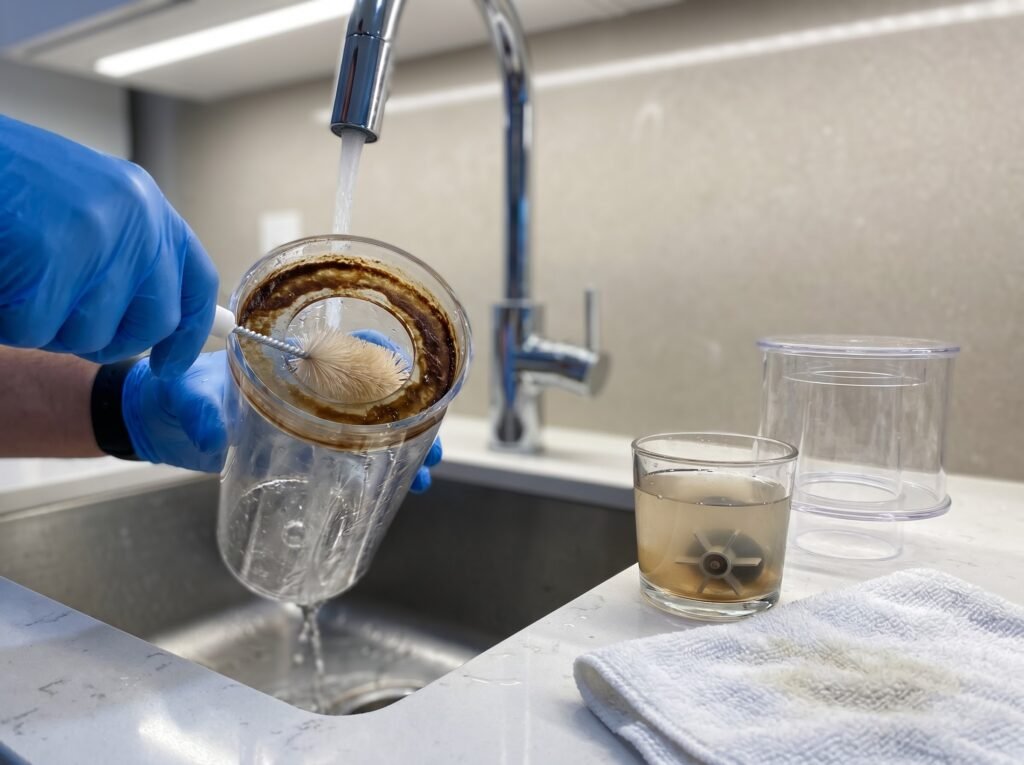
A full skimmer cup starts to overflow skimmate back into the tank. More importantly, even a half-full cup with dried skimmate on the neck walls dramatically reduces foam production – the organic film coats the neck and wets the bubbles before they can rise. Rinse the cup and wipe the neck down with a damp cloth once a week at minimum. Simplicity Aquatics, a skimmer manufacturer, states it directly: “A clean skimmer will always outperform a dirty one.”
Check salt creep
Salt creep – the white crusty buildup around bulkheads, pump cords, and tank edges – is harmless until it isn’t. If it creeps into a pump’s venturi valve, it kills bubble production on your skimmer. If it dries on glass covers, it blocks light. Wipe it down with a damp cloth once a week. Catching it while still soft takes seconds; letting it cake on for two weeks turns it into a chipping job.
Biweekly to monthly tasks: equipment care that keeps gear running
These tasks don’t need to happen every week, but they must happen on a calendar, not when you remember. Monthly or biweekly is the window where most gear problems start before they become failures.
Test magnesium (monthly)
Magnesium doesn’t change as fast as alkalinity, so monthly is sufficient for most tanks. Natural seawater runs around 1,300 ppm, and that is a sensible target for a reef. Seachem’s guidance sets the acceptable range at 1,200-1,350 mg/L; aiming for the upper half of that window (1,250-1,350 ppm) keeps you safely away from the point where chemistry starts to slide. Why does it matter? Magnesium regulates the ratio between calcium and alkalinity in solution; when it drops below about 1,200 ppm, calcium and carbonate begin precipitating out before corals can use them, making it nearly impossible to hold stable alkalinity no matter how much you dose. A monthly test catches a slow slide before it becomes a chemistry puzzle.
Deep-clean the skimmer body and pump (every 2-3 months)
The collection cup rinse is weekly, but the pump itself needs more attention every two to three months. Remove the pump, disassemble the impeller and needle-wheel assembly, and soak the components in a 1:1 mixture of water and white vinegar for 15-20 minutes to dissolve calcium deposits. Scrub with a small brush, rinse thoroughly, and reassemble. Calcium buildup on the impeller reduces motor efficiency and eventually causes the skimmer to run louder and produce less consistent foam.
Change or rinse filter socks (weekly to biweekly, but tracked here)
Filter socks are trap-and-release devices: they trap organic particles brilliantly, but anything they trap starts decomposing into nitrate within a few days. Waterbox Aquariums’ support documentation recommends cleaning socks “about once a week,” though tanks with heavy bioloads may need changes every two to three days. Keep a rotation of four to six clean socks in the laundry – machine wash on hot with bleach but no detergent, extra rinse cycle, air dry completely. Socks that are properly maintained last several months before the fiber loosens enough to warrant replacement.
Inspect and clean wavemakers and powerheads (every 1-2 months)
Reduced flow is the warning sign. If a powerhead that used to push good chaotic water movement now has a visibly weak stream, calcium and coralline buildup have narrowed the impeller clearance. Remove the unit, disassemble the wet end, and soak in a citric acid solution (roughly 3/4 to 1 cup of citric acid powder dissolved in 1 gallon of fresh water) for 15-20 minutes. Current USA’s manufacturer guidance for their eFlux wave pumps recommends cleaning every four to six months and explicitly advises against white vinegar, noting it “can penetrate plastics and can cause swelling around components such as the magnet assembly.” Citric acid is the safer default for most pump housings.
Quarterly tasks: the long-game items that prevent big failures
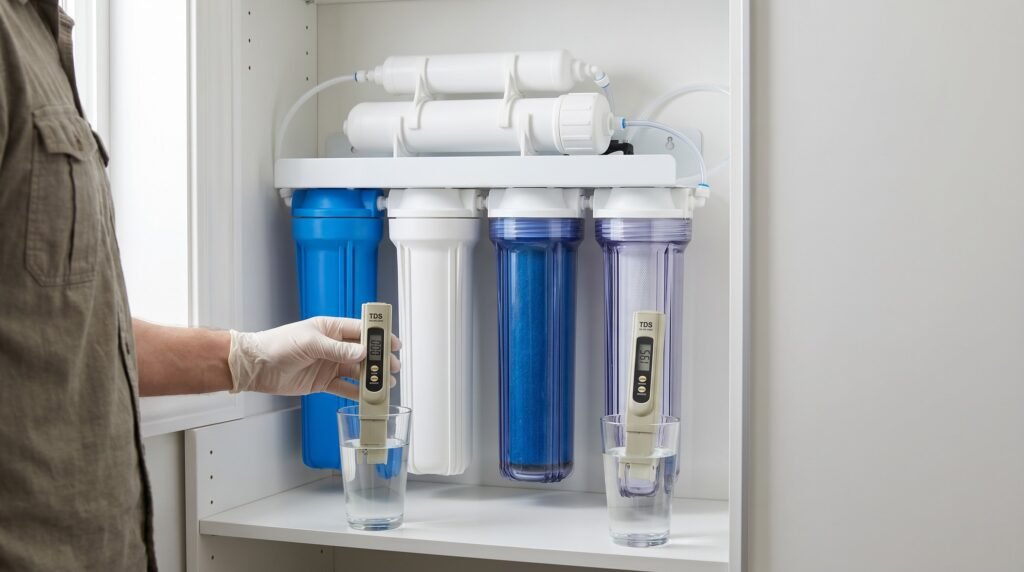
Quarterly tasks are easy to skip because nothing appears to go wrong when you miss one. Then a heater fails in July and cooks the tank, or your RODI membrane quietly lets tap water TDS creep into your top-off supply for three months. These take 30-60 minutes per quarter and prevent the most catastrophic, expensive problems in the hobby.
Inspect and test your heater
Heaters are statistically the most likely piece of reef equipment to fail. Bubble-Magus notes plainly: “While they’re one of the least expensive pieces of equipment you’ll buy for your tank, they’re also the most likely to fail.” Failure modes split roughly into going cold (tank chills overnight) and getting stuck on (tank cooks). Both kill livestock.
Quarterly, verify the heater cycles correctly by watching it turn on and off while you monitor a separate thermometer in the water column. An indicator light that stays on permanently means a stuck thermostat – replace the unit immediately. Many hobbyists replace standard glass heaters every one to two years as a precaution, regardless of apparent condition; titanium heaters are widely reported to last longer when they continue to pass the cycle test, though no manufacturer publishes a fixed service interval. Running two smaller heaters instead of one large one is the best redundancy strategy: if one fails cold, the other holds the tank. See our guide to reef tank heaters for sizing and placement.
Check your RODI system and test output TDS
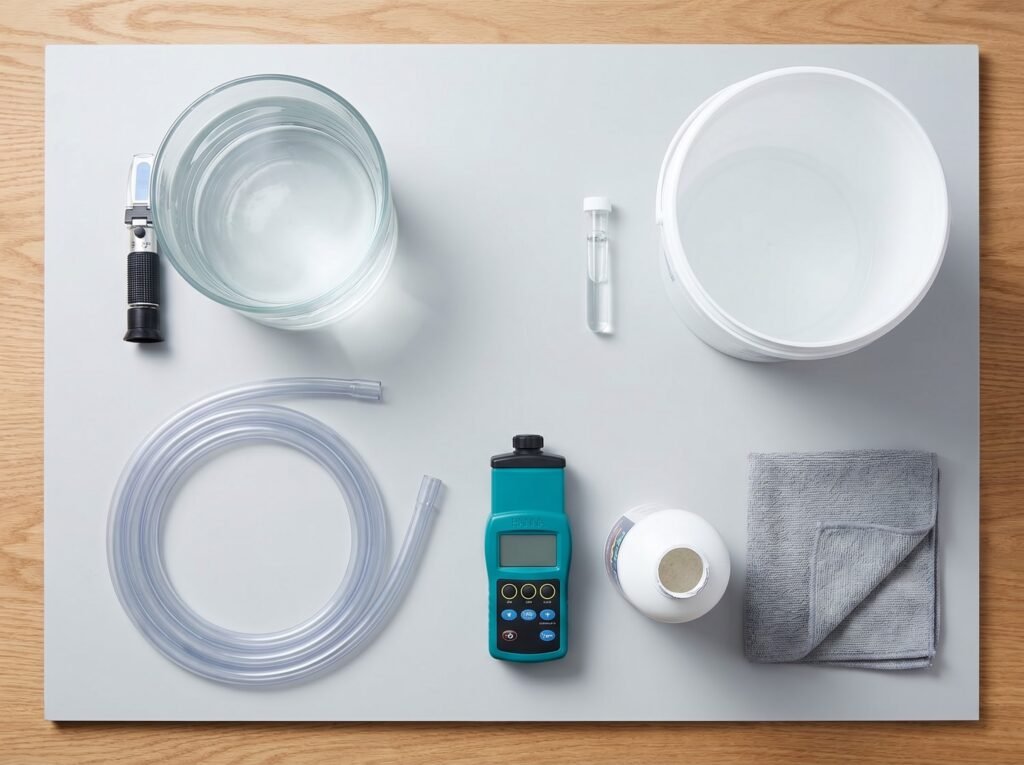
RODI water is the foundation of reef keeping. Tap water full of chlorine, phosphate, silicate, and heavy metals will slowly undo every other maintenance effort you make. Quarterly, pull out the TDS meter and check three points in the system: before the sediment stage (your tap baseline), after the RO membrane, and after the DI resin.
According to AquaticLife’s replacement guidance, standard 10-inch sediment and carbon cartridges should be replaced “every 6 months or 3,000 gallons, whichever comes first.” The RO membrane should reject at least 95% of dissolved solids – if your tap reads 200 ppm and the post-membrane reading is above 10 ppm, the membrane is due. DI resin is done when the color-changing resin turns completely amber, or when TDS from the DI stage rises above zero. Zero TDS out of the DI stage is the only acceptable result for reef top-off water and saltwater mixing.
For a full breakdown of the RODI system, see RODI systems for reef tanks.
The printable maintenance schedule
Print this table, laminate it if you like, and put it somewhere you will see it during maintenance. The “time” column assumes a 40-gallon mixed reef with a sump; nano tanks run shorter, heavily stocked SPS systems run longer.
| Frequency | Task | Approx. time | What you’re preventing |
|---|---|---|---|
| Daily | Observe livestock – fish count, coral extension, behavior | 2 min | Catching disease, stress, deaths early |
| Daily | Check thermometer reading | 30 sec | Heater failure detection |
| Daily | Confirm equipment running (pump, skimmer, lights) | 30 sec | Pump failure going unnoticed |
| Daily | Top off with RODI water (or verify ATO reservoir) | 1-2 min | Salinity creep from evaporation |
| Daily | Feed fish (measured portion, 1-2x) | 2 min | Overfeeding, nutrient spike |
| Weekly | Test and log alkalinity (target 8-11 dKH) | 5 min | Alkalinity swing, dosing undershoot |
| Weekly | 10-15% water change with matched saltwater | 20-30 min | Nitrate/phosphate buildup, trace element depletion |
| Weekly | Scrape inside glass; wipe outside | 5 min | Coralline buildup, view obstruction |
| Weekly | Empty and rinse skimmer collection cup; wipe neck | 5 min | Overflow, reduced foam production |
| Weekly | Wipe salt creep from rims, cords, bulkheads | 3 min | Venturi blockage, light reduction |
| Weekly | Swap/rinse filter sock | 5 min | Nitrate factory from decomposing trapped waste |
| Monthly | Test magnesium (target 1,250-1,350 ppm) | 5 min | Ca/Alk precipitation, dosing failure |
| Monthly | Check salinity with refractometer; calibrate if needed | 3 min | Salinity drift from ATO miscalibration |
| Monthly | Inspect powerheads and wavemakers for flow reduction | 5 min | Calcium buildup cutting flow to corals |
| Every 2-3 months | Deep-clean skimmer pump: disassemble, vinegar soak, scrub | 20 min | Impeller calcium buildup, reduced skimming |
| Every 4-6 months | Citric acid soak for wavemakers and powerheads | 30 min | Bearing and impeller wear from scale |
| Quarterly | Inspect and cycle-test heater(s); replace annually | 10 min | Stuck thermostat – tank cook or crash |
| Quarterly | Test RODI output TDS at all three stages | 5 min | Exhausted filters silently passing tap impurities |
| Every 6 months | Replace RODI sediment and carbon cartridges | 15 min | Chlorine breakthrough damaging RO membrane |
| As needed (TDS test) | Replace DI resin when resin turns amber or TDS > 0 | 10 min | Dissolved solids in top-off water and salt mix |
| As needed (TDS test) | Replace RO membrane when rejection falls below 95% | 15 min | Contaminant accumulation in reef system |
Honest time budget: what this actually costs per week
For a 40-gallon mixed reef, a realistic weekly session looks like this:
- Alkalinity test: 5 minutes
- Mix and add fresh saltwater (if you pre-mixed the night before): 20-30 minutes including siphoning the sand
- Glass scrape, skimmer cup, salt creep, filter sock swap: 15 minutes
Call it 40-50 minutes on a normal week. The daily checks add maybe 10 minutes across seven days. Monthly and quarterly tasks are occasional half-hour sessions that cost very little time but catch problems that would otherwise cost you livestock and money.
What makes reef keeping feel like a lot of work is not the individual tasks – it’s doing them irregularly. Miss three weeks of glass cleaning and you’re scraping coralline. Skip a month of skimmer cup duty and skimmate overflows. The hobbyists with the most beautiful tanks are, without exception, the most boring and consistent. A 40-minute Wednesday routine beats a three-hour Saturday rescue session every time.
What breaks the routine and how to recover
Life happens, and a week off won’t crash a stable reef. Here’s how to come back without overcorrecting:
- Missed 1 week of water changes: Do the usual 10-15% when you return. Don’t do a 30% change to “catch up” – a sudden large dilution can drop alkalinity sharply and stress corals more than the missed week did.
- Skimmer cup overflowed into sump: No crisis. Remove the skimmate, clean the cup and neck, return to weekly routine. Check whether the neck needs a deeper clean if foam quality has dropped.
- Missed a week of top-offs (no ATO): Test salinity before adding anything. A reading above 1.026 SG means you need to come back down slowly – add RODI water in small increments over a day or two rather than all at once. A rapid salinity drop from over-correction stresses inverts harder than the elevated reading did.
- Coming back from vacation: Do a full parameter check first – alkalinity, salinity, nitrate, temperature. Fix any readings that are out of range slowly. Then return to normal maintenance cadence.
A reef that gets consistent moderate care will outperform one that gets neglected for weeks and then over-corrected. Stability is the goal, and the schedule above is how you get it.
Frequently asked questions
How often should I test water parameters in a reef tank?
Test alkalinity weekly – it is the fastest-moving parameter on a reef. Magnesium is stable enough for monthly testing. Calcium can be tested weekly if you dose, monthly if your water changes keep it in range. Nitrate and phosphate are worth testing every two weeks until you know how your tank behaves, then monthly once it is stable.
Can I skip water changes if my parameters look perfect?
Test kits measure the parameters you are testing. They don’t measure the full spectrum of trace elements that deplete over time, or the accumulation of dissolved organic compounds that impair coral health in ways that don’t show up on a basic test. Regular water changes are also the simplest way to reset what you don’t test. A tank with stable major parameters still benefits from weekly partial changes. Our article on reef tank water changes covers the full reasoning.
Do filter socks raise nitrates?
Yes, if left in place too long. A filter sock traps organic waste beautifully, but anything it traps starts breaking down into ammonia and then nitrate within a few days. The sock itself isn’t the problem – the schedule is. Clean or swap it at least weekly, more often in a heavily stocked tank, and a filter sock is a net benefit to water quality.
How do I know when my RODI filters need replacing?
A TDS meter is the answer. Measure before the sediment stage (your tap baseline), after the RO membrane, and after the DI resin. The membrane should remove at least 95% of dissolved solids. DI resin is spent when output TDS rises above zero or the color-changing resin turns completely amber. Sediment and carbon cartridges follow a time-based schedule: every 6 months or 3,000 gallons.
Is my heater dangerous if it runs continuously?
A heater indicator light that stays on permanently points to a stuck thermostat – it is not cycling off when the target temperature is reached. This can overheat the tank quickly. Replace the unit as soon as you notice this. Running two heaters instead of one (each sized for roughly half the tank’s wattage need) provides redundancy so neither failure mode – stuck on or stuck off – crashes the entire system.
Read next
The SteadyReef team
We write calm, plain-English reef-keeping guides. Every claim is checked against the marine-science and manufacturer sources listed above before publishing.