The best fish for a nano reef tank: a species guide for 5, 10, and 15-gallon systems
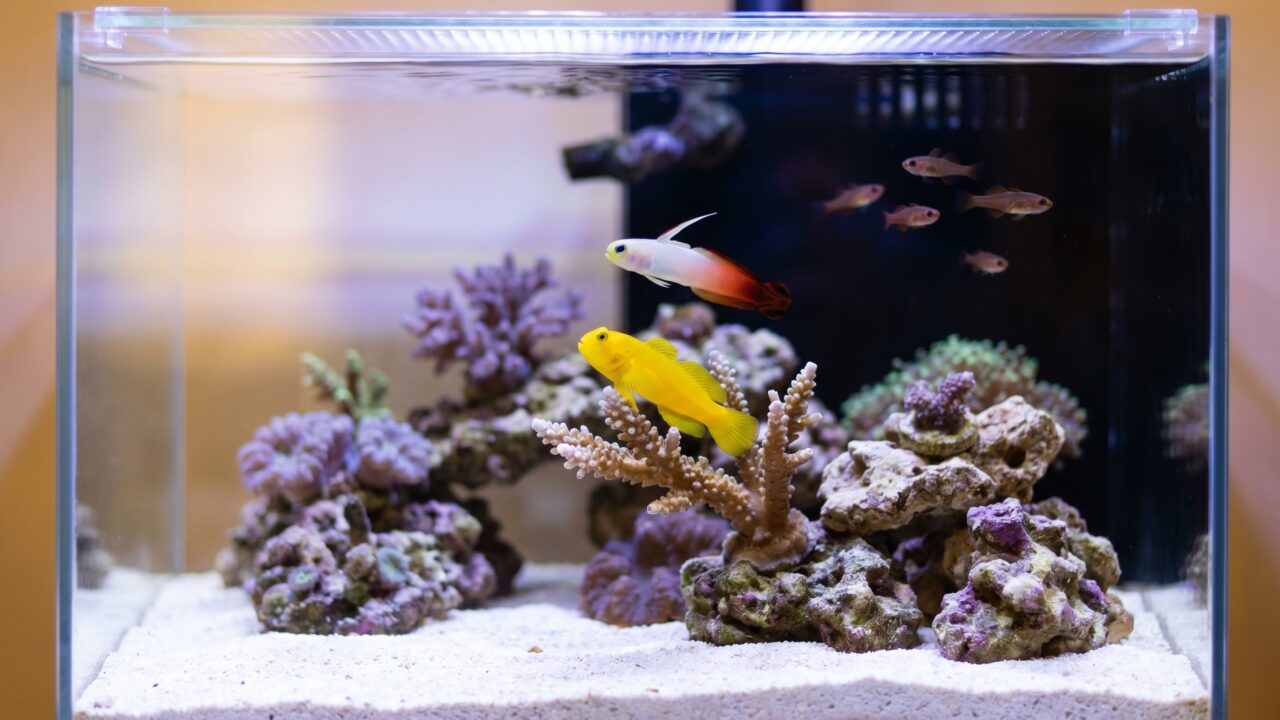
Five or ten gallons of saltwater can hold a genuinely beautiful reef - but only if the fish list is ruthlessly short. The problem is not size alone. Most species sold as "nano-compatible" still need 30, 40, or 75 gallons of water to swim territory they are wired to patrol. The fish that actually belong in a small system share two traits: a maximum adult length under about 3 inches, and a lifestyle built around perching or hovering rather than open-water sprinting. This guide covers six species that meet both criteria, explains what each one truly needs to settle in, and gives you a plain stocking count for three common nano sizes so you can plan before you buy.
If you are still choosing your tank or building your first setup, our nano reef build guide covers the hardware side in detail.
Why nano fish selection is a different problem
A small volume amplifies every mistake. Ammonia from one average-sized fish can spike a 10-gallon tank to dangerous levels within a day; the same waste in a 75-gallon system barely registers. That math makes bioload the central concern, not just physical size.
Swimming territory is the second constraint. A firefish or clownfish is physically small, but it holds and patrols a territory. Compress that into five gallons with a second assertive fish and you get chronic stress, suppressed immune function, and eventually a dead fish. The species below were selected partly because their territory demands are modest relative to their body size.
The general rule for nano stocking is one inch of fish per five gallons of actual water volume (not total tank volume, since rock, sand, and equipment displace a significant portion). That rule is a floor, not a ceiling. Our detailed stocking guide explains why bioload math beats inch-per-gallon counting for reef systems.
The six best nano reef fish
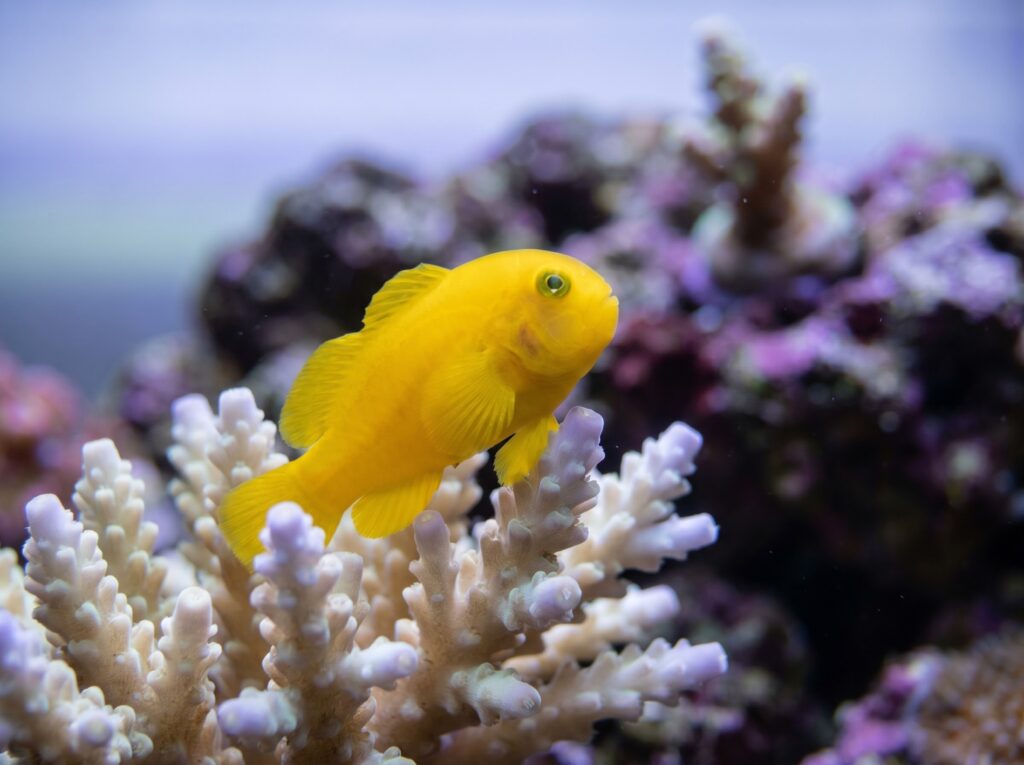
Clown goby (Gobiodon species)
Yellow clown gobies (Gobiodon okinawae) and green clown gobies (G. histrio) top almost every credible nano list, and for good reason. Both max out at 3.5 cm (1.4 in) as adults, and most aquarium specimens settle at around 2 cm. They are not swimmers at all - they perch in Acropora branches or tuck into rock crevices and stay there, which means their bioload footprint is tiny even in five gallons. The Gobiodon genus as a whole is characterized by this branch-perching lifestyle rather than the burrow-digging behavior common to other gobies.
One honest caveat: clown gobies can nip the polyps from Acropora branches, and spawning pairs will clear a small patch of coral to lay eggs on. In a mature colony this damage is negligible and the tissue grows back. In a tank with small, fragile SPS frags, it is a real risk. If your nano is coral-focused with young SPS colonies, stick to rubble rock and bare areas and watch the fish closely.
A single clown goby works well in five gallons. A pair needs at least ten gallons with enough rock complexity to give each individual a separate perch zone. Clown gobies are territorial toward their own species - two yellows in a small tank will fight unless they pair up.
Trimma and Eviota gobies
These two genera are the smallest coral reef fish available in the hobby. Trimma species average 2 cm (0.8 in), with some species reaching only 1 cm. Eviota species are similar - the red neon eviota (E. nigriventris) stays under 0.8 in. In the wild, trimma gobies congregate in loose schools near reef drop-offs, orienting vertically along walls and picking zooplankton from the current. In the aquarium they behave similarly: low flow areas suit them best, and they are most active and visible when kept in small groups of three to five.
These fish are entirely reef safe - they will not harm corals, sessile invertebrates, or even small ornamental shrimp. Captive-bred specimens from Biota and similar aquaculture operations eat prepared pellet and frozen foods readily from day one, which matters in a nano where missed feedings degrade water quality faster than in larger systems.
One biological fact worth knowing before you buy: Eviota species have among the shortest lifespans of any vertebrate. Research published in Current Biology documented that some species complete their entire adult life in weeks. What this means in the aquarium is that even a healthy, well-fed specimen may only survive one to two years at best - plan for eventual replacement rather than treating this as a long-term resident.
A group of four to five trimma or eviota gobies fits a ten-gallon system without meaningful bioload. They are genuinely pico-reef capable.
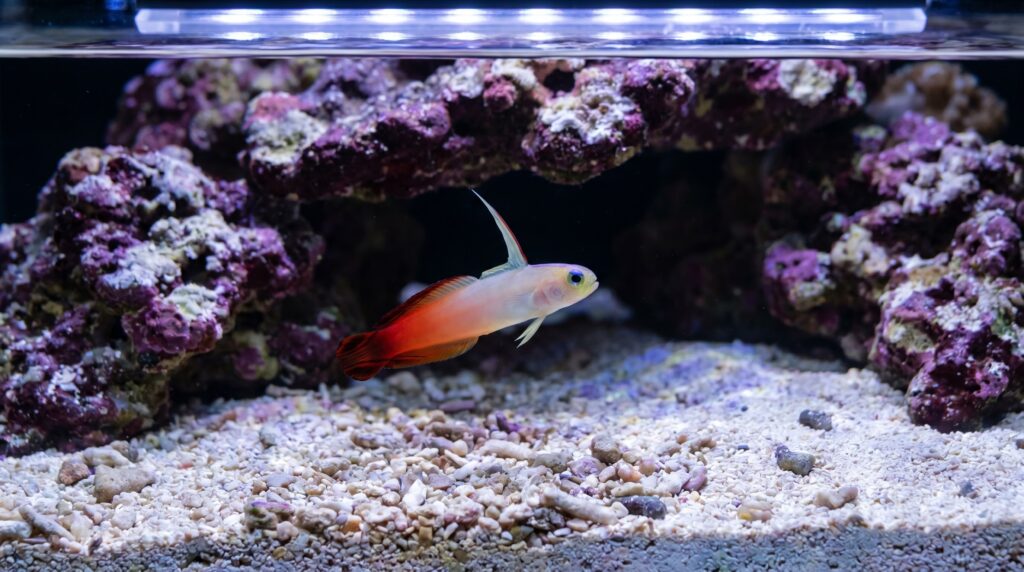
Firefish goby (Nemateleotris magnifica)
The firefish reaches a maximum of 9 cm (3.5 in) TL according to FishBase, though most aquarium specimens are closer to 2.5-3 inches. In the wild it hovers just above sandy rubble at depths of 6-28 m, facing into the current and picking zooplankton from the water column, always above a bolt-hole it can dart into the instant anything alarming moves nearby. That retreat behavior shapes everything about keeping one.
Every keeper of this species eventually learns the same lesson: a stressed firefish will jump. One startling tankmate, a sudden light change, or a gap in the lid, and it is gone. A tight-fitting mesh cover is non-negotiable. Tropical Fish Hobbyist recommends a minimum 20-gallon tank with a sand-and-rubble substrate several inches deep; Coralife's care guide lists 10 gallons as a workable single-fish minimum. In practice a quiet ten-gallon with plenty of rock overhangs and a patch of sand deep enough to dig into can keep one firefish stable, but the fish has less margin for error in that smaller volume. It is not an active swimmer that needs laps - it hovers in one spot for long stretches, which is what makes the smaller footprint possible at all.
Keep one, not two, unless you have a confirmed mated pair. Coralife's care guide notes that keeping more than one firefish requires 75 gallons or more. A single specimen in ten gallons with a good cover is a much more reliable outcome than attempting a pair in a smaller system.
Royal gramma (Gramma loreto)
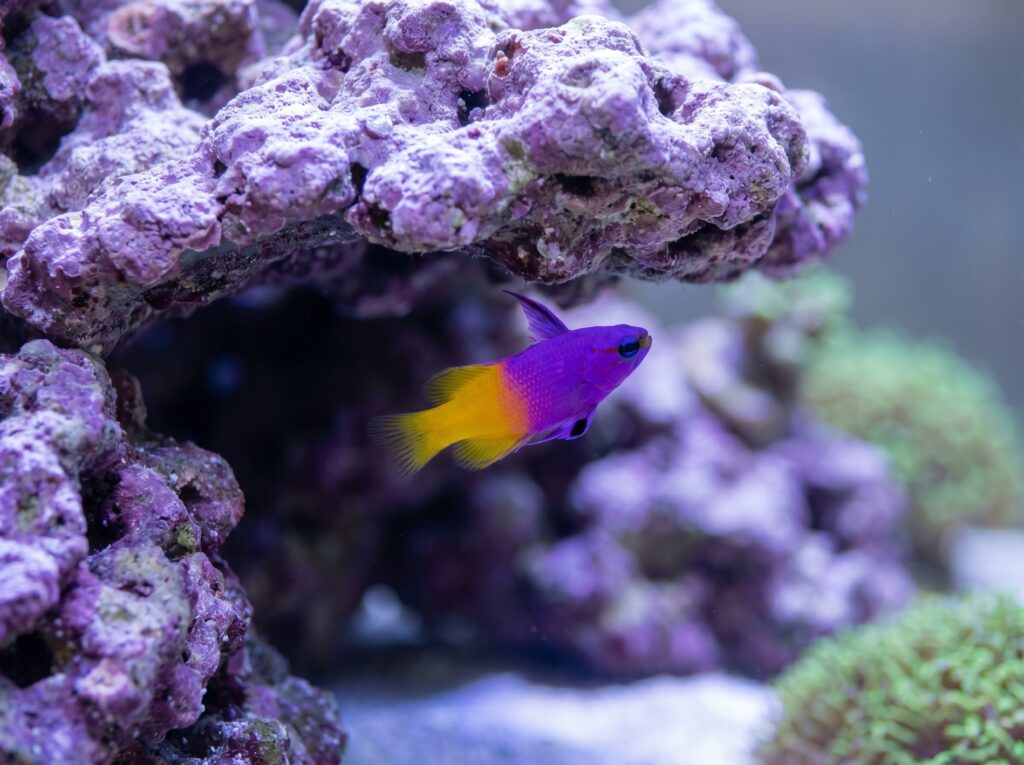
The royal gramma reaches 8 cm (3.1 in) at the scientifically recorded maximum, making it the largest fish on this list. It earns its place because its lifestyle is intensely cave-oriented: it spends most of its time tucked into a crevice, swimming upside down under ledges (this is normal behavior, not illness), and dashing out to snatch zooplankton or perform brief parasite-cleaning runs. Its territory is a single cave plus a small surrounding zone, not the whole tank perimeter.
The gramma's reef safety is excellent - it leaves corals, shrimp, and most invertebrates alone. The territorial issue is intraspecific: two royal grammas in the same tank will fight unless the tank is very large. In a nano, keep exactly one. The standard recommendation is 30 gallons minimum (Coralife's care guide), and that is the safe call. Some experienced keepers do maintain a single specimen in a heavily aquascaped 15-gallon with substantial cave structure and no competing cave-dwellers, but this is the upper edge of what the species tolerates, not a comfortable fit.
Do not add a royal gramma to a five or ten-gallon system. The combination of its size, its territory footprint, and the bioload it adds is too much for those volumes to absorb reliably.
Ocellaris clownfish (Amphiprion ocellaris)
Clownfish reach up to 10 cm (about 4 in) maximum - females grow larger than males and can approach that ceiling, while males typically stay smaller. Captive-bred specimens, which you should always choose over wild-caught, typically range from about 2.5 in (males) to 3.5-4 in (dominant females). They are protandrous hermaphrodites: all fish start as males, and the dominant individual converts to female when conditions call for it. A pair in a small tank forms a stable hierarchy very quickly.
The clownfish does not require an anemone in captivity and will live a completely healthy life without one. An anemone adds feeding complexity, allelopathic chemicals, and sweeper tentacle risk to a small tank - for most nano builds, skip it. The fish will host in a euphyllia coral, a toadstool, or simply patrol a section of rock as its territory.
One clownfish works in a ten-gallon system. A pair is fine in fifteen gallons. Do not add a third - clownfish establish a strict dominance pair, and a third individual in a small tank gets systematically bullied until it dies. Their territorial aggression toward conspecifics is well-documented even in captive populations.
For species comparisons and compatibility with other beginner choices, our beginner reef fish guide covers a wider range of options beyond nano-only species.
Stocking counts for 5, 10, and 15-gallon nano reef systems
The table below is the practical planning tool for this size range. It assumes a fully cycled tank, a mature clean-up crew, consistent water changes, and no other heavy bioload (large shrimp pairs, for example, add meaningful waste). Fish marked with an asterisk carry a note below the table.
| Tank size | Recommended fish count | Best choices | Off the list |
|---|---|---|---|
| 5 gallons | 1 fish maximum | Single clown goby; single trimma or eviota (or a group of 3-4 eviota only) | Firefish, clownfish, royal gramma |
| 10 gallons | 2 fish, or 1 fish + eviota/trimma group | Single firefish*; single clownfish; pair of clown gobies; group of 4-5 trimma/eviota | Royal gramma, clownfish pair |
| 15 gallons | 2-3 fish (depends on species mix) | Single clownfish + single clown goby; single royal gramma*; firefish + eviota group; clownfish pair (no other fish) | Clownfish pair + royal gramma (too much intraspecific tension), two firefish |
*Firefish at 10 gallons: workable for a single fish with a sandy substrate patch, plenty of rock bolt-holes, and a tight lid. The fish's darting nature means it needs unobstructed low-current zones, so avoid placing it with active mid-water swimmers.
*Royal gramma at 15 gallons: the standard recommendation is 30 gallons minimum. A single specimen in 15 gallons with significant cave aquascaping is at the edge of what experienced keepers report working - one specimen only, no other cave-territory fish, and tight water quality discipline.
These counts assume no other substantial bioload. If your 10-gallon runs a large cleaner shrimp pair plus a peppermint shrimp colony plus a healthy clean-up crew, shift the fish count down by one. Water change discipline matters more in nano than in any other reef format - weekly 10-15% changes are standard practice for tanks under 20 gallons. See our stocking density guide for the underlying logic.
Compatibility between species on this list
Most conflicts in a nano come from one fish type competing with another for the same resource. Here is where each species actually lives and eats:
- Clown goby: perches on coral or rock; feeds on small benthic invertebrates and zooplankton. Compatible with firefish (different zones) and clownfish (if clownfish does not bully it, which occasionally happens). Aggressive toward other clown gobies unless paired.
- Trimma/Eviota: hovers in low-flow zones; feeds on zooplankton and copepods. Peaceful with everything. The best "second fish" for any 10-gallon that already has a clown goby or a single clownfish.
- Firefish: hovers mid-water above sandy substrate; retreats to burrow. Compatible with clown gobies (different niche), but not reliably compatible with a second assertive fish in ten gallons.
- Royal gramma: cave-dwelling; periodic aggression toward anything that enters its rock territory. In 15 gallons it tends to bully firefish (which also needs rock cover) and should not share the tank with another gramma or a similarly cave-oriented species.
- Clownfish: territory-oriented around one point; in nano tanks can turn aggressive toward small passive fish that wander too close. Clown gobies perched in coral are usually ignored. Trimma/eviota hovering in open water away from the clownfish territory are generally fine.
What to skip, and why
Plenty of species sold as "nano-compatible" do not belong in true nano systems. Dottybacks are cavity-dwellers that stay small, but their aggression in under-20-gallon tanks is severe enough that most nano builds cannot absorb it. Assessors and basslets need 20-30 gallons minimum for behavioral reasons, not just size. Damsels are genuinely small but their territorial ferocity destroys community harmony in tight spaces. Banggai cardinalfish, popular and often suggested, reach 3 inches but need calm mid-water with minimal current stress, and can be stressed or intimidated by assertive nano species in tight quarters - and unrelated adult males are intensely aggressive toward each other, making a lone specimen or an established pair the only reliable stocking approach.
For a broader look at which reef fish work across all beginner tank sizes, our reef-safe fish overview includes options well beyond nano-only species.
Frequently asked questions
Can I keep a clownfish in a 5-gallon reef?
A single clownfish is physically capable of surviving in five gallons, but the tank is so small that water quality becomes difficult to maintain with any fish that size. Most practitioners consider ten gallons the floor for a clownfish. A five-gallon is better suited to a single clown goby or a group of eviota gobies with lower bioload impact.
Do nano reef fish need a lid?
Firefish jump under stress with almost no warning, making a tight-fitting mesh cover genuinely necessary. Clown gobies, trimma, and eviota rarely jump but can. Royal grammas and clownfish are the least likely to jump but will if badly startled. A lid is the right call for any nano reef housing the species on this list.
Can a royal gramma go in a 10-gallon tank?
No - it is too much fish for ten gallons. The standard minimum recommendation is 30 gallons, and that is the right answer for most people. Some experienced keepers have maintained a single specimen in a heavily caved-out 15-gallon, but that is working at the edge of the fish's tolerance, not within it. A ten-gallon will produce chronic low-grade stress that shortens the gramma's life.
How many eviota gobies can I keep together?
Eviota are social fish that do better in small groups than alone. Three to five individuals work well in ten gallons. They do not form strict pair bonds like clownfish, so you are not limited to pairs. The main constraint is bioload: five eviota produce less waste than a single clownfish, so they are an unusually forgiving group for small tanks.