Reef tank troubleshooting: identify and fix every common problem
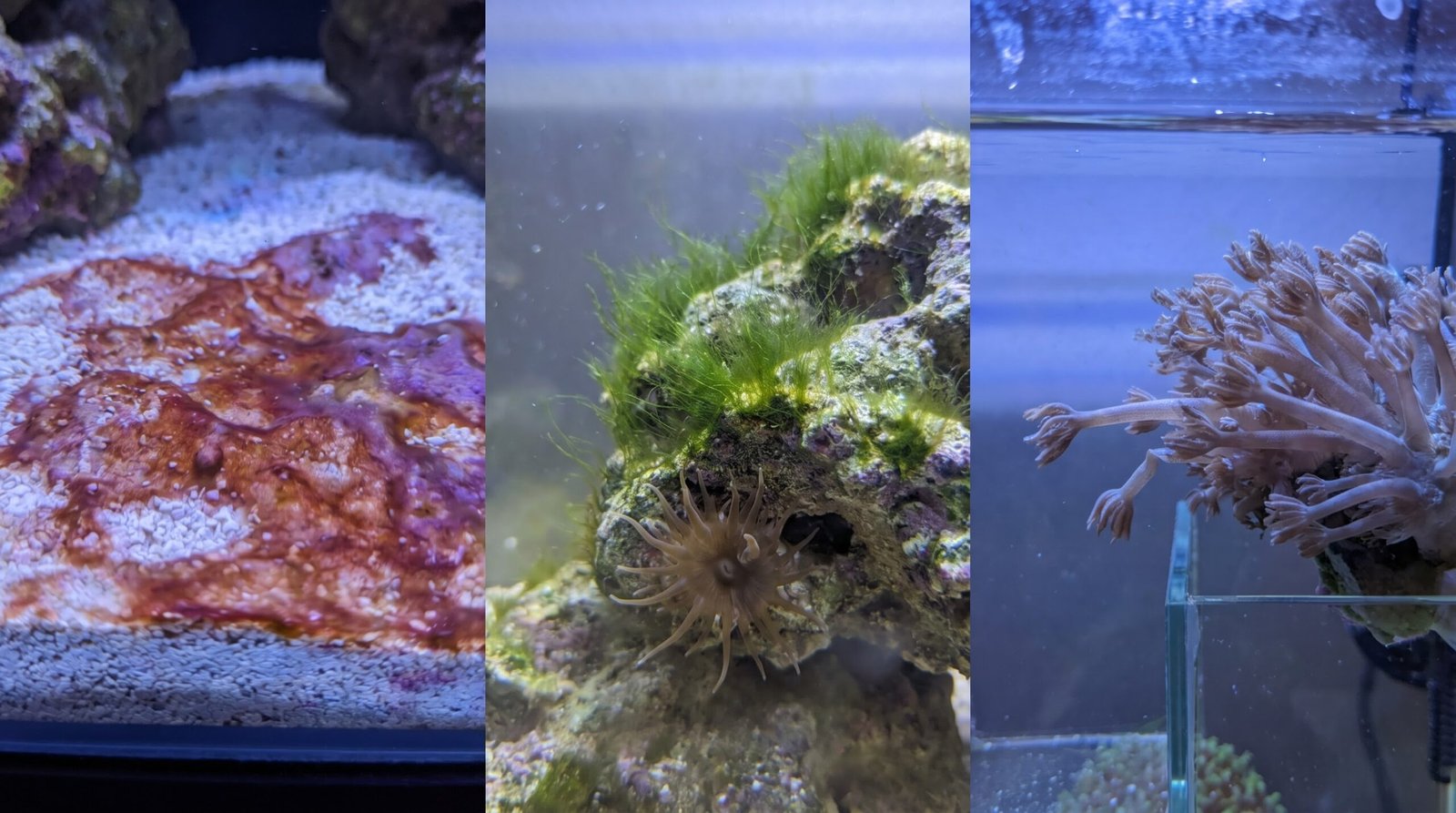
Something looks wrong in the tank. The water has gone green, a rust-colored film is spreading across the sand, your torch coral won’t open, or there’s a rotten-egg smell drifting across the room. Every one of those symptoms has a specific, diagnosable cause – and most of them are fixable with a water test and one targeted action.
Find your symptom in the table below, read the likely cause, then follow the link to the full guide for that problem.
Quick-reference symptom table
The table covers the most common visual and sensory symptoms in a reef tank. Where a symptom has more than one likely cause, the causes are listed by frequency – the one you’ll encounter first in most setups appears at the top.
| What you see or smell | Most likely cause | Second possibility | Immediate check | Full guide |
|---|---|---|---|---|
| White or gray cloudy water | Bacterial bloom (new tank or after large change) | Calcium/alkalinity precipitation after dosing | Ammonia, nitrite, alkalinity, Ca | Why is my reef tank cloudy |
| Green cloudy water | Free-floating algae bloom (high phosphate + high light) | Overfeeding, poor skimming | Phosphate, nitrate | Why is my reef tank cloudy |
| Milky white haze after dosing | Mineral precipitation (Ca/Alk imbalance) | Overdose of two-part or kalkwasser | Alkalinity, calcium, pH | Water parameters |
| Brown powder on sand and rock (new tank) | Diatoms – silicate bloom | Residual silicates in new substrate or low-quality RODI | Silicate (TDS of RODI water, target 0) | Diatoms in a reef tank |
| Red, rust, or purple slimy sheet on sand/rock | Cyanobacteria (red slime algae) | Low flow + warm temperature + elevated nutrients | Nitrate, phosphate, flow rate | Cyanobacteria in a reef tank |
| Brown or dark-green slimy film with air bubbles, hard to remove | Dinoflagellates | Often triggered by near-zero nutrients (over-clean tank) | Nitrate (target 1-5 ppm), phosphate (target 0.03-0.10 ppm) | Dinoflagellates in a reef tank |
| Green filamentous strands growing on rock and sand | Green hair algae – excess nitrate and phosphate | Overfeeding, insufficient nutrient export | Nitrate, phosphate, skimmer output | How to get rid of hair algae |
| Transparent or dark green spheres on rock | Bubble algae (Valonia) | Introduced on live rock or coral frags | Inspect new frags before adding | Bubble algae in a reef tank |
| Pink or purple crust spreading across glass and rock | Coralline algae – this is good news | – | Confirm Ca 400-450 ppm, Alk 8-11 dKH | Coralline algae guide |
| Corals closed, shrunken, or withdrawn | Water parameter stress (pH, temp, salinity, Alk spike) | Pest damage, shipping stress, low flow, or wrong light | Full parameter test – pH, temp, Alk, Ca, Mg, salinity | Why are my corals not opening |
| White salt-like spots on fish | Marine ich (Cryptocaryon irritans) | Velvet (Amyloodinium) – more rapid and gill-focused | Isolate fish – do NOT add copper to reef | How to treat ich in a reef tank |
| Small translucent palm-tree-shaped anemones on rock | Aiptasia (glass anemone) infestation | Majano anemone (rounder, more colorful) | Identify before treating – Berghia only eats Aiptasia | Aiptasia removal |
| Flat reddish-brown worm-like shapes on coral | Flatworms (Convolutriloba retrogemma) | Other benign flatworm species | 2 mm, reddish, rapid spread | Flatworms in a reef tank |
| Thick pink or white bristled worms in substrate | Bristle worms – often harmless scavengers | Fireworms (larger, thicker bristles, aggressive) | Size and bristle thickness: over 3 inches warrants removal | Bristle worms in a reef tank |
| Oily film on the water surface | Protein buildup from poor surface agitation or skimmer issue | Chemicals from hands, cleaners, or new equipment | Check return pump flow, skimmer neck | Why is my reef tank cloudy |
| Rotten-egg smell | Hydrogen sulfide from anaerobic bacteria in deep sand or dead spots | Decaying organics trapped under rock | Locate dead flow spots; check sandbed depth | Water parameters and flow |
| General foul or ammonia-like smell | Dead organism decomposing (fish, snail, coral) | Overstocked tank with poor skimming | Search and remove dead livestock; test ammonia | Reef tank pests checklist |
How to read the table and use the linked guides
Each row points you from symptom to cause to a specific diagnostic action you can take right now. If the immediate check comes back clean, move to the second possibility in column three. Some symptoms share the same underlying cause – green cloudiness, hair algae, and cyanobacteria all trace back to excess nutrients, so fixing one often improves the others.
The linked guides carry the full treatment protocols. Keep this page bookmarked – it is designed to scan in under a minute when something looks wrong at 11 pm and you need a fast answer.
The two most misdiagnosed problems
Dinoflagellates versus cyanobacteria
These two are mixed up constantly, and treating them with the same method often makes one of them worse. Cyanobacteria is a bacterial mat – slippery, often red or rusty, peels off in sheets, and thrives when nutrients are high and flow is low. Dinoflagellates are a brown, stringy slime that traps air bubbles, stays put after a blast of flow, and – crucially – tends to appear when nitrate and phosphate have been pushed too close to zero. Raising nutrients slightly often breaks a dino bloom; raising them for cyano makes the problem worse. Check diatoms in a reef tank for a comparison of all three brown-looking problems and how to tell them apart.
Corals not opening: parameter problem versus pest
Most keepers blame pests first. Most of the time it is a water parameter. Corals are sensitive enough that a single large water change with mismatched alkalinity can cause a full tank to close for 24-48 hours. Run a complete test before assuming something is eating your corals. Only when parameters are solid should you start checking for flatworms, Aiptasia, or other visible pests. The full diagnostic is at why are my corals not opening.
The five checks that solve 80% of problems
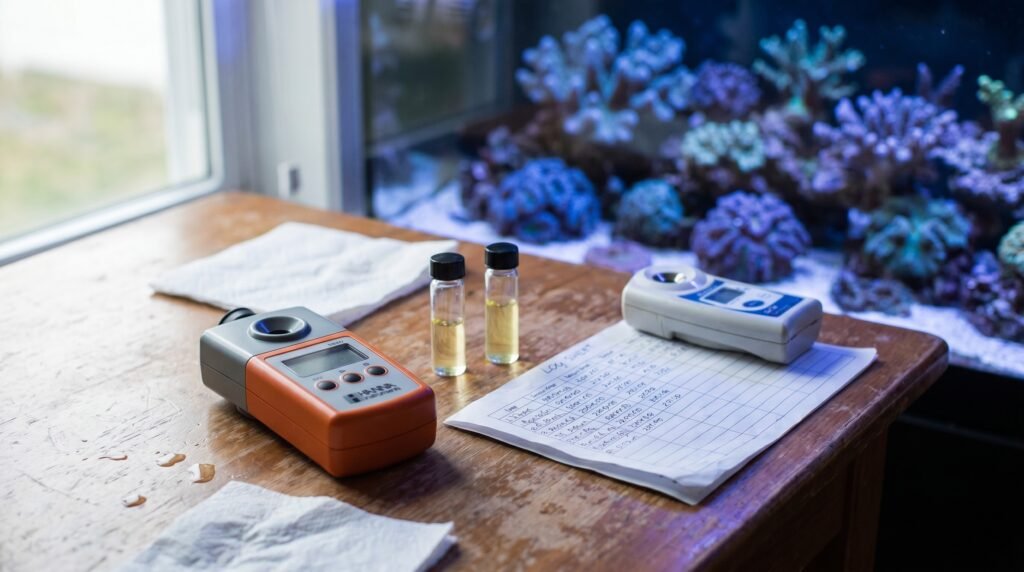
Most reef tank problems come back to a short list of root causes. If something looks wrong and you are not sure where to start, run these five checks in order before doing anything else.
- Salinity: 1.025 SG / 35 ppt. Drift in either direction stresses every organism in the tank. Use a refractometer, not a swing-needle hydrometer. More detail at reef tank salinity.
- Alkalinity and calcium: Alkalinity 8-11 dKH, calcium 400-450 ppm. Low alkalinity causes bleaching and tissue necrosis in SPS corals. A sudden spike – from overdosing or a malfunctioning dosing pump – can burn SPS tips and cause LPS tissue recession. More at reef tank alkalinity and calcium in a reef tank.
- Nitrate and phosphate: Nitrate 1-10 ppm (not zero), phosphate 0.03-0.10 ppm (not zero). Nutrients at zero starve corals and can trigger dinoflagellate blooms. High nutrients drive hair algae and cyanobacteria. Both extremes cause problems. See nitrates in a reef tank and phosphates in a reef tank.
- Temperature: 76-78F, stable. Even small daily swings cause stress – ATI notes that fluctuations of a degree or two are enough to affect corals. A heater failure in either direction can crash a reef quickly. Details at reef tank temperature.
- Flow: Dead spots in the tank – areas where water barely moves – are where cyano, detritus, and hydrogen sulfide problems start. Walk around the tank and look for surfaces the flow never reaches.
Algae types: a field guide for quick identification
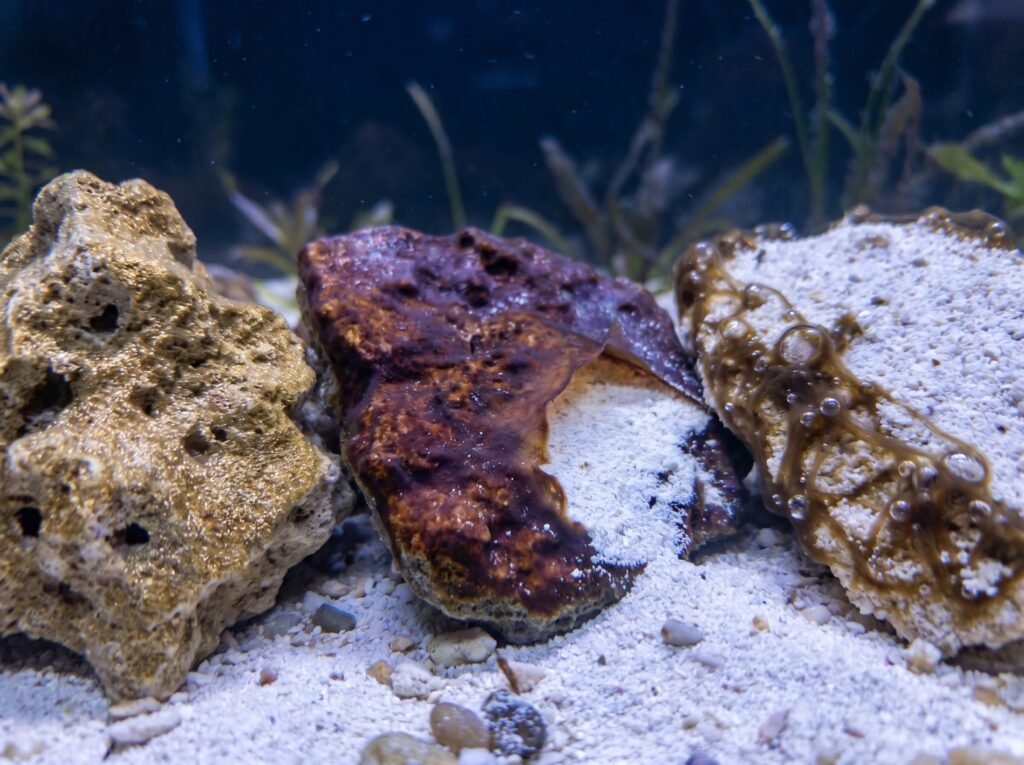
Algae is the most common category of problem in reef keeping, and the different types look similar enough to confuse. Here is a condensed visual key. The full species breakdown with photos is at reef tank algae types.
| Algae type | Color and texture | Where it grows | Key trigger | Resolves on its own? |
|---|---|---|---|---|
| Diatoms | Brown/golden, dusty, soft | Sand, glass, rock – everywhere in new tanks | Silicates in new substrate or poor RODI | Yes, usually within 2-8 weeks |
| Cyanobacteria (cyano) | Red, rust, purple, or dark green; slimy, peels in sheets | Substrate, low-flow areas, rock surfaces | Low flow + elevated nitrate/phosphate | No – needs intervention |
| Dinoflagellates (dinos) | Brown/dark, stringy, slimy, traps air bubbles | Sand, rock, coral surfaces | Near-zero nutrients; new or over-stripped tanks | Rarely without action |
| Green hair algae | Bright green, filamentous, thread-like | Rock, sand, any hard surface | High nitrate and phosphate | No – needs nutrient control |
| Bubble algae (Valonia) | Shiny green spheres, pea- to grape-sized | Rock, frag plugs | Introduced on live rock or frags | No – spreads if popped |
| Coralline algae | Pink, purple, or red encrusting crust | Glass, rock, powerheads | Good Ca/Alk/Mg – it is a sign of a healthy tank | N/A – this is beneficial |
Pests: what to look for and when to act
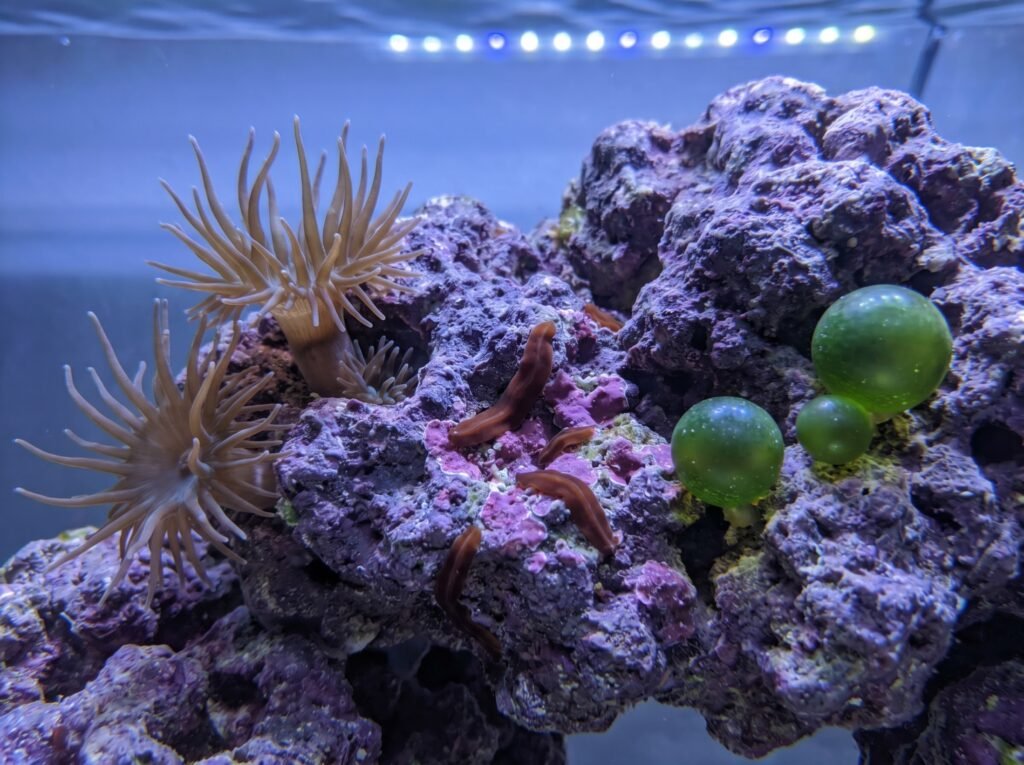
Most reef hitchhikers are harmless or actively useful. Bristle worms, copepods, and many small crustaceans clean the tank. The ones that cause real damage are a short list.
Aiptasia looks like a small palm tree – a column with a crown of slender, translucent tentacles. It stings corals and spreads fast via fragmentation or gametes released into the water column. One or two can become dozens in a few weeks if you ignore them. The fastest biological fix is Berghia nudibranchs, which eat only Aiptasia. Peppermint shrimp work on smaller specimens. Full protocol at aiptasia removal.
Red flatworms (Convolutriloba retrogemma) are about 2 mm long, flat, and reddish-brown. They multiply quickly and crowd coral surfaces, blocking light. The population signal to act on: if you see more than a handful on a single coral, the colony is growing. Six-line wrasses eat them. Chemical treatment options carry a risk because mass die-off releases toxins – do a large water change immediately if you use a flatworm product. More at flatworms in a reef tank.
Bristle worms are mostly scavengers and do useful work in the sandbed. The ones worth removing are fireworms: thick, bright-bristled, and more than 3-4 inches long. They can damage corals and irritate skin badly. Bristle worm traps work well. Details at bristle worms in a reef tank.
For a full pest checklist including less common hitchhikers, see reef tank pests checklist.
When the tank just smells wrong
A well-maintained reef should smell like the ocean – clean and faintly saline. Two specific smells signal a problem worth investigating immediately.
A rotten-egg or sulfur smell means hydrogen sulfide is escaping from an anaerobic zone – usually a deep sandbed area where water movement has stopped and oxygen has run out. Anaerobic bacteria produce hydrogen sulfide as they process organics without oxygen. The fix is improving flow to eliminate dead spots. Stir a small area of the sandbed gently during a water change to see whether gas releases; if it does, that spot needs more circulation.
A protein or ammonia smell usually means something has died and is decomposing. Check inside caves in the rock, under overhangs, and near the back corners of the sump. A dead fish hidden behind a rock can crash a tank fast. Remove the source, run a large water change, and test ammonia and nitrite.
An oily film sitting on the surface is a related signal. Poor surface agitation lets dissolved organics accumulate at the water line. The fix is usually pointing the return pump or wavemaker output so it breaks the surface gently. If the film returns within hours of wiping it away, check whether the protein skimmer is pulling wet rather than dry skimmate.
Frequently asked questions
My tank has been running for three years and suddenly has brown algae. What changed?
In an established tank, a sudden diatom bloom usually means silicates have crept back in – often through a new batch of salt mix, replacement substrate, or degraded RODI filters. Test your RODI output with a TDS meter; anything above 0 ppm means your filters need replacing. Alternatively, check whether nitrate and phosphate have risen, which can feed a secondary wave of growth.
Can I use copper medication to treat ich in a reef tank?
No. Copper is acutely toxic to every invertebrate in a reef – snails, shrimp, hermit crabs, corals, and anemones. Move infected fish to a bare-bottom quarantine tank for copper treatment and leave the display tank fish-free for at least 6-8 weeks to break the parasite lifecycle. More at how to treat ich in a reef tank.
Why do my corals close every evening?
Many soft corals and some SPS naturally retract polyps during the dark period. Most LPS, by contrast, extend their tentacles at night when they feed. Either way, occasional partial retraction with a regular daily pattern is normal behavior, not a symptom. The concern is corals that stay closed during daylight hours, close immediately after lights come on, or show tissue recession. Those signals point to parameter stress or pest damage rather than a natural light-cycle response.
I have zero nitrate and phosphate – is that good?
Zero nutrients sounds ideal but it is actually a risk. Corals and the bacteria that stabilize a reef both need trace nitrate (1-10 ppm) and phosphate (0.03-0.10 ppm). A tank stripped to zero on both is more vulnerable to dinoflagellate blooms and can show coral color loss. The goal is stable low nutrients, not zero nutrients. See nitrates in a reef tank and phosphates in a reef tank.
The SteadyReef team
We write calm, plain-English reef-keeping guides. Every claim is checked against the marine-science and manufacturer sources listed above before publishing.