The best beginner reef-safe fish: 10 picks that actually work in a starter tank
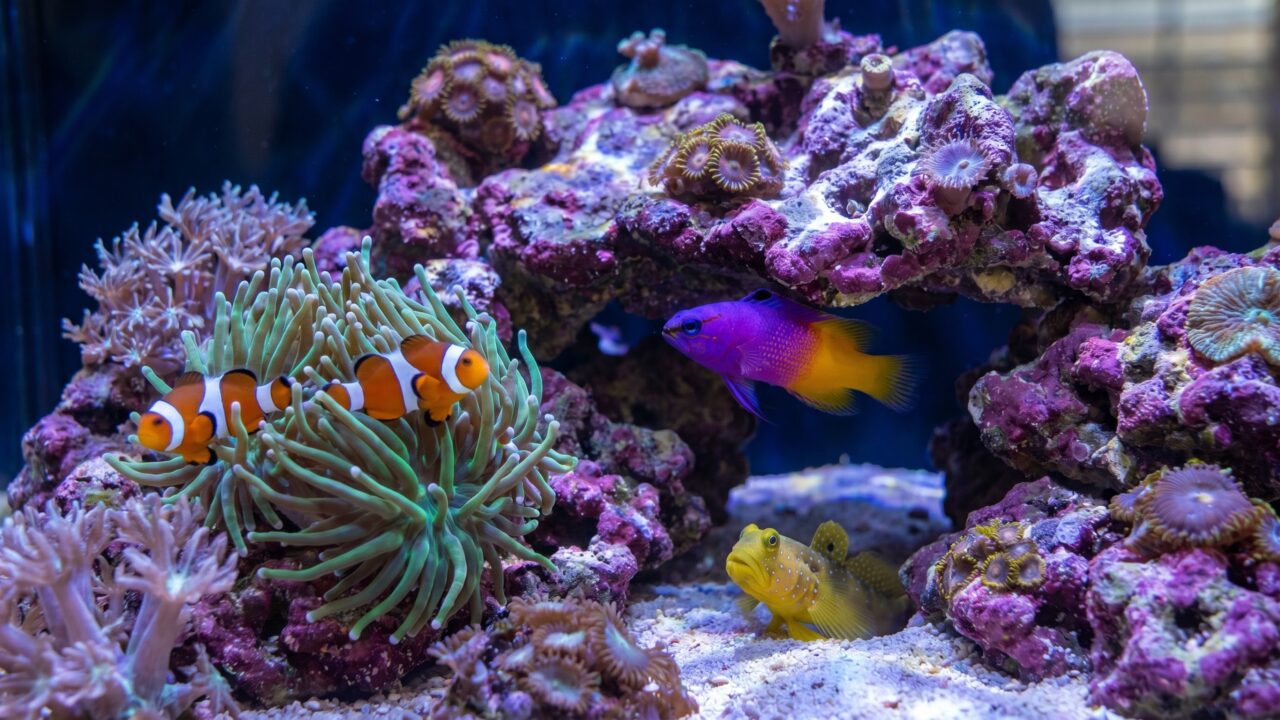
Pick the right fish first and your reef practically runs itself. Pick the wrong ones and you spend months chasing mysterious coral damage, stressed tankmates, and fish that vanish overnight. We reviewed public-aquarium husbandry pages, manufacturer care sheets, and marine science sources, then put together 10 species that consistently succeed for beginners - plus an honest list of fish to skip until you have a year or two of saltwater experience under your belt.
If you want the quick version: a pair of captive-bred ocellaris clownfish, a royal gramma, and a firefish will fill a 30-gallon reef with colour and personality without endangering a single coral or shrimp. The table further down compares all 10 picks side by side so you can plan your stocking list in one place.
What "reef safe" actually means - and why it matters
A fish is reef safe when it reliably ignores corals, clams, and the cleanup crew that keeps your tank healthy. Some species are reef safe with caveats - they might nip under specific conditions. A few are marketed as reef safe but will demolish your LPS corals within a week. Knowing the difference before you buy is the whole point of this guide.
Temperament matters just as much. A fish that terrorises its tankmates causes chronic stress, which suppresses immune function and makes everyone in the tank vulnerable to ich. Our fish section covers the broader compatibility picture, but for stocking a first reef, stick to species rated peaceful or shy - not "semi-aggressive" or "with caution."
One more thing worth saying up front: minimum tank size recommendations are real. They exist because active fish burn energy pacing a tank that is too small, and because territorial species need enough territory that disputes stay manageable. The numbers in this guide come from manufacturer care sheets and public aquarium data, not guesswork.
The 10 best fish for a beginner reef tank
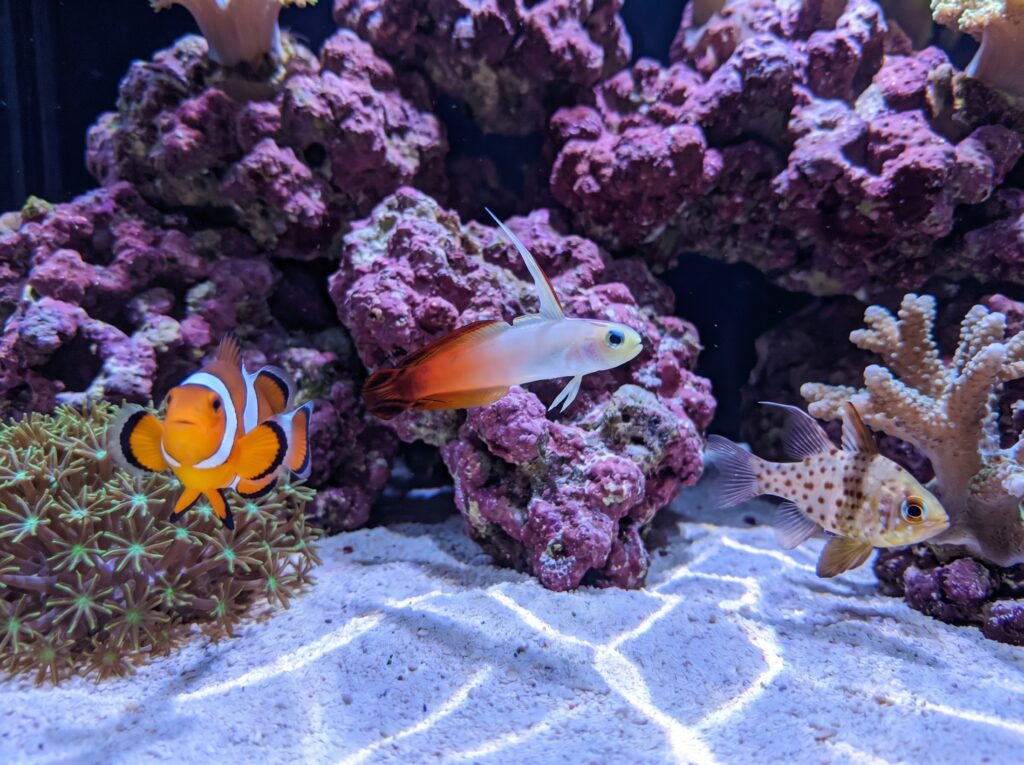
1. Ocellaris clownfish (Amphiprion ocellaris)
The default first fish recommendation for most reef keepers - and the reputation is earned. Coralife's care data lists the maximum size at 2-3 inches, with females slightly larger. Minimum tank size varies by source: Coralife cites 10 gallons for a single fish, while the Reeflings species profile puts it at 21 gallons (80 L). In practice a pair does best in 20-30 gallons, where they have room to establish territory without harassing everything else in the tank. Captive-bred specimens, which make up the majority of the trade today, are hardier than wild-caught fish and arrive already eating prepared foods. They are omnivores that accept nearly anything: flakes, pellets, frozen mysis, and brine shrimp.
The main gotcha: a pair will claim a territory - typically around an anemone if you have one, or around a favoured coral head if you don't - and they will chase anything that strays too close. That's normal behaviour, not aggression. A single pair in a 20-30 gallon tank rarely causes problems. Adding a second pair to a small system is asking for trouble. For a deep dive on keeping them long-term, see our guide to clownfish care in a reef tank.
2. Royal gramma (Gramma loreto)
The royal gramma is half purple, half yellow, and completely reef safe - it is one of the cleaner combinations in this hobby. Wikipedia, synthesising primary range data, places this species across the tropical western Atlantic from the Bahamas through Venezuela and the Antilles. Maximum size averages 8 cm (3.1 inches). Coralife's care sheet puts the minimum tank at 30 gallons.
In the wild, royal grammas are known to act as cleaner fish, removing ectoparasites from larger fish - a behaviour documented by Wikipedia and widely reported in the hobby literature. In a tank they accept frozen mysis, brine shrimp, and enriched flake foods with no fuss. They orient to the nearest surface, which means you will often spot them hovering upside-down under a ledge - that's normal, not a sign of illness.
Keep one per tank. Two royal grammas in anything smaller than a very large system will fight. They will also have words with similarly coloured fish (royal dottybacks in particular), so avoid combinations that look like competition to them.
3. Firefish goby (Nemateleotris magnifica)
Three inches of cream-to-orange-to-red gradient, constantly hovering above a burrow entrance and waving that elongated first dorsal ray. The firefish is peaceful, reef safe, and startlingly easy to feed - vitamin-enriched brine shrimp, frozen mysis, and small prepared foods all work well. Coralife lists the minimum tank at 10 gallons for a single fish.
Two non-negotiables: a secure lid and a burrow. Firefish are accomplished jumpers and a gap in the lid cover is a death sentence. They also need a crevice or cave to retreat to when startled. A firefish that cannot hide will spend all its time hidden anyway - or it will jump. Provide the hiding place and the fish becomes visible and confident within a few weeks of settling in.
Do not keep two firefish together unless they are a proven mated pair. Unpaired individuals fight, often until the subordinate fish stops eating and wastes away.
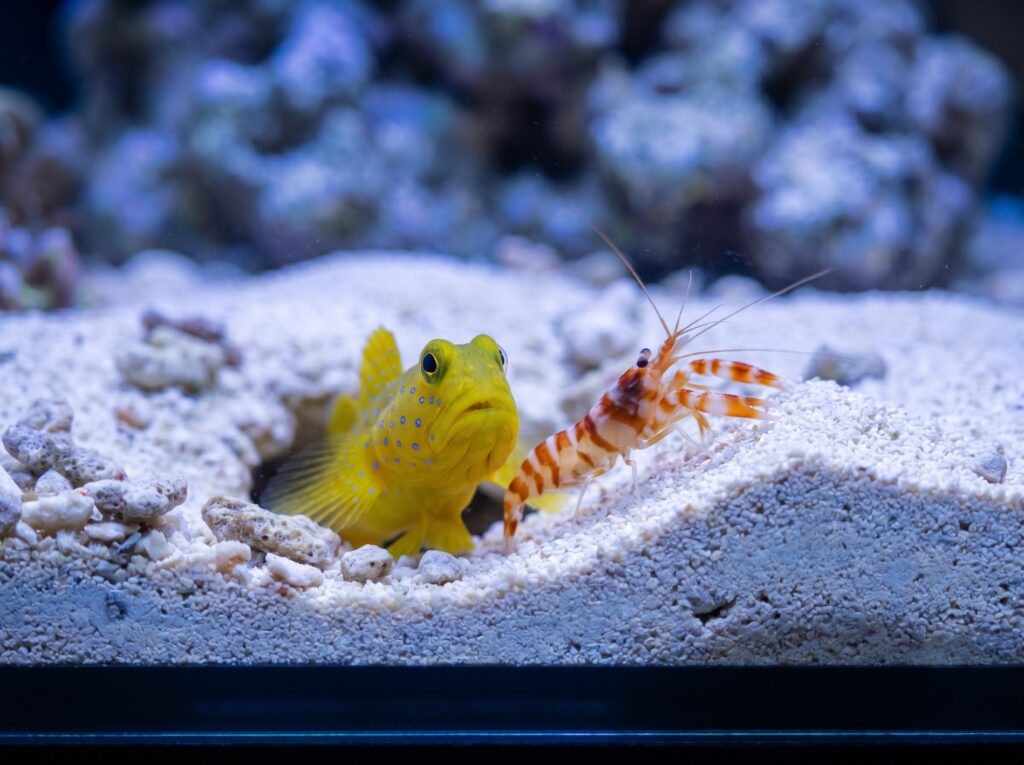
4. Yellow watchman goby (Cryptocentrus cinctus)
The yellow watchman goby sits at burrow entrances with an expression of permanent suspicion, ready to dart underground the instant anything looks threatening. Sources vary slightly on adult size - nippyfish.net records 3 inches (7 cm) and LiveAquaria lists 4 inches, so expect somewhere in the 3-4 inch range depending on the individual. It needs a minimum 30-gallon system with a sand bed deep enough for burrowing - at least 2-3 inches. Diet is straightforward: mysis shrimp, brine shrimp, and meaty prepared foods.
The best reason to add one: pairing it with a pistol shrimp (Alpheus bellulus is the classic choice). The nearly blind shrimp builds and maintains a burrow while the goby stands watch and signals danger - a genuinely mutualistic partnership that plays out visibly in the tank. It is one of the more reliably entertaining things you can add to a beginner reef.
Watch the lid here too. Watchman gobies are not chronic jumpers the way firefish are, but any startled goby can leap. They are also territorial toward other goby species that try to take over their patch of sand, so plan your stocking list accordingly.
5. Pajama cardinalfish (Sphaeramia nematoptera)
Spotted rear half, orange eyes, a broad dark midband, and a yellow head - the pajama cardinal does not look like something that would actually exist. Georgia Aquarium confirms the species naturally forms aggregations among coral branches; FishBase records a depth range of 1-14 meters in lagoons and sheltered reefs. Maximum size is around 3-3.5 inches. Coralife's care data puts the minimum tank at 20 gallons.
These are among the most peaceful fish in the trade. PetMD's cardinalfish guide describes the family as "relatively peaceful, showing little aggression toward their own or other species." Males are paternal mouthbrooders - they incubate the eggs, which means a mated pair in a stable tank will eventually attempt to breed on their own. They can be kept singly or in small groups; groups need a larger tank (55+ gallons) and more structure.
One caveat on the "reef safe" label: very small ornamental shrimp (tiny cleaner shrimp fry or micro shrimp species) may occasionally be taken. Standard-sized cleaner shrimp are fine.
6. Banggai cardinalfish (Pterapogon kauderni)
The Banggai cardinal is silver-white with bold black vertical stripes, elongated fin rays, and white spots - an unmistakeable look. FishBase lists it as endemic to the Banggai Archipelago, Indonesia, inhabiting shallow reefs under five meters. It is also an endangered species, so buy captive-bred stock only - this is not optional from a conservation standpoint, and captive-bred individuals are also significantly hardier.
In the aquarium the Banggai is peaceful, hardy, and reef safe. Like the pajama cardinal, males are mouthbrooders and pairs will breed in a well-run tank. Maximum size is around 3 inches. A 30-gallon system works for a single pair. Feed them frozen mysis, enriched brine shrimp, and small pellets. They are not demanding eaters.
Keep one pair or one individual per tank unless the system is large enough to establish clear separate territories. Two males in a small space will fight.
7. Neon goby (Elacatinus oceanops)
Two inches of black fish with an electric blue stripe running nose to tail. ORA (Oceans, Reefs and Aquariums), one of the largest marine aquaculture operations in the US, supplies neon gobies to public aquariums specifically for parasite control and confirms they are "easy to keep in aquariums, and are especially well suited to reef tanks." They reach about 2 inches and are completely reef safe with corals and invertebrates.
In the wild, neon gobies run cleaning stations where larger fish queue up to have parasites removed. In a home tank they retain that behaviour as a welcome bonus - they will cruise the bodies of your other fish and pick off external parasites, which complements (but does not replace) a proper quarantine routine. ORA data shows they spawn readily in captivity, laying 500-800 eggs every 10 days.
Keep a single specimen or a proven mated pair. Two unpaired individuals in a small tank will fight. They are also vulnerable to pistol shrimp and mantis shrimp, so check your live rock for stowaways before adding them.
8. Lawnmower blenny (Salarias fasciatus)
The lawnmower blenny is the reason your tank's diatom and hair algae problem can solve itself - eventually. Tropical Fish Hobbyist Magazine, citing feeding-rate research, describes this species as scraping roughly 3,000 bites of substrate per day - primarily detritus, biofilm, and filamentous algae. It grows to 4-5 inches and needs a minimum 55-gallon system with established algae growth so the fish always has enough to graze on.
This is the critical gotcha for beginners: a new tank does not have enough biofilm to sustain a lawnmower blenny. Add one too early and it starves. Wait until your tank has been running for at least three to four months and has visible algae growing on the rock and glass before adding one. Some individuals also refuse prepared foods entirely, so a mature tank with real algae is the insurance policy.
Keep only one per tank. They are territorial with conspecifics and with other blennies. Secure the lid - lawnmower blennies jump, and an open top is a risk once they are settled and active.
9. Bicolor blenny (Ecsenius bicolor)
The bicolor blenny splits neatly down its length - dark blue-black on the front half, orange on the rear - and perches on rockwork with alert, wide-set eyes. It reaches about 4 inches, needs a 30-gallon minimum, and grazes on algae and biofilm throughout the day. Diet should include frozen herbivore foods, Spirulina-enriched preparations, and whatever algae grows in the tank.
The important caveat: the bicolor blenny earns a "mostly reef safe" rating, with a conditional risk of nipping LPS corals and tridacnid clam mantles when underfed or overcrowded. This risk drops significantly with regular feeding and adequate swimming room. If your tank leans heavily toward LPS corals - especially large-polyp species like frogspawn or hammers - observe carefully in the first few weeks. A well-fed bicolor blenny in an appropriately sized tank is typically fine; a hungry one in a small tank is a liability. Keep the lid closed - bicolor blennies jump when startled.
10. Scissortail dartfish (Ptereleotris evides)
The scissortail hovers in the midwater column, pale blue-grey with a deeply forked tail whose dark upper and lower lobes really do look like scissor blades. AquariumDomain's species profile lists the maximum size at 5 inches and the minimum tank at 30 gallons. It is completely reef safe, peaceful toward all corals and invertebrates, and eats frozen meaty foods without fuss - mysis, enriched brine shrimp, and small chopped krill.
Juveniles naturally school. A mated pair in an adult tank is the standard approach. Like firefish and watchman gobies, they are prone to jumping when startled, so a tight lid is mandatory. They are also sensitive to aggressive tankmates - no damsels, dottybacks, or triggerfishes in the same system. In a calm, peaceful reef, a pair of scissortails adds elegant mid-level movement that contrasts nicely with bottom-dwelling gobies and rock-hugging grammas.
Beginner fish comparison table
| Fish | Max size | Min tank | Diet | Truly reef safe? | Lid required? | Key gotcha |
|---|---|---|---|---|---|---|
| Ocellaris clownfish | 3 in | 10 gal (20 gal for pair) | Omnivore; flake, pellet, frozen | Yes | Recommended | Territorial pair - one pair per small tank |
| Royal gramma | 3 in | 30 gal | Carnivore; frozen mysis, brine shrimp | Yes | Recommended | One per tank; fights own kind and look-alikes |
| Firefish goby | 3 in | 10-20 gal | Carnivore; mysis, brine shrimp | Yes | Mandatory | Jumps when stressed; needs burrow |
| Yellow watchman goby | 3-4 in | 30 gal | Carnivore; mysis, brine shrimp | Yes | Recommended | Territorial over sand patch; pairs well with pistol shrimp |
| Pajama cardinalfish | 3.5 in | 20 gal | Carnivore; frozen, pellet | Yes* | Recommended | *May take micro shrimp; avoid very small ornamental crustaceans |
| Banggai cardinalfish | 3 in | 30 gal | Carnivore; mysis, brine shrimp | Yes | Recommended | Endangered - captive-bred stock only |
| Neon goby | 2 in | 10-20 gal | Carnivore; tiny frozen, parasites | Yes | Not required | Vulnerable to pistol/mantis shrimp in live rock |
| Lawnmower blenny | 4-5 in | 55 gal | Herbivore; algae, biofilm, detritus | Yes (usually) | Mandatory | Needs mature tank with established algae; may starve in new or small tanks |
| Bicolor blenny | 4 in | 30 gal | Herbivore; algae, Spirulina foods | Mostly* | Mandatory | *May nip LPS/clam mantles if underfed |
| Scissortail dartfish | 5 in | 30 gal | Carnivore; mysis, brine shrimp, krill | Yes | Mandatory | Jumps when startled; needs calm tankmates |
How to build a stocking list from these picks
Most 30-gallon beginner reefs do well with three to five small fish total. A reasonable combination: a pair of ocellaris clowns, a royal gramma, and a firefish. That is three fish, each occupying a different zone of the tank (clowns in the middle water near their territory, the gramma patrolling rockwork, the firefish hovering near the sand), with no territorial overlaps. Add the watchman goby with its pistol shrimp partner if your tank has a proper sand bed and you want something interesting happening at the bottom.
For a fuller picture of how many fish a reef can actually support without crashing water quality, the guide to how many fish in a reef tank works through the numbers by tank size. And if you want to see the full spectrum of what is and is not reef compatible before you start buying, the reef-safe fish list covers dozens of species beyond this starter set.
One practical note on the order of addition: add fish from least aggressive to most aggressive, and let each fish settle for at least two to three weeks before adding the next. Clowns and cardinals first, grammas and gobies after. This gives each new arrival a chance to establish before the next one arrives.
Fish to skip for now: the honest skip-for-now list
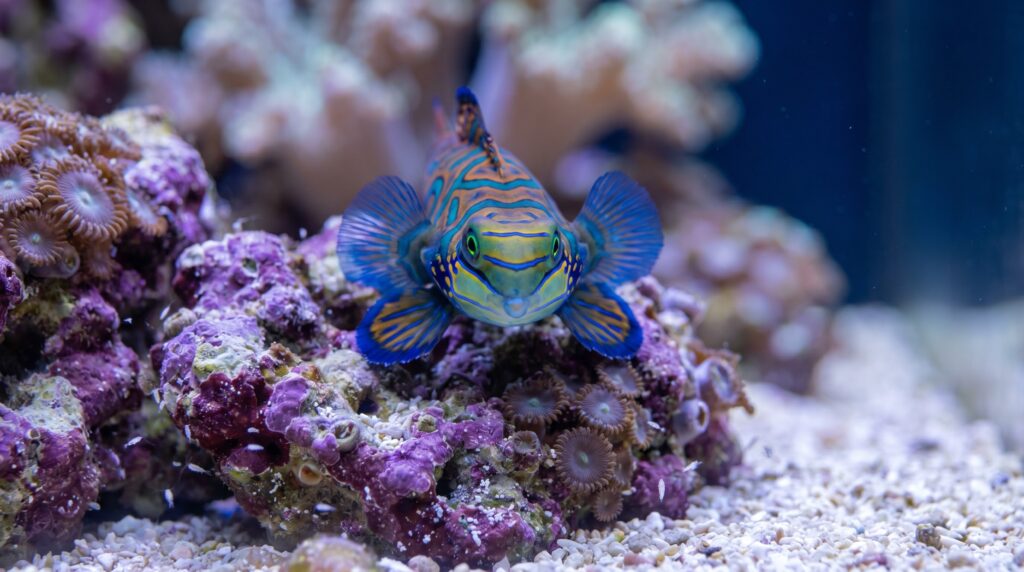
Some fish come up constantly in reef discussions but belong on a list you revisit once you have a mature system and a year or more of experience. Here is why each one is a mistake for a beginner reef.
| Fish | Why not yet | What you actually need first |
|---|---|---|
| Mandarin dragonet (Synchiropus splendidus) | Obligate live-copepod predator; rejects non-moving prey in the wild; starvation is the leading cause of death in captivity. Pod Your Reef documents the species' "strict dependence on live foods" and a unique jaw mechanism built only for live prey pursuit. Even captive-bred individuals trained to frozen foods need a dense, reproducing copepod population as the core of their diet. | A tank running 12+ months with a refugium and established copepod population; or a captive-bred specimen trained to frozen mysis before you buy it. |
| Anthias (Pseudanthias spp.) | On the reef, anthias feed continuously on plankton throughout the day. TFH Magazine states plainly: "They fail rapidly when not properly fed." Three to four feedings daily is not optional - it is the minimum. Most beginner schedules cannot sustain this, and the fish decline quickly in under-fed conditions. They also need 75+ gallon tanks with strong flow. | An established large system (75+ gal), an automated feeder or very consistent 3-4x daily feeding schedule, and ideally a refugium producing live zooplankton. |
| Tangs (Zebrasoma and Acanthurus spp.) | Most tang species require a minimum of 55-75 gallons of open swimming space - some considerably more. Cramped tangs develop head and lateral line erosion (HLLE), stress markings, and immune suppression. A yellow tang at 3 inches looks small at the fish store but swims constant laps: it needs a tank length of at least 4 feet to move naturally. Add one to a 30-gallon reef and you are watching a fish that cannot turn around comfortably. | A tank of at least 55-75 gallons (4+ feet long) running stably for several months, with established algae growth the tang can graze on between feedings. |
| Dwarf angelfish (Centropyge spp.) | Several Centropyge species are famously unpredictable with corals - the same individual may ignore SPS for months and then begin nipping LPS and clam mantles without warning. There is no reliable way to predict which individuals will behave and which will not. This is a risk profile that suits an experienced keeper who can respond quickly, not a beginner still learning the warning signs. | Experience reading fish behaviour, a quarantine tank to isolate an offender quickly, and a reef that does not contain expensive LPS or clams you cannot afford to lose. |
| Harlequin tuskfish and larger wrasses | Beautiful fish that eat your cleanup crew. Many larger wrasse species and the tuskfish prey actively on ornamental shrimp, small crabs, and snails - the exact animals that keep your reef from drowning in algae and detritus. Adding one to a starter reef means rebuilding your cleanup crew repeatedly. | A larger system where the cleanup crew can reproduce faster than it is eaten, and a clear plan for which invertebrates can coexist with the species in question. |
A few things worth getting right before you add any fish
Water parameters matter more than fish selection. A royal gramma in a tank with unstable alkalinity or a nitrate spike will not thrive no matter how hardy the species rating. Salinity should sit at 1.025 specific gravity, measured with a refractometer - swing-needle hydrometers drift badly and cannot be trusted. Temperature needs to hold steady around 76-78°F; swings of more than two degrees in a day stress fish. For the full parameter targets that apply to a fish-and-coral system, the water parameters guide has every number with the reasoning behind it.
Quarantine new arrivals before they go into the display tank. Even captive-bred fish can carry ich, and introducing an unquarantined fish to a stocked reef is how entire tanks are lost. A basic 10-gallon quarantine tank with a heater and sponge filter costs very little and prevents expensive disasters. Copper-based medications must never touch a reef display tank - they kill invertebrates and corals - so treating fish in a dedicated quarantine tank is the only safe option.
Finally, plan the sequence. The fish in this guide are all compatible with each other, but add them slowly, and add the more passive species first. Clownfish and cardinals before grammas and blennies. Let the tank settle between additions. Crowding even peaceful fish too quickly causes stress, and stressed fish get sick.
Frequently asked questions
Can I keep a clownfish without an anemone in a reef tank?
Yes. Ocellaris clownfish thrive without an anemone in captivity. They will often host in a hammer coral, torch coral, or simply choose a favourite corner of rock. Hosting behaviour requires an anemone only in the wild; in tanks, most clownfish adapt readily to coral or empty space.
How many beginner fish can I keep in a 30-gallon reef?
Three to four small fish is a reasonable target for a 30-gallon reef. A pair of ocellaris clowns, a royal gramma, and a firefish is a classic combination that works well. Adding a watchman goby as a fourth fish is fine if you have a sand bed. Beyond that, nutrient load rises faster than most beginner filtration can handle. See the full guide to how many fish in a reef tank for the detailed reasoning.
Are clownfish aggressive toward other fish?
A bonded pair will defend their chosen territory - the area around their hosting spot - by chasing fish that come too close. This is normal territorial behaviour, not pathological aggression. In a tank of 30+ gallons with enough rock structure that other fish have their own zones, it is rarely a problem. Cramming a second pair into a small tank with the first pair is where serious fighting starts.
What fish is best for a 10 or 15-gallon nano reef?
A single ocellaris clownfish, a firefish goby, or a neon goby are the strongest options for small tanks. Cardinalfish work too. Avoid anything with a minimum tank recommendation over 20 gallons, and be realistic about how few fish a nano system can support without water quality deteriorating. The best fish for a nano reef tank guide covers the nano-specific stocking question in full.