How to lower alkalinity in a reef tank without stressing your corals
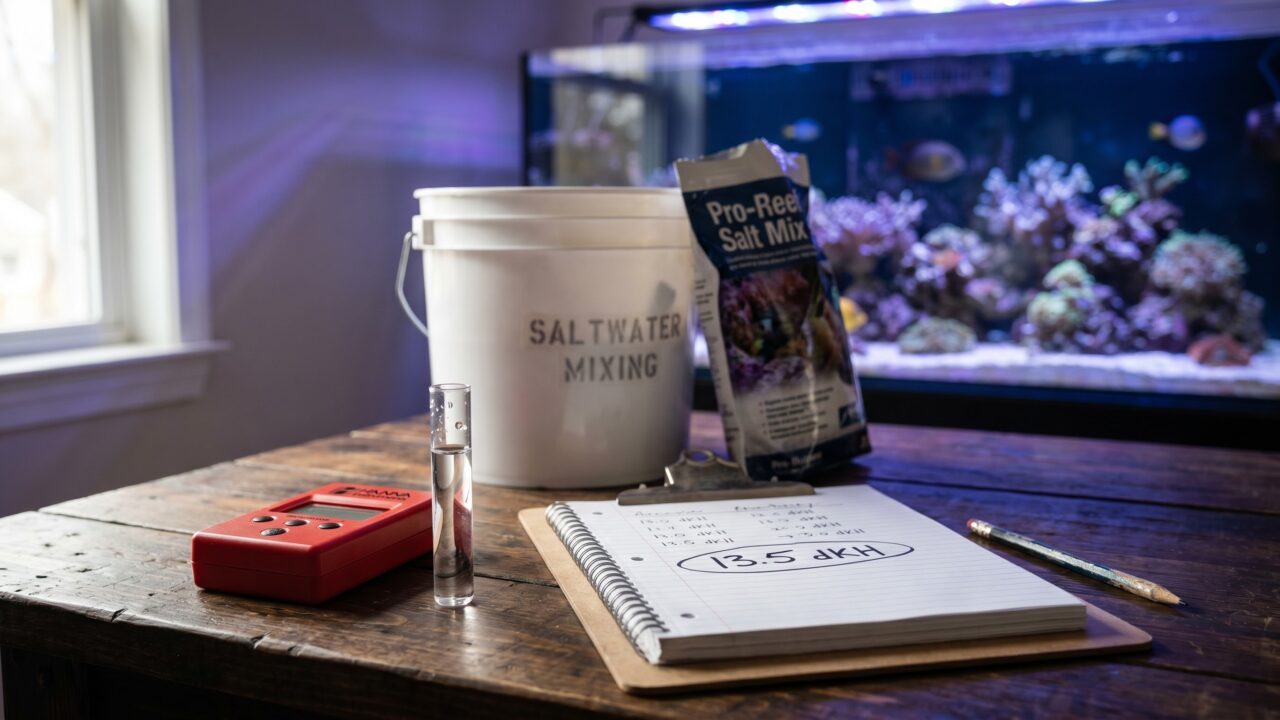
If your alkalinity is sitting above 11-12 dKH and climbing, the fix is almost always the same: stop whatever is adding alkalinity to the tank, confirm the reading with a second test, then pull it down gradually with water changes mixed using a salt that sits closer to natural seawater levels. The one thing you must not do is try to crash it fast - a sudden alkalinity drop is as stressful to corals as a sudden spike.
This guide walks through why alkalinity overshoots happen, how to bring it back into range safely, and a simple decision flow so you always know which step to take next. For background on what alkalinity does and why it matters in the first place, the reef tank alkalinity overview covers the chemistry in detail.
Why alkalinity goes too high in the first place
The vast majority of high-alkalinity cases trace back to one of two sources: overdosing a two-part supplement, or adding a sodium bicarbonate/carbonate buffer in response to a low reading that turned out to be a bad test result. Both are easy mistakes to make, especially when a new tank is still settling and chemistry swings unpredictably.
Kalkwasser (calcium hydroxide) can also push alkalinity up if dosed too aggressively through an auto top-off system - the drip rate that worked fine during summer evaporation may be too much during a cooler, lower-evaporation period.
Calcium reactors are less common culprits but worth mentioning: a reactor set with too-high a flow rate or too-low an effluent pH will push both calcium and alkalinity upward together. And occasionally the salt mix itself is the issue. Some salts ship with alkalinity in the 10-12 dKH range, so every water change slowly accumulates rather than dilutes.
One situation that catches people out is acting on a single anomalous test. Drip-titration kits and even digital colorimeters can produce false-high readings if the sample is taken from an area of poor flow, if the reagents are old, or if dosing happened within the last hour. Always test twice, from the same spot in a well-circulated area, before concluding that alkalinity is genuinely elevated.
Stop dosing first - every time
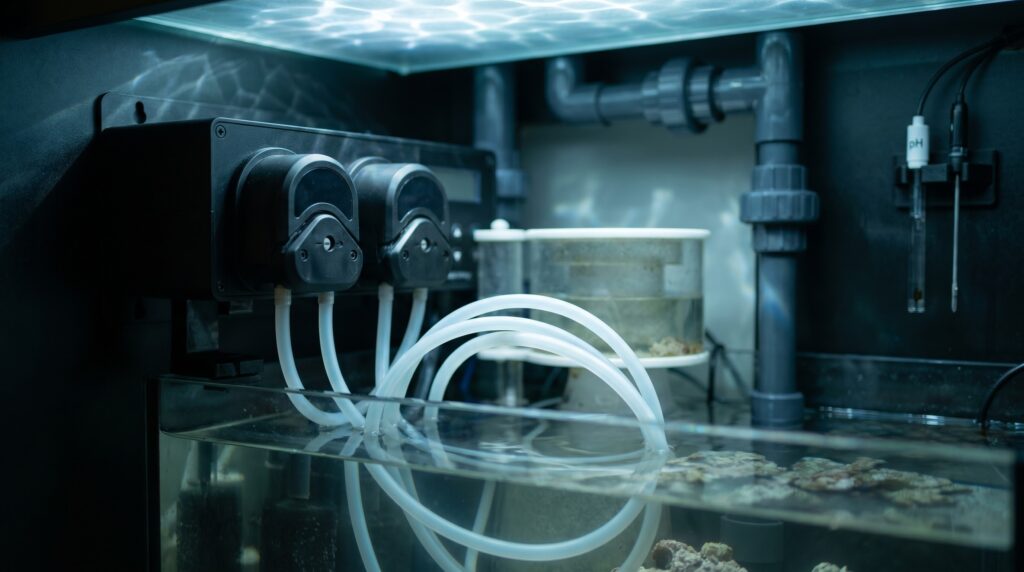
Before any correction, halt the source. Pause the two-part dosing pump, close the kalkwasser drip, reduce the calcium reactor effluent to a trickle, or skip the next manual buffer addition. This sounds obvious, but the instinct when chemistry is off is to add something; here the instinct is backwards.
Corals and other calcifying organisms consume alkalinity continuously. As the peer-reviewed marine chemistry literature describes it, two moles of alkalinity are removed from the water column for every mole of calcium carbonate a coral deposits - so a tank with a reasonable coral load will naturally pull alkalinity down on its own once the external source is removed. A lightly stocked new tank may move slowly, perhaps 0.3-0.5 dKH per day, while a dense SPS system can pull 1-2 dKH daily without any intervention at all.
If you stopped dosing, confirmed a genuine high reading, and your corals look normal, you can simply wait it out and retest in 24-48 hours. Many cases resolve passively within a few days.
When to use water changes - and which salt to pick
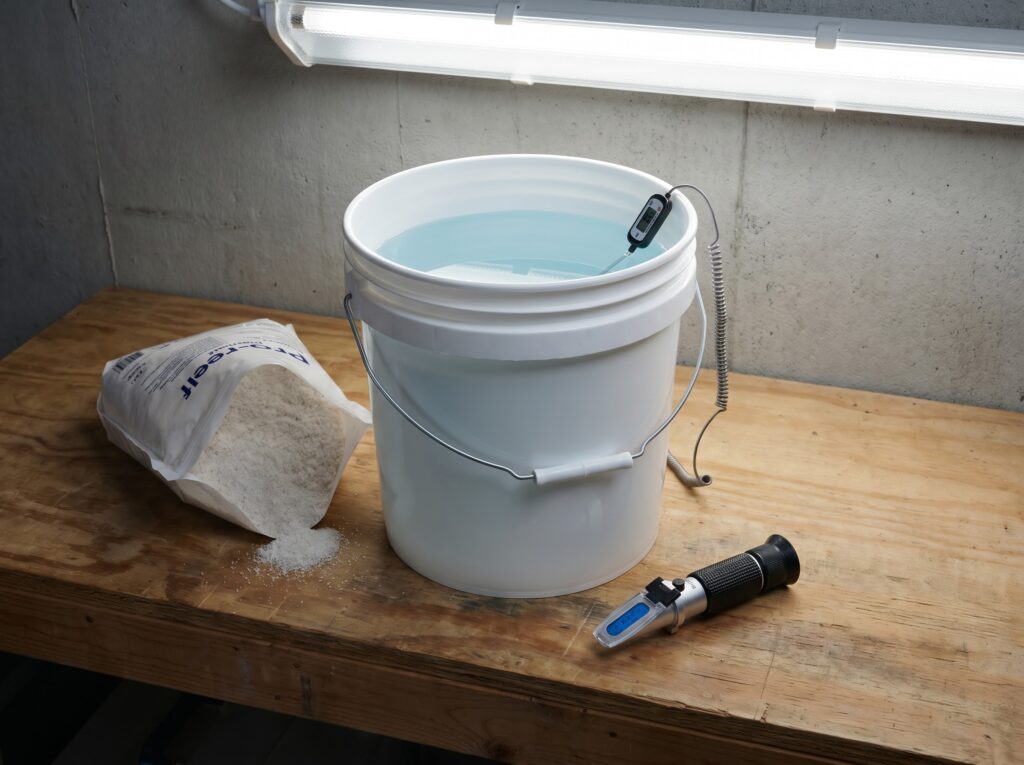
Passive consumption alone is slow if alkalinity is significantly elevated or if the tank is lightly stocked. Water changes with a lower-alkalinity salt mix accelerate the process by replacing high-alk water with water that sits near natural seawater levels.
Natural ocean surface water has a total alkalinity of approximately 7-8 dKH - a number confirmed by marine chemistry data from NOAA's ocean acidification monitoring program and reflected in manufacturer specifications. Tropic Marin Pro-Reef, for example, is formulated to produce 7-8 dKH when mixed to reef salinity - the manufacturer's spec page states explicitly: "With Tropic Marin Pro-Reef you can maintain the alkalinity in a 7-8° dKH range." ATI's guidance for their Essentials Pro system takes the same position: switch to a salt in the 7-8 dKH range and "perform daily 10% water changes to speed up the process." (Note: ATI's 7-8 dKH target is specific to their Essentials Pro dosing program, which is designed around natural seawater parameters. The broader reef hobby consensus, reflected in test kit manufacturer guidelines such as Hanna Instruments, places the general reef target at 8-12 dKH. If you are not running an ATI system, 8-9 dKH is a suitable correction target rather than the lower ATI-specific floor.)
A 10-15% water change with a 7-8 dKH salt will noticeably nudge the number down without creating a chemical shock. If alkalinity is well above 12 dKH, two or three consecutive daily changes of 10-15% will bring it back into range over 2-3 days - a pace your corals can handle comfortably.
Do not use your usual high-alkalinity salt for this purpose. Mixing water changes with a salt that already sits at 10-11 dKH and then adding it to a high-alk tank contributes almost nothing, or even worsens the problem. For more on choosing and mixing saltwater correctly, the guides on best salt mix for a reef tank and how to do a reef tank water change have full protocols.
The "stop, test, water-change" decision flow
The table below maps the most common scenarios to the right action. Use it as a repeatable checklist whenever a high reading appears.
| Reading | Corals look normal? | First action | Next step |
|---|---|---|---|
| 9-11 dKH (within target range - monitor) | Yes | No action needed; continue regular testing | If trending upward toward 12+ dKH: reduce or pause dosing proactively |
| 9-11 dKH (within target range - monitor) | No - polyps retracted, pale tips | Retest immediately from a different spot; rule out other stressors (salinity, temperature, pH, flow) | If alkalinity confirmed at 9-11 dKH and corals still look poor, alkalinity is likely not the cause - test full parameter suite |
| 12-14 dKH (significantly high) | Yes | Stop all dosing; confirm reading with a second kit or fresh reagents | Daily 10-15% water changes with 7-8 dKH salt until back in range; retest each day |
| 12-14 dKH (significantly high) | No - bleaching, tissue recession | Stop all dosing; 10-15% water change immediately with NSW-level salt | Retest in 12 h; second water change if still above 12 dKH; investigate source |
| Above 14 dKH | Any | Stop all dosing; check for spontaneous cloudiness (calcium carbonate precipitation) | Two 10-15% water changes 12 h apart; do NOT use acidic additives; identify and correct root cause before resuming any dosing |
| Single anomalous high reading | Yes | Retest immediately with fresh reagents and a different water sample location | If second test is normal: no action needed; note test kit reliability |
What not to do when alkalinity is elevated
A few approaches circulate in the hobby that range from unnecessary to genuinely harmful.
Do not add acid directly to the tank. Fauna Marin's chemistry guidance is clear: avoid "organic acids or bases and no highly concentrated chemicals" for alkalinity adjustment, noting that such approaches increase precipitation and can promote long-term water quality problems. The risk of a localized pH crash near the dose point is real and hard to control in practice.
Do not overcorrect in a single day. Stability matters as much as hitting the right number. Seachem's product documentation for Reef Buffer warns specifically that "excess alkalinity may enhance the loss of calcium, magnesium, and strontium" - but the reverse is equally true: swinging alkalinity sharply downward within hours stresses corals whose calcification machinery is tuned to a stable environment. Limiting correction to no more than 1-2 dKH per day is widely accepted hobbyist practice and consistent with the gradual, stability-first approach recommended by major dosing system manufacturers.
Do not stop testing calcium and magnesium while you adjust alkalinity. The three parameters are linked. Tidal Gardens' chemistry notes explain that calcium and carbonate "combine to form calcium carbonate and fall out of solution, thus lowering both levels" - meaning that as you bring alkalinity down, calcium can drift too. Run the full parameter check every day or two during the correction period.
The companion article on how to raise alkalinity in a reef tank covers the opposite problem and explains the dosing methods in more detail, including two-part, kalkwasser, and calcium reactors - useful context for understanding how the overshoot happened.
Resuming dosing after a high reading
Once alkalinity is back in the 8-11 dKH range and has held stable across two consecutive daily tests, you can resume supplementation - but at a reduced dose. Waiting until it settles in the lower half of the target window (rather than resuming the moment it dips below 12) gives you a buffer against immediately overshooting again. If you were previously dosing a set volume of two-part each day, start at roughly half that amount and retest after three days before adjusting further. The goal is to match the dose to actual consumption, which means measuring how much the tank pulls down over 24 hours when no dose is added, then replacing exactly that amount.
If the original overshoot came from a high-alkalinity salt, switching mixes before the next water change cycle is the cleanest long-term fix. Any ongoing supplementation can then be dialed in from a stable baseline rather than fighting a salt that pushes chemistry in the wrong direction before dosing even begins.
Alkalinity drifts in both directions over a tank's life as coral biomass changes, seasons shift evaporation rates, and dosing schedules get set-and-forgotten. The discipline of testing weekly and adjusting dosing in small increments - rather than reacting to large deviations - is what keeps the parameter genuinely stable rather than oscillating around a target.
Frequently asked questions
Can I use vinegar or muriatic acid to lower alkalinity in my reef tank?
This is not recommended. Adding acids directly to a reef tank risks a sharp, localized pH crash that can bleach corals and harm invertebrates. The same result - lower alkalinity - is achieved safely and gradually by stopping dosing and performing water changes with a lower-alkalinity salt, which keeps pH swings within a range the tank can buffer.
How long does it take for alkalinity to come down on its own?
A heavily stocked SPS tank can consume 1-2 dKH per day once dosing is stopped, so a moderate overshoot often resolves within 48-72 hours passively. A lightly stocked or new tank may only pull 0.3-0.5 dKH daily - meaning it could take a week or more to drift back into range on its own. If your tank is in that slower category and alkalinity is sitting well above 12 dKH, waiting it out is not the right call: run daily 10-15% water changes with a 7-8 dKH salt to actively accelerate the correction rather than leaving corals in elevated conditions for days.
What happens if alkalinity goes above 14 dKH?
At very high levels, calcium carbonate can precipitate spontaneously out of solution - sometimes called a "snowstorm" effect - causing cloudiness and stripping calcium, magnesium, and strontium from the water simultaneously. Coral tissue recession and bleaching are also likely. Stop all dosing, perform water changes, and do not resume supplementation until the root cause is identified.
Does high alkalinity affect pH?
Yes, indirectly. Very high alkalinity can shift the carbonate equilibrium and contribute to elevated pH. The bigger risk runs the other way: rapid corrections that drop alkalinity sharply can destabilize the buffering system and cause pH to swing. Gradual reduction over multiple days keeps both parameters stable. The reef tank pH article explains the buffering relationship in more detail.