How to get rid of hair algae in a reef tank: a step-by-step eradication plan
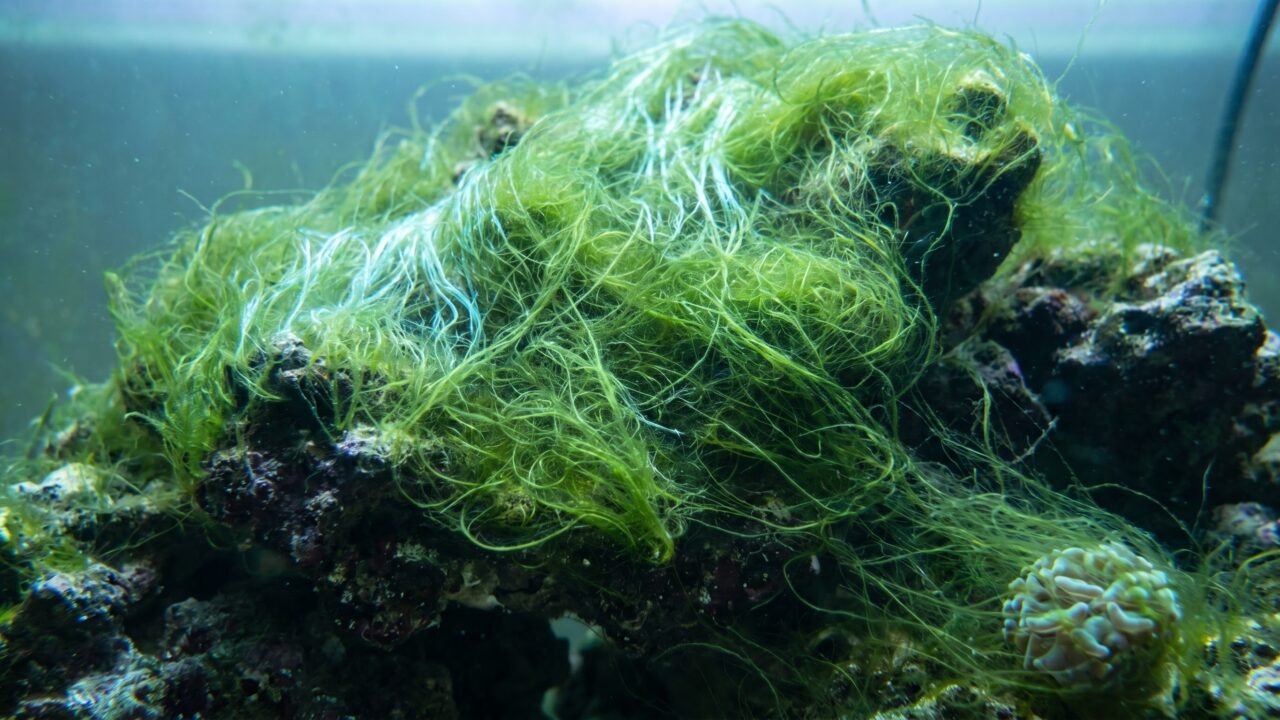
Green hair algae will not disappear just because you pull it out. Rip a clump off the rockwork today, and by next week the same spot is fuzzy again, because the nutrients that fed it are still in the water. The only way to actually clear a tank is to attack the root cause (excess phosphate and nitrate, too much light) while physically removing what's already there and deploying grazers to mop up what you miss. Done in the right order over four to six weeks, this combination works reliably.
This guide explains exactly how to do that, with a week-by-week plan at the end.
Why hair algae takes over: nutrients and light
Hair algae belongs to the filamentous green algae group (primarily species in the genera Cladophora, Derbesia, and Bryopsis). Like all photosynthetic organisms, they need two things to grow: nutrients (phosphorus and nitrogen) and light. Penn State Extension's research on filamentous algae states plainly that outbreaks "stem from excessive nutrients (phosphorus and nitrogen) in pond water," and the same principle applies to any lit aquatic system. NOAA's coastal education materials describe what happens next: when excess nutrients enter the water, they cause "algae to grow faster than ecosystems can handle."
In a reef tank those nutrients come from several places at once. Fish waste and uneaten food break down into ammonia, then nitrite, then nitrate (the final step in the nitrogen cycle). Phosphate leaches from the same food, from certain additives, and occasionally from new live rock. If your skimmer is undersized, your water change schedule is sporadic, or you're running the lights 12 hours a day, you've handed hair algae everything it needs.
So what counts as "too high"? Keep nitrate at 1-10 ppm and phosphate at 0.03-0.10 ppm. Zero on either parameter is not the goal, because corals actually need measurable nutrients, and anything above those ceilings tips the balance toward problem algae. If you're seeing thick mats of hair algae, test both parameters first. You cannot fix what you haven't measured.
For a deeper look at driving phosphate down to that range, see our guide on how to lower phosphates in a reef tank. Nitrate reduction strategies are covered separately at how to lower nitrates in a reef tank.
Step one: manual removal
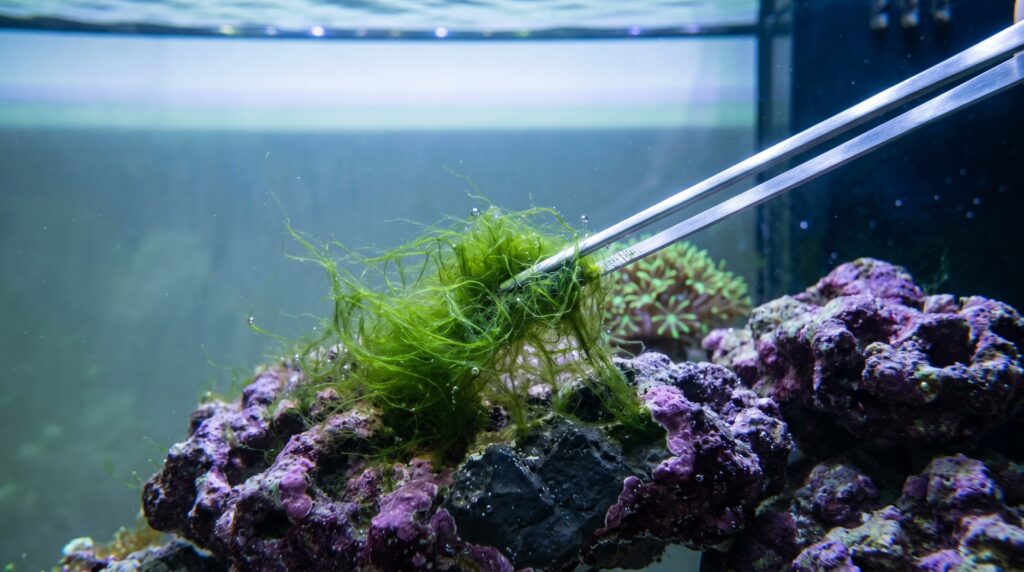
Pulling algae out by hand does not fix the problem, but it does reduce the standing biomass and, crucially, removes a reservoir of phosphate and nitrogen that would otherwise recycle back into the water as the algae dies. Get as much out as you can before the next step.
Use your fingers or a pair of long aquascaping tweezers to twist strands free from rock surfaces. Work slowly around coral frags and don't detach colonies from their plugs in the process. A turkey baster is useful for blasting loose filaments off tight spots so your return pump can carry them toward the filter sock. Run a fine mesh filter sock or a 100-micron sock during this pass and check it every few hours. The loose fragments will clog it fast.
One practical tip: do this right before a water change, then siphon the disturbed detritus out with the outgoing water. You're doubling the nutrient export from a single session.
Nutrient export: the real work
Removing the visible algae addresses the symptom. Lowering nutrients addresses the cause. Seachem's aquarium care guidance makes the point directly: "algae is a symptom of a nutrient imbalance or buildup," and "directly killing off the algae is only a temporary solution if the underlying issue is not dealt with." You need at least two or three of the following export mechanisms working together.
Water changes
A 10% weekly water change dilutes both nitrate and phosphate, replenishes trace elements, and helps maintain stable alkalinity and calcium. Swell UK's reef guidance is straightforward: "If the nitrate level continues to climb, you need to change more water." Mix with RODI water only. Tap water carries its own phosphate and silicate load that feeds the algae you're fighting. During an active outbreak, bump up to 15-20% per week for the first three to four weeks.
Protein skimmer performance
Your skimmer removes dissolved organic compounds before bacteria process them into nitrate and phosphate. Check that the neck is clean (a dirty neck kills foam production), that the collection cup is emptied at least every two days, and that the skimmer is rated for your total system volume, not just the display tank. An undersized or poorly tuned skimmer is one of the most common reasons phosphate climbs despite everything else looking fine.
GFO (granular ferric oxide)
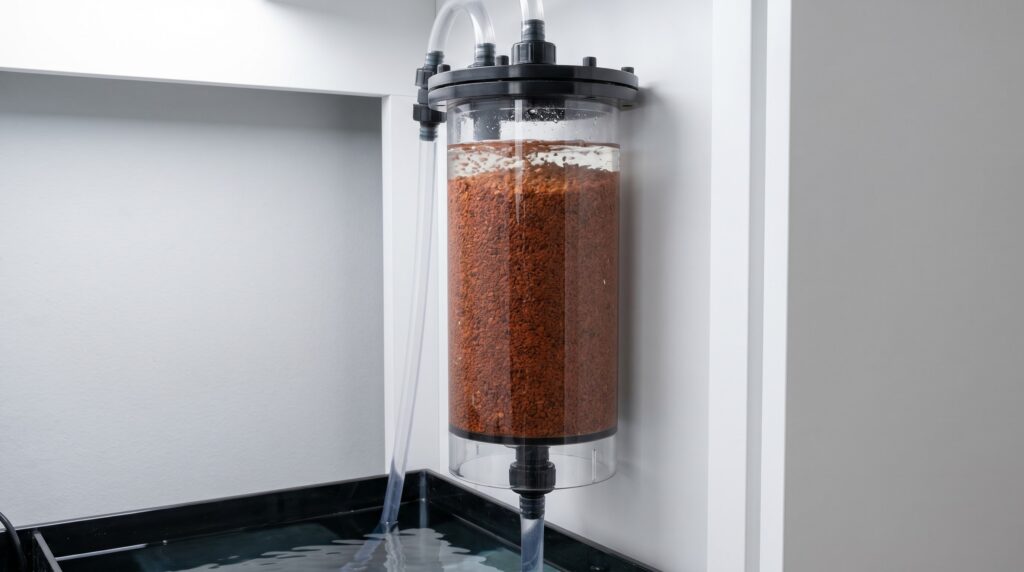
GFO is a reddish-brown filter media that removes phosphate by adsorption: phosphate ions chemically bond to the surface of the granules. Run it in a media reactor, not a passive bag, so the media tumbles gently and doesn't channel. The key caution: start with a conservative dose and ramp up slowly. Dropping phosphate too fast can stress corals. Replace the media when phosphate begins to climb again, typically every four to eight weeks.
Refugium with macroalgae
A refugium stocked with Chaetomorpha (chaeto) or Caulerpa competes directly with hair algae for the same dissolved nutrients. As the macroalgae grows, it locks up phosphate and nitrate in its biomass; harvest a fist-sized portion every one to two weeks and you've physically removed those nutrients from the system permanently. Run the refugium light on a reverse cycle (on when your display lights are off) to buffer pH overnight. A refugium also provides a safe zone for copepods, which adds biological diversity that a healthy reef needs.
Adjust the photoperiod
Light is the second driver, and it's the easiest one to change without spending money. AlgaGen's reef lighting guidance caps photoperiods at 10 hours maximum, noting that longer schedules cause algae to explode. Most hobbyists run their tanks at 10-12 hours because "more light seems better for corals." It may be, slightly, for SPS growth rates, but longer photoperiods absolutely benefit nuisance algae at the same time.
During an outbreak, pull your photoperiod back to eight hours. Run a one-hour ramp up, six hours of full intensity, and a one-hour ramp down. After the algae recedes you can extend to nine or ten hours if your corals need it. Also check your intensity settings. If PAR at the rock surfaces where hair algae is growing exceeds 100-150, the algae is getting more photons than it needs to thrive there.
Cleanup crew (CUC) for hair algae
A well-chosen CUC won't solve an outbreak on its own. If nutrients remain elevated, algae grows faster than any grazer can eat it. Once you've brought phosphate and nitrate under control, though, the right animals keep new growth in check. The wrong animals are useless against hair algae specifically, so species selection matters.
For a full comparison of saltwater cleanup crew animals including species counts by tank size, see our reef tank algae eaters guide.
Mexican turbo snails (Turbo fluctuosa)
These are the workhorses for hair algae removal. Native to the Gulf of California, turbo snails graze relentlessly on filamentous algae, diatoms, and cyanobacteria on rockwork and glass. A rough starting point is one snail per 20-30 gallons of system volume for normal maintenance; during an active outbreak you can push that to one per 10 gallons, but overloading beyond that risks starvation once the algae recedes. The caveat: they're large and heavy, and an active snail will bulldoze unsecured frags and frag plugs. Secure your rockwork before adding them, and be prepared to right them if they flip. Turbo snails can't self-right on a flat sand bed and will die if left upside down.
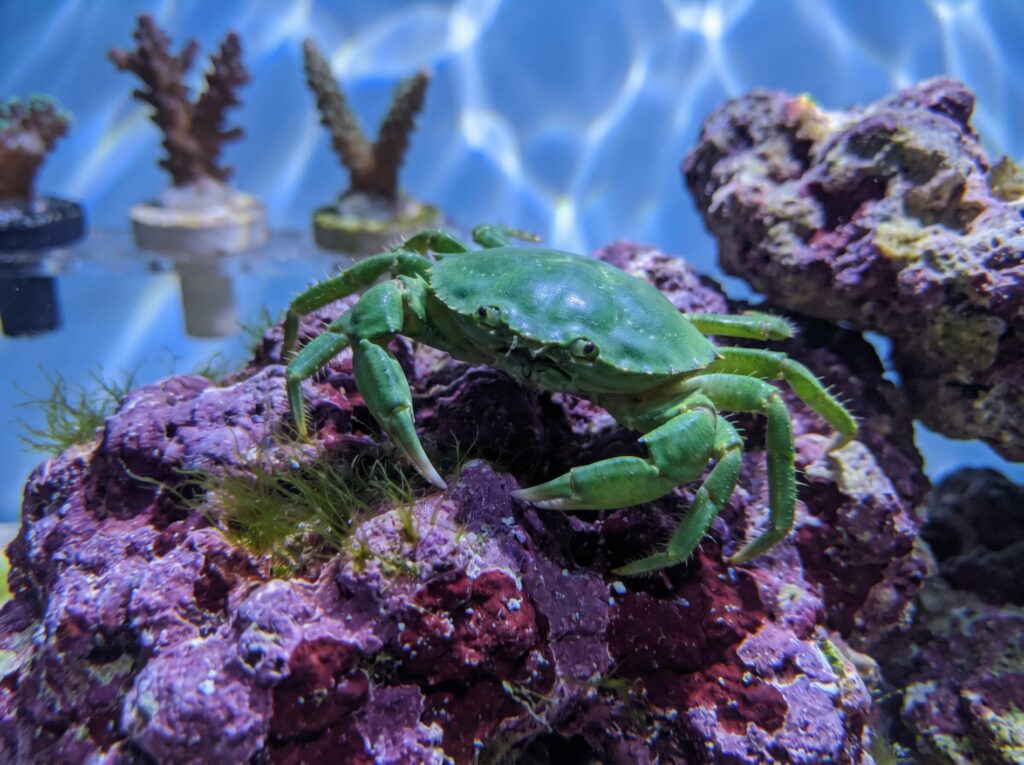
Emerald crabs (Mithraculus sculptus)
Emerald crabs eat bubble algae and also graze on filamentous algae and detritus. Research published in the Journal of the Marine Biological Association (Figueiredo et al., 2008) found that when pellets are available, M. sculptus chose them over algae 77% of the time. Don't overfeed the tank if you want them working. Medium to large individuals graze more actively than small ones. One per 20-25 gallons is a reasonable starting density; adding a second in a larger system is fine but watch for territorial scrapping between them. They're generally reef safe but can get opportunistic if starved, so watch for any nipping at small-polyp corals.
We cover emerald crabs in more detail in our article on emerald crabs for bubble algae.
Tangs
A yellow tang (Zebrasoma flavescens) or sailfin tang (Zebrasoma veliferum) will graze filamentous algae off rock surfaces throughout the day. The Animal Diversity Web documents that yellow tangs possess "small teeth that are specialized for grazing on algae" and perform a critical ecological function by "preventing them from overgrowing and killing corals." They're active, require a minimum tank size of 100 gallons, and need a varied diet of nori and frozen herbivore food in addition to what they graze. A tang is a long-term investment, so add one only if your tank size is appropriate and you're committed to keeping it long-term.
The 4-6 week eradication plan
The table below sequences every action in a logical order. Skip ahead and things don't work as well: the CUC won't keep up if nutrients are still high, and GFO won't make a dent if your skimmer is dirty. Work through it in order.
| Week | Priority action | Supporting actions | What to watch for |
|---|---|---|---|
| Week 1 | Test phosphate and nitrate; manual removal of all visible hair algae; install filter sock | Clean skimmer neck and cup; check skimmer rating vs. system volume | Baseline nutrient readings before you change anything |
| Week 1-2 | Reduce photoperiod to 8 hours; begin 15-20% weekly water change (RODI only) | Cut feeding by 25%; target zero visible food remaining after 2 minutes | Slower algae growth rate on rocks; corals should remain open |
| Week 2 | Start GFO in a media reactor at half the manufacturer's recommended dose | Add refugium macroalgae (Chaetomorpha) if you have a sump; run on reverse cycle | Phosphate reading: should begin dropping toward 0.05-0.10 ppm range |
| Week 2-3 | Add turbo snails once phosphate is below 0.15 ppm | Add emerald crab(s) if bubble algae is also present | Snails actively grazing rock surfaces; frag plugs still in place |
| Week 3-4 | Second manual removal pass; harvest first portion of refugium chaeto | Retest nitrate and phosphate; adjust GFO dose if phosphate isn't moving | Visible hair algae patches should be noticeably thinner |
| Week 4-5 | Continue weekly water changes and chaeto harvesting; monitor skimmate daily | Evaluate tang addition if tank size allows and hair algae persists on rockwork | Nitrate trending toward 1-5 ppm; phosphate holding at 0.03-0.08 ppm |
| Week 5-6 | Return photoperiod to 9-10 hours once hair algae is no longer dominant | Drop water change volume back to 10% weekly once parameters stabilize | No new dense patches; coralline algae beginning to reclaim bare spots |
What if the algae keeps coming back?
Persistent regrowth after running the full plan usually points to one of three unresolved sources:
- A phosphate source you missed. New live rock, a brand of food pellet with high phosphate binders, or a calcium supplement that introduces phosphate can undermine every other fix. Test your freshly mixed saltwater, because some budget salt mixes have measurable phosphate right out of the bag.
- Insufficient nutrient export for the bioload. More fish means more waste. If your skimmer, water changes, and refugium are calibrated for five fish and you're keeping eight, the math doesn't work. Reduce bioload or scale up export.
- A Bryopsis problem disguised as hair algae. Bryopsis is a feathery, fern-like green alga that is often mistaken for hair algae but is far more persistent. CUC animals largely ignore it, and nutrient export alone rarely clears it. If you've run this entire plan and the algae has a distinctly branching, feather-like structure rather than loose tangled strands, you may be dealing with Bryopsis, which requires a different approach involving elevated magnesium levels (typically raised to 1500-1600 ppm and held there for two to four weeks).
Patience is not a soft suggestion here. Even when you're doing everything right, hair algae retreats slowly over weeks, not days. The grazers need time to work through the existing growth, and the macroalgae in the refugium needs time to establish and start pulling meaningful amounts of phosphate. Two weeks in with no visible change is normal. Six weeks in with no visible change means something upstream hasn't been fixed yet.
Frequently asked questions
How long does it take to get rid of hair algae in a reef tank?
Most tanks see meaningful improvement in three to four weeks if nutrients are actively being reduced and grazers are in place. Full clearance with no regrowth typically takes five to eight weeks. Faster results usually mean the outbreak was mild to begin with; severe mats with high phosphate can take longer because the nutrient load is larger.
Will hair algae go away on its own?
Rarely, and only in tanks where nutrient levels drop naturally as a new tank matures. In established systems with a stable bioload, hair algae will not self-limit without intervention. It competes successfully against coralline algae and encrusting organisms at elevated phosphate, so it can persist for months or years if the cause isn't addressed.
Is hair algae harmful to corals?
Hair algae can smother corals when allowed to grow unchecked. Dense mats block light reaching the coral tissue and can physically overgrow the edges of LPS corals and soft corals. Moderate amounts on rockwork away from corals are less immediately dangerous but signal that conditions favor algae over corals generally, which affects water chemistry, oxygen levels, and pH stability.
Can I just use a chemical treatment to kill hair algae?
Copper-based algaecides are absolutely off the table in a reef tank. Copper kills invertebrates and corrodes coral tissue. Hydrogen peroxide spot treatments are sometimes used cautiously on isolated patches, but they carry real risk of harming nearby corals and do not address nutrients. Physical removal plus export plus grazers is the only approach that works without collateral damage to the reef.
Do I need a refugium to get rid of hair algae?
No. A refugium with macroalgae is one of the most effective long-term nutrient export tools, but tanks without a sump can still clear hair algae using GFO, increased water changes, careful feeding, and a strong cleanup crew. The refugium becomes more valuable after the outbreak as a maintenance tool: it keeps phosphate stable week to week.