The best beginner reef tank: size and kit recommendations for a first reef
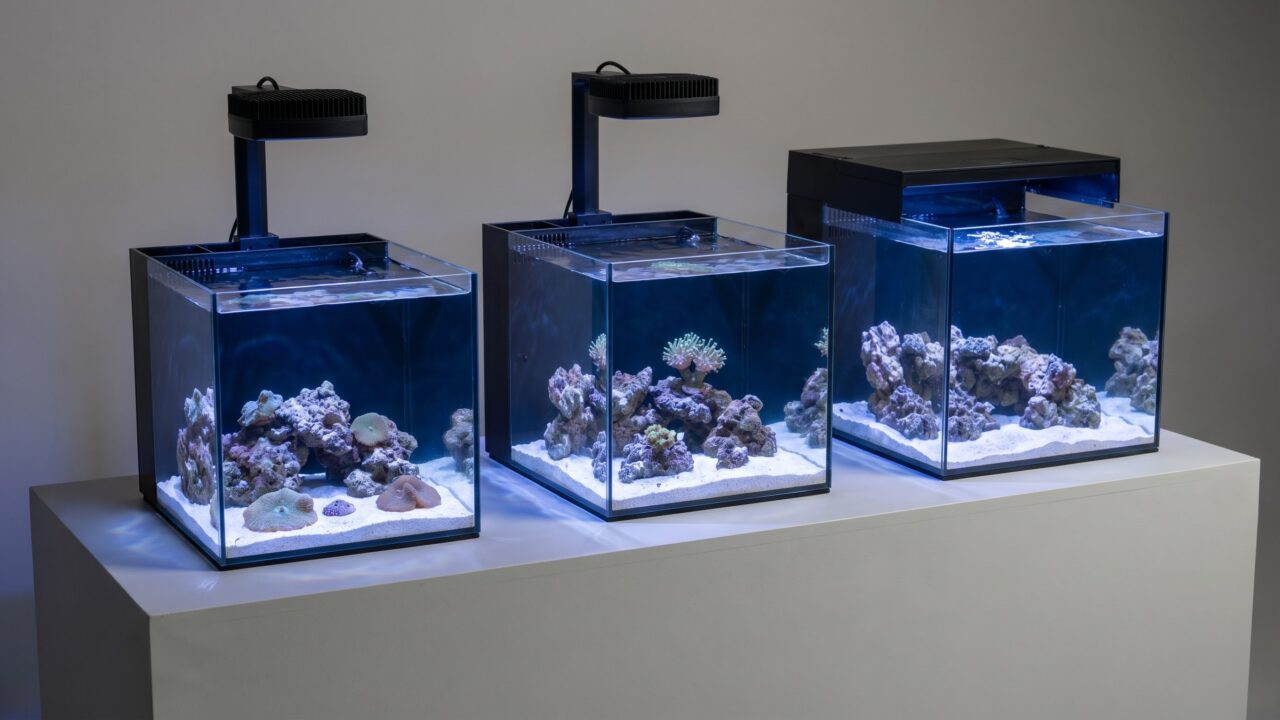
Twenty gallons is where most successful reef keepers wish they had started. It is enough water to smooth out the daily swings in temperature and salinity that kill livestock in smaller tanks, compact enough to sit on a sturdy furniture piece without engineering a floor, and sized for equipment that costs a few hundred dollars rather than a few thousand. That 20-to-40-gallon window is the practical sweet spot for a first reef, and the all-in-one (AIO) format makes the most sense within it.
This guide explains why that size range works, compares four popular AIO kits by spec, and gives you a plain table of what each box actually contains, because what a manufacturer includes is never quite as complete as the marketing implies.
Why 20-40 gallons is the right starting size
The core logic is water volume as a buffer. When 2 gallons evaporate from a 5-gallon pico tank overnight, salinity climbs sharply. The same 2 gallons evaporating from a 30-gallon system barely registers. ATI North America's reef-chemistry reference states the principle plainly: "Stability is key to grow and color up coral." Every gallon you add to a system makes that stability easier to maintain.
Temperature follows the same physics. Small volumes heat and cool with the room. A 20-gallon tank with a quality heater holds a steady 77 F through a warm afternoon; a 5-gallon pico can overshoot by several degrees in the same conditions. One review of pico reef keeping puts it directly: "In a reef pico tank, the total volume of water is so low that fluctuations in temperature, pH, and chemical concentrations can take place rather rapidly. This can be extremely dangerous for the fish." A pico tank also leaves almost no margin after equipment failure. At 5 gallons, a skipped top-off or a heater stuck in the on position can reach a fatal parameter level within hours.
The same logic applies to chemistry. Alkalinity, calcium, and magnesium are consumed by corals daily. In a small volume, that drawdown is steep and fast. In a 30-gallon system you have a wider window between dose and crash, which is exactly the kind of forgiveness a newcomer needs.
Going above 40 gallons on a first tank adds cost, equipment complexity, and physical weight (saltwater runs roughly 8.5 lbs per gallon, so a filled 55-gallon is nearly a quarter-ton) without proportionally increasing beginner friendliness. A properly equipped 30-gallon system that gets consistent weekly care will outperform a larger, poorly maintained setup. The 20-40 gallon range is not the only viable bracket, but it is the one where the most beginners find their footing without early disaster or budget shock.
For more on how to decide between specific tank footprints and their livestock implications, see our guide to reef tank sizes.
AIO tanks versus a custom build
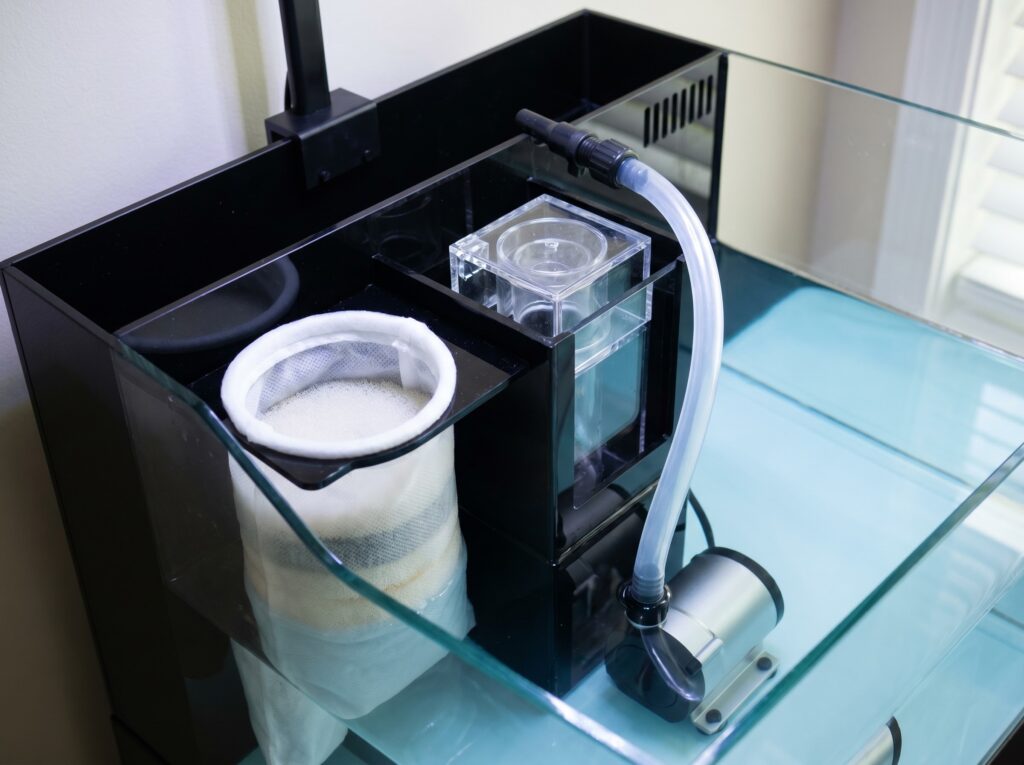
An all-in-one tank hides filtration, a return pump, and often a skimmer inside a built-in rear chamber. You see the display, not the machinery. There is no separate sump cabinet to plumb, no bulkhead to drill, and no guesswork about whether a return pump is properly sized. For a first reef that matters. The rear chamber keeps equipment out of the display view, and because everything stays within the tank footprint, you skip the question of how much cabinet space you have beneath the stand.
The trade-off is flexibility. AIO rear chambers limit skimmer choices to models that physically fit, and you cannot easily expand to a large external refugium later. That rarely matters at the 20-to-40-gallon scale, but it is worth knowing before you buy.
Our dedicated article on all-in-one AIO reef tanks covers the format in depth. For a broader look at starter options, see reef tank starter kits compared.
Four popular AIO kits: what you get and what you still need
Manufacturers bundle equipment differently. Some include lighting, a skimmer, and an auto top-off (ATO) right out of the box. Others ship only the tank, a basic return pump, and media. The table below maps what each kit actually includes at retail so you can budget realistically.
| Tank | Display vol. | Total system vol. | Return pump | Lighting | Protein skimmer | ATO included | Heater included | Glass thickness | Tank price (approx.) |
|---|---|---|---|---|---|---|---|---|---|
| Red Sea MAX Nano G2 Cube | 16.5 gal (62 L) | 20 gal (75 L) | 240 GPH Sicce | ReefLED 50 (WiFi) | Yes - REEF-SPEC nano | Yes (built-in reservoir) | No | 8 mm | ~$799 (no stand) |
| Waterbox AIO 20 Cube | 20 gal (76 L) | 20 gal | 265 GPH | No | No | No | No | 6 mm | ~$290 (no cabinet) |
| Innovative Marine Fusion Pro 2 (20 gal) | ~20 gal | ~20 gal | 326 GPH DC (controllable) | No | No | No | No | 8 mm | ~$400-560 depending on variant |
| Coralife BioCube 32 | ~30 gal (true display) | 32 gal | 264 GPH | Yes - LED hood (3 channels, timer) | No | No | No | Standard glass | ~$490 (tank only), ~$800 (with stand) |
What the table does not show: every tank on this list requires a heater (none include one), and three of the four require you to buy lighting separately. The Red Sea MAX Nano is the only kit here that ships with a protein skimmer and an ATO already fitted. That explains the price gap: $800 against $290 for the Waterbox is not purely a quality difference - it is a difference in how complete each box is.
Still-need-to-buy list, by tank
Red Sea MAX Nano G2 Cube
The closest thing to plug-and-play in this size class. What you still need: a heater (100W models fit the return chamber neatly), a wavemaker or small powerhead for supplemental flow, RODI water and salt, rock and sand, and test kits. Budget an extra $150-250 beyond the tank price to complete the setup.
Waterbox AIO 20 Cube
Tank, pump, filter media, and leveling mat are included. Everything else is on you: lighting (plan $150-300 for a quality nano LED), a heater, a protein skimmer sized for the rear chamber, an ATO system, RODI water and salt, rock, sand, and test kits. The lower entry price reflects this: budget $500-700 in additional equipment for a complete build.
Innovative Marine Fusion Pro 2 (20 gal)
The DC return pump with controller is a genuine plus - variable flow is useful. You still need lighting, a heater, a protein skimmer (IM sells dedicated AIO skimmers sized for the rear chambers), an ATO, RODI water, salt, rock, sand, and test kits. Similar additional budget to the Waterbox: around $500-650.
Coralife BioCube 32
The integrated LED hood and timer are usable for soft corals and most LPS; serious SPS keepers typically upgrade the light later. Still needed: a heater (150W fits the rear chamber), a protein skimmer (BioCube-specific models exist), a powerhead for supplemental flow, an ATO, RODI water, salt, rock, sand, and test kits. Additional budget around $400-600.
For a complete gear checklist across all tank sizes, the what do I need to start a reef tank article walks through every item in order.
How to read these kits honestly
The Red Sea MAX Nano's all-inclusive bundle is genuinely convenient, and the ReefLED 50 is a capable light for the money. The catch is the rear chamber: it is sized for the included skimmer, which means upgrading to a different model requires careful measuring to find something that physically fits. If you already have a preferred skimmer or light brand in mind, the Waterbox or IM Fusion gives you that freedom and can produce a better-matched system at a similar or lower total cost.
The BioCube 32 sits in a different category from the other three because its footprint is 32 gallons of total system volume, not 20. That extra volume improves stability noticeably. The hood is a closed canopy design rather than a pendant-style LED, which some beginners find easier to work with and others find limiting for tall aquascaping. Its main weakness is the built-in pump: 264 GPH return flow for a 32-gallon tank is adequate for fish and soft corals, but SPS keepers almost always add a powerhead.
One honest note on pricing: tank prices shift regularly. The figures in the table reflect retailer listings at the time of research. Always verify current pricing before budgeting.
The pico trap: why under 10 gallons fails beginners
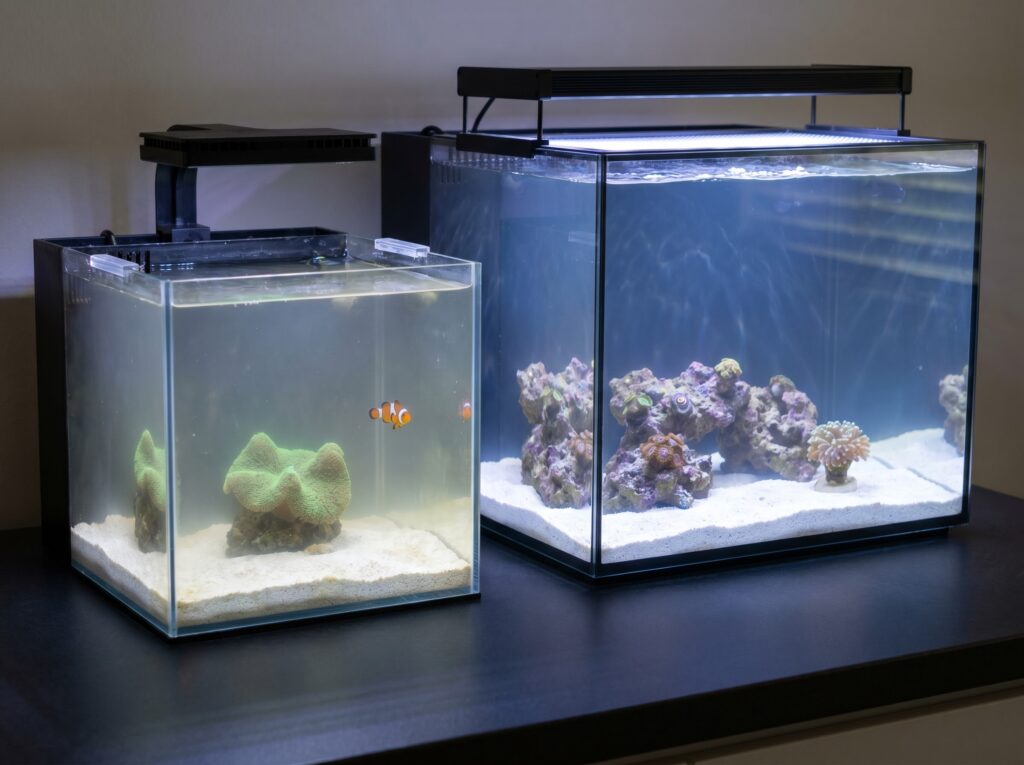
Tiny tanks look appealing. A 3-gallon cube on a desk seems manageable and cheap. In practice it is the opposite of beginner-friendly. Evaporation alone, perhaps half a cup a day in a warm room, is a meaningful fraction of total volume. Skip a single top-off and salinity climbs. Add a coral, lose the coral to a brief temperature spike, and there is almost no water body to dilute the ammonia spike that follows. A 10-to-20-gallon nano reef "can swing dramatically in temperature, pH, and salinity compared to a 50+ gallon system," and anything under 10 gallons amplifies that effect further. The response window for correction is very short.
Pico tanks under about 10 gallons are a specialty format that experienced hobbyists pursue as a deliberate technical challenge. They require more frequent testing and top-offs than a larger system, not less. Starting there means learning the hard lessons at maximum speed and minimum margin.
If a small footprint is the real constraint, a 20-gallon AIO on a furniture stand takes up roughly 18 by 18 inches of floor space. That is compact. There is no need to go smaller to save space.
Parameters to hold stable from day one
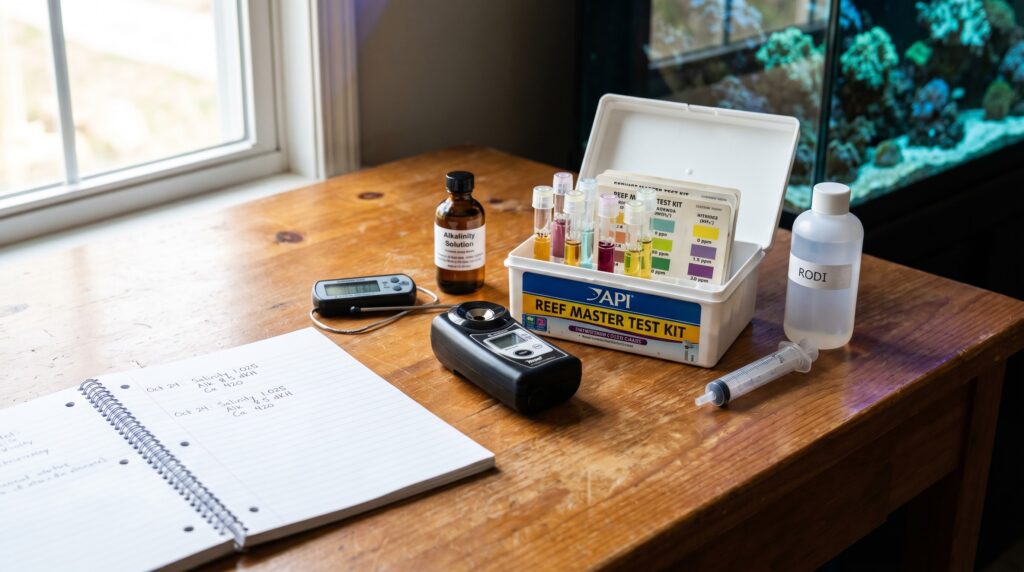
Whichever tank you choose, the same numbers govern success. ATI North America's water-quality reference lists the core targets: salinity 1.024-1.026 SG (35 ppt), temperature 75-78 F, alkalinity 8-11 dKH, calcium 400-450 ppm, magnesium 1250-1350 ppm. None of those figures are difficult to hit. What trips up beginners is letting them drift, because corals adapt to the number you hold, not the number you aim for. A tank sitting at a steady 8.5 dKH is easier on corals than one swinging between 7 and 11 dKH while you chase "perfect." (Natural seawater runs 8-9 dKH; staying at or below 11 dKH keeps you safely below the threshold where calcium carbonate precipitation risk rises.)
Two numbers beginners often misread: nitrate and phosphate. Many early hobbyists try to drive both to zero, believing cleaner is better. It is not. Corals need some nutrients - nitrate in the range of roughly 1-10 ppm and phosphate around 0.03-0.10 ppm. A "zero nutrient" tank does not produce lush coral growth; it produces pale, starved corals and can trigger dinoflagellate outbreaks. The goal is low and stable, not absent.
Stability starts with two pieces of equipment that are worth budgeting before livestock: an ATO system and a quality heater with a separate controller. The ATO replaces evaporated water automatically, preventing the daily salinity creep that stresses corals silently. The controller catches a heater stuck in the on position before it cooks the tank. Together they address the two most common stability failures in small systems.
Use RODI water for every top-off and every water change. Tap water introduces phosphates, silicates, and chloramines that compound over time in a closed system. A basic RODI unit is one of the better-value investments in this hobby. Our article on reef tank water parameters covers target ranges and testing schedules in full.
Choosing based on your real situation
Four questions help narrow the decision:
- Budget to complete the system: If your total budget including all equipment is $600-800, the Waterbox or IM Fusion lets you allocate more to a better light or a quality heater controller. If you have $1,000-1,200 to spend on just the starting setup, the Red Sea MAX Nano's included equipment becomes genuinely competitive.
- Coral ambitions: Soft corals and most LPS (zoanthids, mushrooms, bubble coral, torch coral) are achievable in any of these tanks with appropriate lighting. SPS corals demand tighter parameter stability and higher flow - easier to achieve in the BioCube 32's extra volume than in a 20-gallon system, and easier still in a tank with a dedicated wavemaker budget.
- Equipment preferences: The IM Fusion Pro 2's DC return pump controller is more useful than it sounds in a small tank - minor flow adjustments matter. If you want to pick your own light and skimmer, the Waterbox or IM Fusion give you that freedom at lower initial cost.
- Space and aesthetics: The BioCube's closed canopy hides the light but limits pendant-style replacement. The Red Sea and Waterbox cubes use pendant arms, which are easier to raise as corals grow.
For a deeper look at how each of these systems stacks up over time, our reef tank starter kits compared article covers long-term ownership considerations including upgrade paths.
Frequently asked questions
Can I start with a 10-gallon reef tank?
Technically possible, but not advisable. Ten gallons amplifies every mistake: a skipped top-off, a dying snail, or a heater variance becomes a crisis much faster than in a 20-gallon tank. The equipment savings disappear once you account for the extra monitoring time and higher livestock loss rates most beginners experience. A 20-gallon tank is a much more forgiving starting point.
Do AIO tanks include everything I need?
No kit on the market ships complete for saltwater. Even the most bundled package, such as the Red Sea MAX Nano, still requires a heater, RODI water, salt mix, live rock, substrate, and test kits. Most AIO kits also omit lighting or a protein skimmer. Always check the included-equipment list before assuming the box is ready to fill.
What is the first extra piece of equipment I should buy?
An auto top-off (ATO) system, if your tank did not include one. Evaporation raises salinity silently every day. An ATO replaces the lost freshwater automatically and prevents the single most common stability problem in small reef tanks. It costs $50-120 for a basic optical-sensor unit and pays for itself in reduced livestock stress.
How much does a complete beginner AIO reef setup cost?
Expect $800-1,500 for a complete 20-to-30-gallon system including all essential equipment (tank, light, heater, ATO, skimmer, RODI, salt, rock, sand, test kits) before any livestock. The tank itself is rarely the largest expense. Lighting, a good heater controller, and RODI together typically exceed the tank price on budget builds.
Is a protein skimmer necessary in a small AIO tank?
Not strictly required in the first month before livestock is added, but nearly every experienced reef keeper adds one. A skimmer removes dissolved organics before they fuel algae and nitrate buildup. In a 20-to-32-gallon system with a light bioload it can be run conservatively, but skipping it entirely puts more pressure on water changes as the tank matures and stocking increases.