The best beginner corals for a reef tank: 11 genuinely forgiving picks
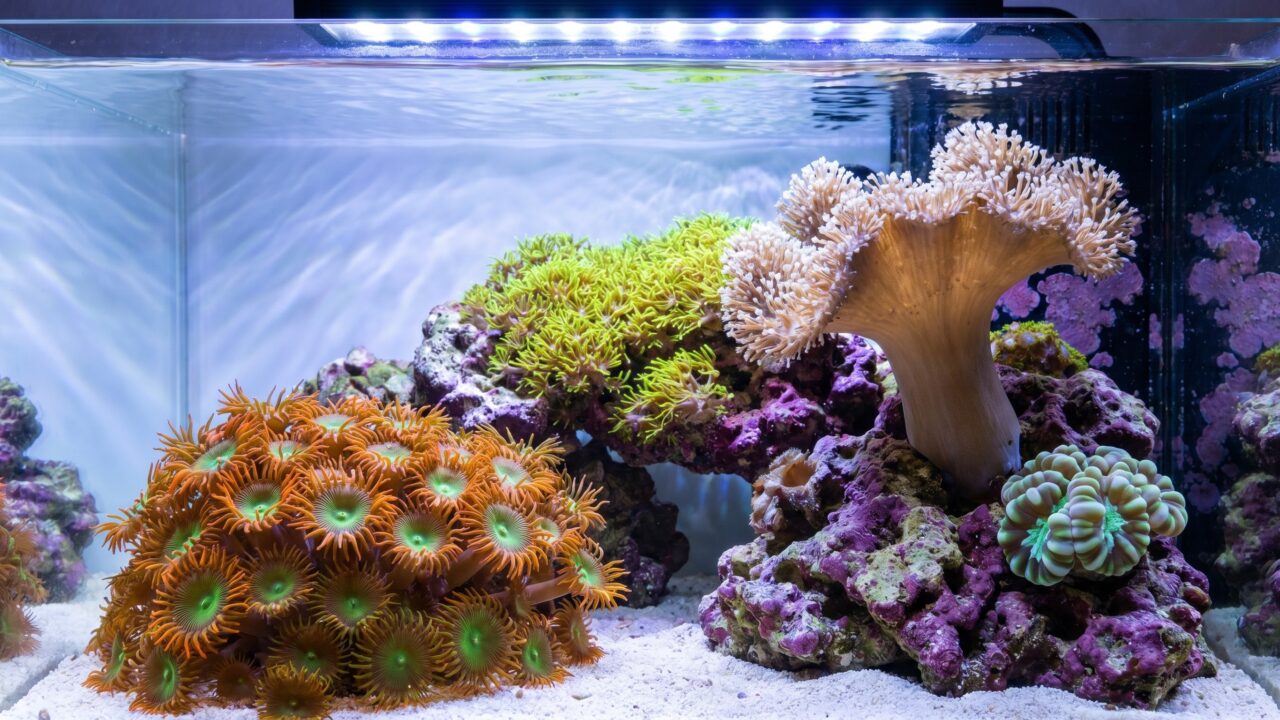
Most beginner corals die from the same three causes: wrong placement, impatient stocking, and buying something that looked great in the store but needed expert-level stability to survive. This list avoids all three traps. These eleven species were chosen because they handle the wobbles that come with any new tank - a brief salinity spike, a heater failing overnight, a nutrient crash while you sort out dosing. Some are soft corals, some are large polyp stony (LPS) corals, and one or two come with a sharp warning. Knowing which is which before you buy saves both money and a great deal of frustration.
If you want a deeper look at how corals are classified, our guide to understanding corals covers the basics. For a focused list of soft-only species, see soft corals for beginners; for more on LPS species beyond what's covered here, see LPS corals for beginners. Placement logic (where in the tank, and why) is covered separately in coral placement, light, and flow.
How to read the comparison table
PAR (photosynthetically active radiation) is the unit reef keepers use to describe how much usable light a coral receives. A low-light mushroom coral sitting on the sand bed of a well-lit tank might see 30-50 PAR, while a hammer on the middle rockwork sits in 100-150 PAR. The table below gives you a quick reference across all 11 species, then each coral gets its own section with the detail you actually need.
| Coral | Type | Difficulty | PAR range | Flow | Growth speed | The gotcha | Typical frag price |
|---|---|---|---|---|---|---|---|
| Mushroom (Discosoma) | Soft | Beginner | 30-150 | Very low | Moderate | Will detach and wander in strong flow | $5-$20 |
| Zoanthids / Zoas | Soft | Beginner | 50-150 | Low-moderate | Fast | Palythoa species contain palytoxin - wear gloves | $10-$40+ |
| Green star polyps (GSP) | Soft | Beginner | 50-150 | Moderate | Very fast | Will carpet-bomb the entire rockwork if not isolated | $10-$20 |
| Pulsing xenia | Soft | Beginner | 100-200 | Low-moderate, indirect | Very fast | Can overrun a tank in months; difficult to eradicate | $10-$25 |
| Toadstool leather (Sarcophyton) | Soft | Beginner | 100-200 | Moderate-strong | Moderate-fast | Releases allelopathic terpenoids; run activated carbon | $20-$50 |
| Candy cane (Caulastrea) | LPS | Beginner | 50-70 | Low | Moderate | Short sweeper tentacles extend a few inches; give neighbors space | $15-$40 |
| Duncan (Duncanopsammia) | LPS | Beginner | 75-150 | Low-moderate | Moderate-fast | Direct powerhead flow causes persistent retraction | $20-$50 |
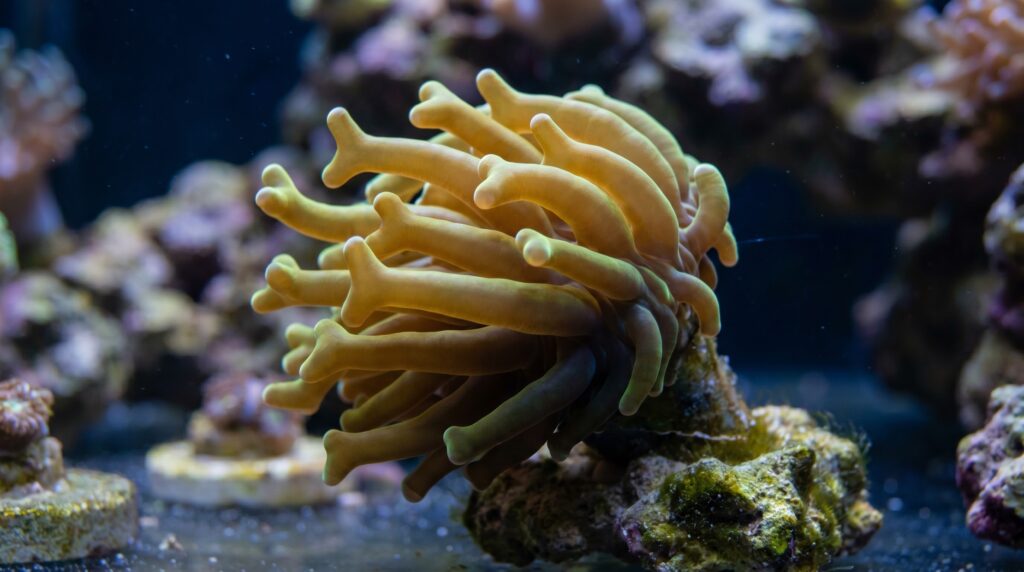
| Hammer (Euphyllia ancora) | LPS | Beginner-intermediate | 80-150 | Moderate, indirect | Slow-moderate | Sweeper tentacles extend up to 10 inches at night; 6-inch buffer required | $30-$80 |
| Torch (Euphyllia glabrescens) | LPS | Beginner-intermediate | 75-150 | Moderate, indirect | Slow-moderate | More aggressive sweeper than hammer; most aggressive Euphyllia | $40-$100+ |
| Frogspawn (Euphyllia divisa) | LPS | Beginner-intermediate | 75-150 | Moderate, indirect | Slow-moderate | Sweeper tentacles present; less aggressive than torch | $30-$80 |
| Kenya tree (Capnella) | Soft | Beginner | 50-150 | Moderate | Fast | Drops branches that regrow wherever they land; can self-propagate quickly | $10-$25 |
The soft coral group: forgiving, fast, and sometimes invasive
Soft corals have no hard calcium carbonate skeleton, which makes them far more tolerant of the parameter swings that hit new tanks. They flex instead of bleach. The trade-off is that several of them grow fast enough to cause real problems if you place them without thinking.
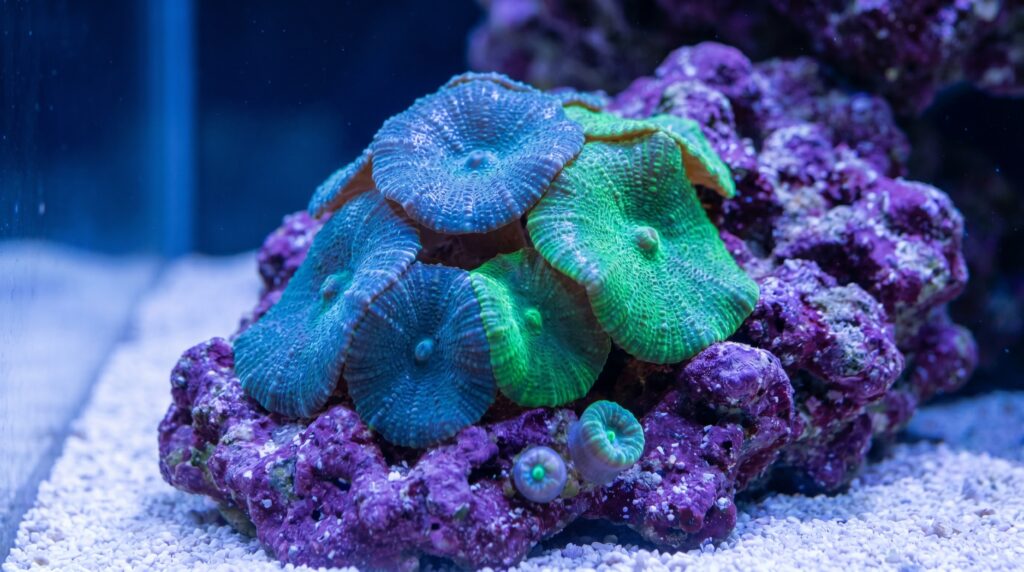
Mushroom corals (Discosoma)
These are the single most forgiving corals available, and the one most experienced reefers recommend as a true first coral. Discosoma species are found across the Indo-Pacific, from Fiji and the Solomon Islands to the shallow reefs along Australia's east coast, typically in low-light, sheltered lagoon zones where other corals struggle. That background is why they work so well in tanks that are not yet dialed in.
Keep them in the lower third of your tank where they receive 30-150 PAR. Water flow should be very gentle: Discosoma detach easily in strong current and then struggle to reattach. They reproduce by pedal laceration, leaving small pieces of their base as they move, so a single frag becomes a colony over several months without any effort on your part. The main price note is that standard color morphs (red, blue, green) sit in the $5-$20 range per frag. Collector-grade variants like bounce mushrooms can run into the hundreds, but those have no place on a beginner list.
Zoanthids and palythoas
Zoas are the most colorful corals a beginner can buy for $10-$40, and they thrive under moderate lighting (50-150 PAR) with indirect flow. They spread by adding polyps outward across the rock, which is satisfying to watch and harmless to manage with a razor blade if needed. Price variance is enormous: common morphs are nearly free at frag swaps, while hyped collector zoas can cost hundreds of dollars per polyp.
The serious warning applies specifically to Palythoa species, which are sold alongside zoanthids and look similar to the untrained eye. A peer-reviewed study published in PLoS ONE confirmed that Palythoa heliodiscus purchased from retail aquarium stores contained 500-3,500 micrograms of crude palytoxin per gram of wet tissue. Palytoxin is one of the most potent non-protein toxins known; the CDC documented household poisoning cases in the US with symptoms including bitter metallic taste, fever, cough, and respiratory distress - onset typically within 2-8 hours of exposure. Always wear nitrile gloves and eye protection when handling any zoanthid or palythoa. Never expose them to boiling water, scrubbing, or activities that create aerosols.
Green star polyps (GSP)
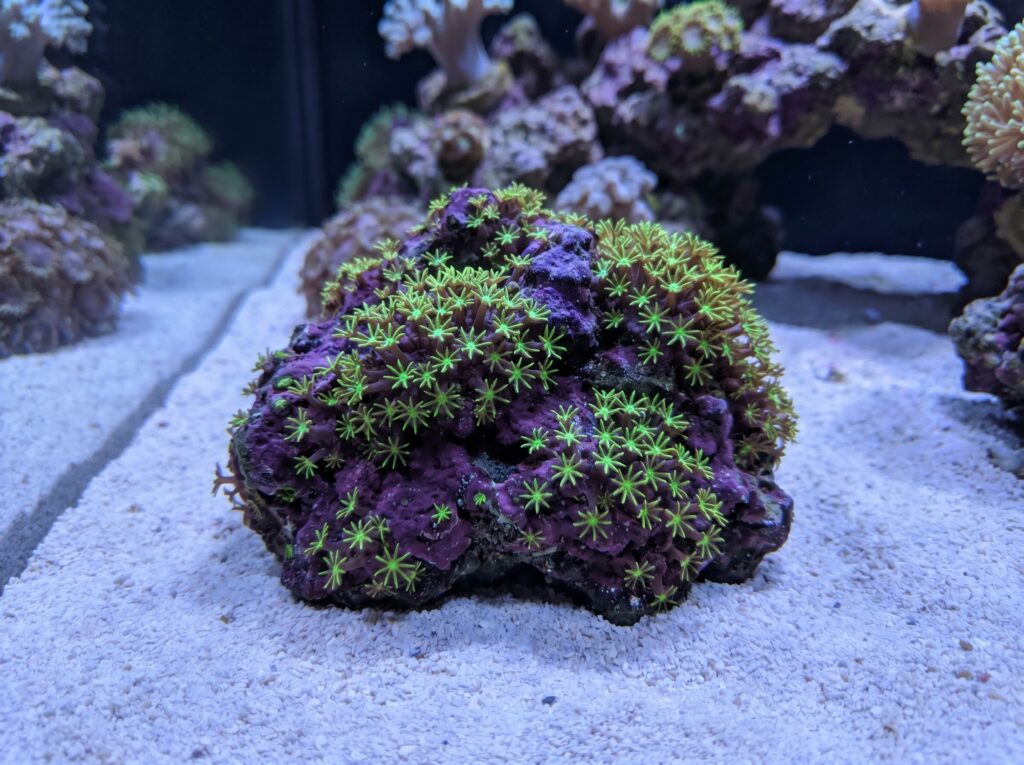
Pachyclavularia violacea is one of those corals that earns its beginner status by being nearly indestructible under normal conditions. It tolerates a wide range of light (50-150 PAR) and handles moderate flow without protest. When the polyps extend, a colony looks like a rippling green velvet carpet. Frags cost $10-$20 for a small plug.
The catch is growth speed. GSP can spread across an entire rockwork system within weeks, growing over and shading out neighboring corals it was never introduced near. The standard solution, used by most experienced keepers, is to grow GSP on an isolated rock completely surrounded by sand. Because GSP will not colonize bare sand, a gap of just a few inches acts as a natural firebreak. Never place a GSP frag directly on your main rockwork unless you want it everywhere.
Pulsing xenia
Few corals generate the same aesthetic payoff as pulsing xenia - the rhythmic opening and closing of its feathery polyps is genuinely mesmerizing. It does well in 100-200 PAR with gentle, indirect flow, and it is genuinely hardy once established. The problem is that xenia can produce many new colony heads within a few months of purchase, and unlike GSP, it can also release free-floating fragments that land and grow elsewhere in the tank.
Experienced reefers strongly recommend using xenia only on an island rock, separated from the main structure by a sand gap of at least two to three inches. If xenia overruns your rockwork, removal is a substantial task. Add it deliberately if you love the movement, with clear spatial boundaries from the start.
Toadstool leather coral (Sarcophyton)
The toadstool leather is the most appropriate stepping stone toward SPS in terms of sheer presence: it grows a wide fleshy cap that can eventually reach 12 inches across, and it handles moderate to bright light (roughly 100-200 PAR) with a brisk, chaotic flow pattern. It is truly hardy. New tanks that have cycled and stabilized for a few weeks can support a toadstool without drama.
The one non-negotiable: run activated carbon continuously in any tank containing leather corals. AlgaeBarn's coral husbandry documentation notes that Sarcophyton is "well known to secrete noxious allelopathic compounds (such as sarcophytoxide), particularly when encroached upon by a nearby coral colony." These terpenoid chemicals are released into the water column and can stunt the growth of sensitive corals elsewhere in the tank. A canister of granular activated carbon (GAC) changed every four weeks handles this effectively. Do not skip it.
Toadstools also periodically shed a waxy film over their cap, close their polyps for several days, and look entirely dead. They are almost certainly fine. This is a normal shedding cycle, not a sign of trouble.
The LPS group: harder skeleton, bigger reward, a few rules
Large polyp stony corals build a calcium carbonate skeleton beneath fleshy tissue. They respond to stable water parameters more than to perfect parameters - a tank where alkalinity sits at a steady 9 dKH is safer for LPS than one that swings between 8 and 11. LPS also tend to benefit from occasional target feeding in ways that soft corals typically do not.
Candy cane coral (Caulastrea furcata)
Candy cane is the LPS beginner's best friend. Its large round heads - pale green or teal with white bands, hence the name - sit on individual stalks that branch outward slowly over months. Tidal Gardens' husbandry documentation notes that 50-70 PAR is "more than enough" for healthy growth and coloration, making this one of the most low-light-tolerant stony corals available. It also prefers low flow: strong current causes the polyps to lose their characteristic fullness and retract.
Candy cane does have short sweeper tentacles and will defend its space against directly adjacent corals, so leave a couple of inches of clearance from neighbors. Feed it frozen mysis or small meaty foods two to three times per week with the pumps off and you will see noticeably faster head growth. Frags run $15-$40 for a two-head piece.
Duncan coral (Duncanopsammia axifuga)
Duncan is the only monotypic coral genus on this list - the entire genus Duncanopsammia contains just one species. It is native to sandy and rocky seabeds in Australia and the South China Sea, growing naturally at depths down to 30 meters, which helps explain its tolerance for moderate-low lighting (75-150 PAR). Under aquarium conditions with regular feeding, new heads emerge steadily, and target feeding with small meaty foods like mysis or reef roids accelerates that pace significantly.
The tentacles are short and carry minimal sting, which makes Duncan genuinely peaceful in a mixed reef. The only consistent error beginners make is placing one in a direct powerhead stream: the polyps retract and stay retracted for days. Indirect, gentle flow is all it needs. Frags cost $20-$50 for a small branching piece.
Hammer, torch, and frogspawn (Euphyllia)
These three are grouped together because they share the same care profile, the same placement rules, and the same warning. Hammer coral (Euphyllia ancora) is the most beginner-appropriate of the three; frogspawn (Euphyllia divisa) is close behind; torch coral (Euphyllia glabrescens) is noticeably more aggressive with its sweepers and slightly less tolerant of imperfect flow.
All three do well in moderate indirect water movement and similar PAR ranges - hammer is happiest at 80-150 PAR, while torch and frogspawn are broadly similar. Place them in the lower half of the rockwork, angled so that flow reaches their tissue gently rather than blasting it from the front. They grow slowly compared to soft corals but produce striking visual movement as their tentacles sway in the current. Clownfish will often host hammer or frogspawn in the absence of an anemone, which many keepers find a bonus.
The caveats matter. Hammer sweeper tentacles can extend up to 10 inches, primarily at night, and they will sting and kill neighboring LPS, mushrooms, and most other corals within reach. Maintain a minimum 6-inch buffer between a hammer and any other coral. This is not optional - the stinging happens even when the coral looks retracted during the day. Frogspawn is broadly similar; torch is more aggressive still and deserves an even wider berth.
Price ranges reflect demand and coloration: wall hammer frags start around $30-$40, branching forms and gold variants run $60-$80 and above. Torch corals frequently cost more, with Indo-Pacific gold torches often exceeding $100.
Kenya tree coral: honorable mention
Capnella sp., sold as Kenya tree, rounds out this list as one of the most stubborn survivors in the hobby. It takes moderate light and moderate flow, shrugs off minor swings, and grows without fuss in all but the smallest nano tanks. The propagation habit is what catches people off guard: Kenya tree regularly drops small branches into the current, and those branches sink, land, and start growing wherever they settle. In a tank with a sand bed and some open rubble space, new colonies appear without any help from you. Most keepers treat this as a pleasant surprise. Give it space anyway, because it colonizes a tank quickly if left unchecked.
What matters more than species choice
Even the most forgiving coral on this list will struggle if it arrives in a tank that has not finished cycling. Wait until ammonia and nitrite have both dropped to zero and nitrate is present but controlled - ideally 1-10 ppm, not zero. A trace of nitrate tells you the nitrogen cycle has run its course and your biological filter is working. Zero across all three parameters usually means the tank is not ready, or that nutrients are so depleted the biology has stalled.
Stability outweighs perfection. A tank where alkalinity holds at 9 dKH week after week is kinder to corals than one that swings between 8 and 11 dKH even if those numbers are both within range. Keep salinity at 1.025 (35 ppt), temperature steady at 76-78°F, and use RODI water - never tap. Get those parameters stable before adding anything with a hard skeleton.
For coral placement specifics - how high in the water column, how far from the powerhead, which corals can be neighbors - the full breakdown is in coral placement, light, and flow.
Frequently asked questions
Can I add corals to a new tank that finished cycling last week?
Soft corals like mushrooms and zoanthids can be added once ammonia and nitrite both read zero and the tank has been stable for at least a week or two. LPS corals like candy cane or duncan are better introduced after a few more weeks of consistent parameters. SPS corals need months of stability before being considered.
Do beginner corals need feeding?
Most soft corals on this list draw the majority of their energy from the zooxanthellae in their tissue via photosynthesis. LPS species like duncan, candy cane, hammer, and frogspawn benefit noticeably from target feeding two to three times per week with small meaty foods such as frozen mysis shrimp. Feeding is optional but accelerates growth and coloration for LPS.
Can I keep beginner corals in a nano tank under 20 gallons?
Yes, with some exceptions. Mushrooms, zoanthids, candy cane, and duncan are good nano choices. Toadstool leather can eventually reach 12 inches and belongs in tanks of 30 gallons or more. GSP and xenia grow so fast that containment is harder in a small volume where isolation rocks are difficult to position away from everything else.
Why is my coral closed during the day?
Closed polyps are the coral equivalent of a frown, but they are not always serious. Common triggers include being freshly moved, flow hitting them directly, a parameter swing, a nearby aggressive coral, or (in the case of toadstool leathers) a normal shedding cycle that can last several days. Give a newly placed coral 48-72 hours to open before troubleshooting. If it stays closed past that, check flow direction and verify your alkalinity has not shifted.