Coralline algae: the good purple algae and how to grow it in a reef tank
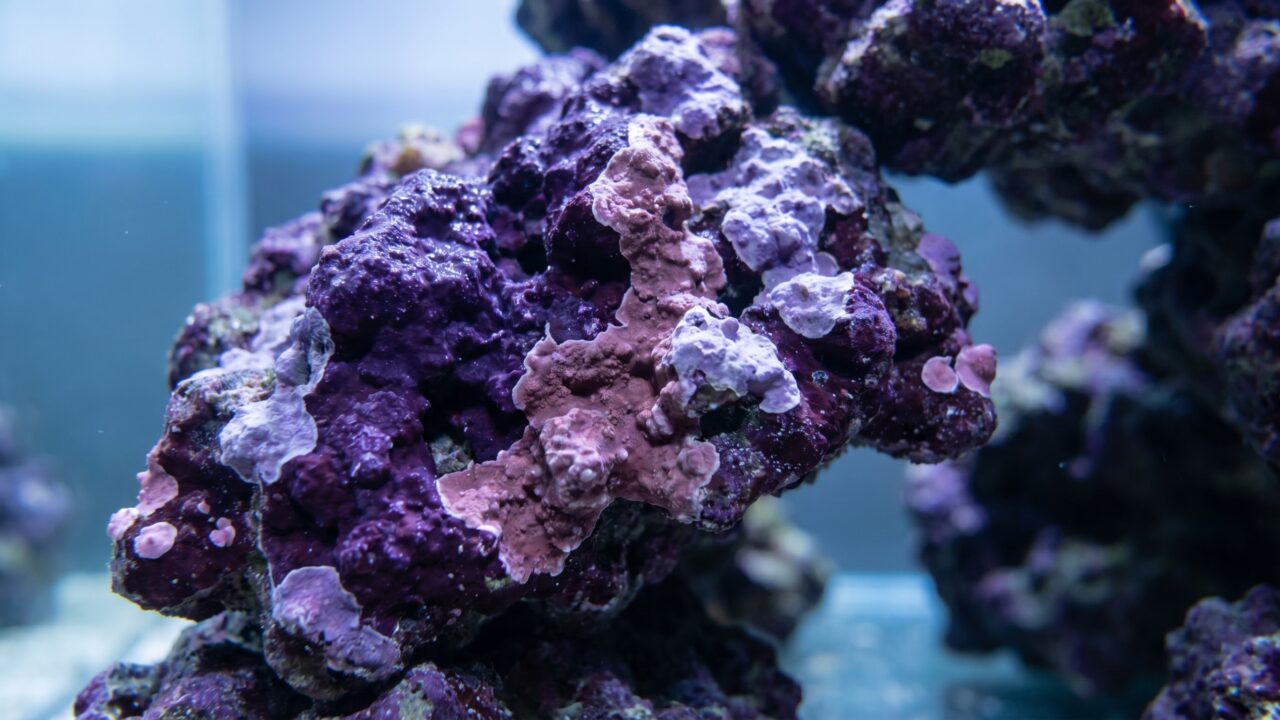
Purple-pink patches spreading slowly across your rock are one of the best signs a reef tank is maturing well. That encrusting growth is coralline algae, and unlike the green fuzz you scrub off the glass every week, this is the kind you want to encourage. Understanding what it is and what it needs makes growing it straightforward.
What coralline algae actually is
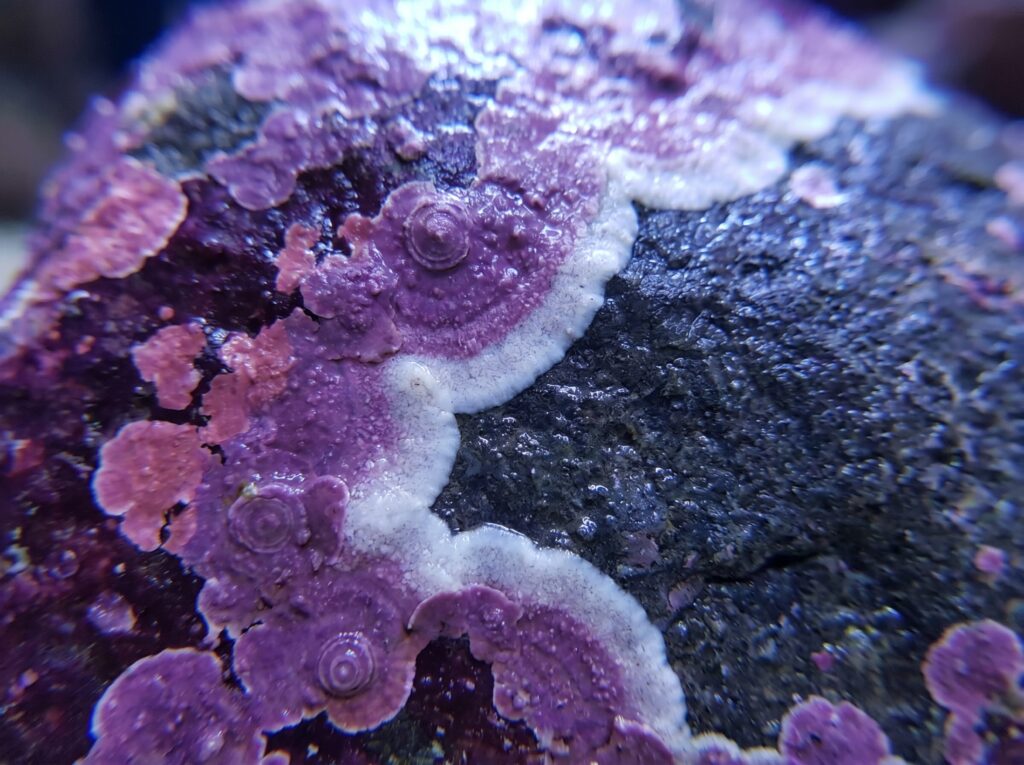
Coralline algae are calcifying members of the red algae division Rhodophyta, belonging to the order Corallinales. More than 1,600 described species exist in the crustose (encrusting) form alone. Unlike soft algae, they build calcium carbonate directly into their cell walls. The mineral they deposit is high-magnesium calcite - not aragonite, which is what most stony corals use. That distinction matters for understanding why magnesium plays such an outsized role in coralline health.
Two growth forms turn up in aquariums. Crustose corallines grow as tight, paint-like sheets that adhere to rock, glass, and equipment. Articulated corallines have jointed, branching fronds that look almost like a small bushy plant. Both share the same calcification chemistry, but the crustose form is what blankets live rock and gives mature reef tanks their signature purple-encrusted look.
Their colors - ranging from dusty pink and lavender to deep purple and occasionally red, white, or even greenish - come from the photosynthetic pigment phycoerythrin, the signature pigment of red algae. Depth and light spectrum shift the ratio of pigments, which is why pieces of the same species can look quite different from one tank to another.
Why reefers want coralline in their tank
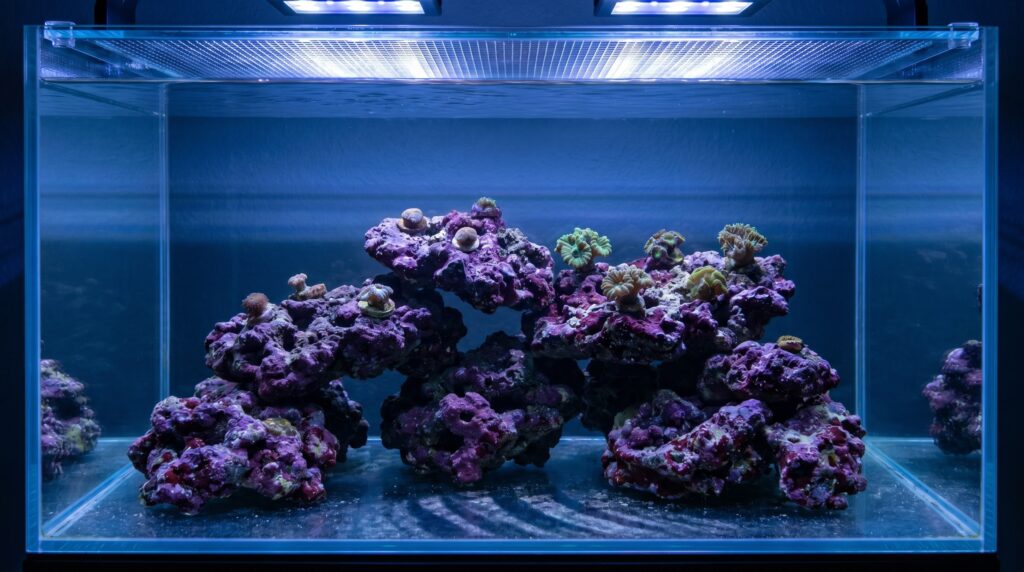
The appeal goes well beyond aesthetics. On natural reefs, crustose coralline algae are described by researchers as "essential structural components of coral reef ecosystems." They add calcareous material to reef structure, help cement rubble and rock together, and in dense reef zones they often cover close to 100% of available rocky substrate. In the aquarium that translates to several real benefits.
Biological cementation. In an aquascape, encrusted coralline gradually binds loose rock together - useful in tanks where physical aquascaping anchors are limited.
Competition against nuisance algae. Coralline physically occupies surface space that would otherwise be colonized by hair algae, diatoms, and other fast-growing nuisance species. Beyond competition for space, scientific research shows that crustose coralline algae also employ allelopathy - chemical signals that deter the settlement of competing seaweeds. The mechanism involves secondary metabolites released into the boundary layer around the algae, plus a natural surface-shedding behavior that physically removes epiphytes before they can establish. A tank with well-established coralline is a harder environment for nuisance algae to dominate. For more on managing the common invaders, see our guide to reef tank algae types.
Coral recruitment signals. On wild reefs, coral larvae actively seek out crustose coralline algae as settlement sites, responding to specific chemical cues the algae release. This has no direct parallel in aquariums stocked with aquacultured coral frags, but it reflects how deeply coralline is woven into reef-ecosystem function.
The maturity signal. Purple rock simply reads as a healthy, established system to any experienced reefer. It builds slowly. A tank covered in coralline tells you the water chemistry has been consistently stable for months - something you cannot fake.
What coralline needs to grow
Coralline algae is a calcifying organism, so it consumes the same three parameters that drive coral growth: calcium, alkalinity, and magnesium. Getting all three into the right range - and keeping them stable - is the whole game. Fluctuating parameters stress coralline more than slightly imperfect numbers do.
Calcium
Calcium is the primary building block of the Mg-calcite skeleton. ATI North America's water quality guidance places the optimal range at 400-450 ppm, consistent with Seachem's dosing specification of 380-420 mg/L. Either range works; the critical thing is that it does not swing more than 20-30 ppm day to day. Low calcium simply stops growth. Pushing calcium well above 500 ppm is not a shortcut to faster growth - at that level, combined with high alkalinity, conditions favor spontaneous calcium carbonate precipitation, which appears as a white haze in the water column and pulls alkalinity down as a secondary effect. More detail on managing this parameter is in our calcium in a reef tank guide.
Alkalinity
Alkalinity provides the carbonate that pairs with calcium to form the mineral skeleton. A target of 8-12 dKH supports coralline well, with many aquarists finding the middle of that range (around 9-10 dKH) the most practical day-to-day aim. Consistency matters more than hitting the exact number. A tank that swings between 7 dKH and 12 dKH in a week is worse for coralline than one that holds 8.5 dKH without variation. Check your water parameters regularly - at least twice a week when coralline is establishing.
Magnesium
Magnesium deserves special attention for coralline algae specifically. Because coralline deposits Mg-calcite rather than pure calcite, it incorporates more magnesium per unit of skeleton than most corals do. Seachem recommends 1200-1350 mg/L; ATI's guidance aligns at 1250-1350 ppm. When coralline growth stalls despite solid calcium and alkalinity numbers, check magnesium first - it depletes quietly and is the most frequently overlooked culprit. Below about 1200 ppm, the chemistry does not allow the high-magnesium calcite mineral to form correctly. Full context for managing this parameter is in our magnesium in a reef tank article.
Light
Coralline is a photosynthetic organism - it cannot grow in complete darkness. But it is also a genuinely low-light-adapted group. Research on the species Porolithon onkodes found that very low light (below about 0.1 mol photons m⁻² day⁻¹) causes rapid discolouration and partial mortality. In practical terms, any aquarium with a working reef lighting schedule provides enough light for coralline on the rock surface. It grows in the shadowed sides of overhangs, behind powerheads, and on the back wall - areas your SPS would never touch. Extremely high-intensity direct light does bleach coralline, so if you notice white patches appearing under a focused spotlight on rockwork, moving the rock slightly or adjusting the schedule helps.
Phosphate and nitrate
Phosphate is the nutrient parameter that most directly affects coralline growth. Phosphate ions adsorb onto calcium carbonate crystal-growth sites, physically blocking calcification - the same mechanism that retards stony coral growth when phosphate climbs too high. The useful working range is 0.03-0.10 ppm: at the lower end of that window coralline tends to calcify fastest, but driving phosphate to zero starves the rest of the system and creates its own problems. Nitrate is less critical for coralline than for some corals, but levels above 10 ppm are associated with slower establishment in new tanks. The goal is a stable, low-nutrient environment, not a sterile one.
The conditions checklist for growing coralline
Use this as a quick reference before and during a coralline-growing push. All ranges assume a system that has completed its nitrogen cycle.
| Parameter | Target range | Common mistake |
|---|---|---|
| Calcium | 400-450 ppm | Letting it drift below 380 ppm; no testing routine |
| Alkalinity | 8-12 dKH | Large daily swings (even within range) halt growth |
| Magnesium | 1250-1350 ppm | Never testing it; it depletes quietly below 1200 ppm |
| Phosphate | 0.03-0.10 ppm | Chasing zero phosphate starves the rest of the system; elevated (above 0.10) inhibits calcification |
| Nitrate | 1-10 ppm | Very high nitrate (above 10 ppm) slows early establishment |
| Temperature | 76-78 F, stable | Swings matter more than exact number; avoid heater failures |
| Salinity | 1.025 SG / 35 ppt | Swings from top-off water evaporation; use an ATO |
| Light | Moderate; any functional reef schedule | Prolonged blackouts kill it; very intense direct spots bleach it |
| Stability | All parameters consistent day to day | Chasing perfect numbers with large daily corrections |
| Spore source | Live rock, frag plugs, or a bottled coralline product | Starting with 100% dry rock and no inoculation |
How to seed coralline in a new tank
Coralline algae reproduces by releasing tiny spores into the water column. Those spores need somewhere to land, adhere, and find the right chemistry to calcify. Seeding is simply a matter of introducing spores and then maintaining the conditions above consistently.
The easiest route is live rock from an established reef. Cured live rock carrying coralline encrustation already has viable spores on its surface, and within weeks of placement in a stable tank you will typically see small pink and purple dots appearing on adjacent surfaces. For more on how live rock compares with dry rock as a starting material, see our live rock vs. dry rock article - the short version is that live rock seeds faster but carries more pest risk.
If you start with dry rock - which is increasingly popular because it arrives pest-free - the tank needs active inoculation. Options:
- A small piece of encrusted live rock as a "seed rock," placed among the dry rock. The resident spores spread naturally over time.
- Scraped material from an established tank. With the aquarium's pumps running, scrape a patch of coralline directly into the water and let the flow distribute the fragments. Turning up the flow while doing this helps distribute spores to distant parts of the aquascape. The more colorful the source, the more varied the final coloration in your tank.
- Bottled coralline spore products. Several commercial products contain concentrated live coralline spores. These work well for tanks starting from scratch with no live rock option.
Regardless of the seeding method, the chemistry has to be ready before you seed, not after. Spores that land in a tank with calcium at 320 ppm simply cannot calcify. Get the parameters stable first, seed second.
Scrape the front glass only
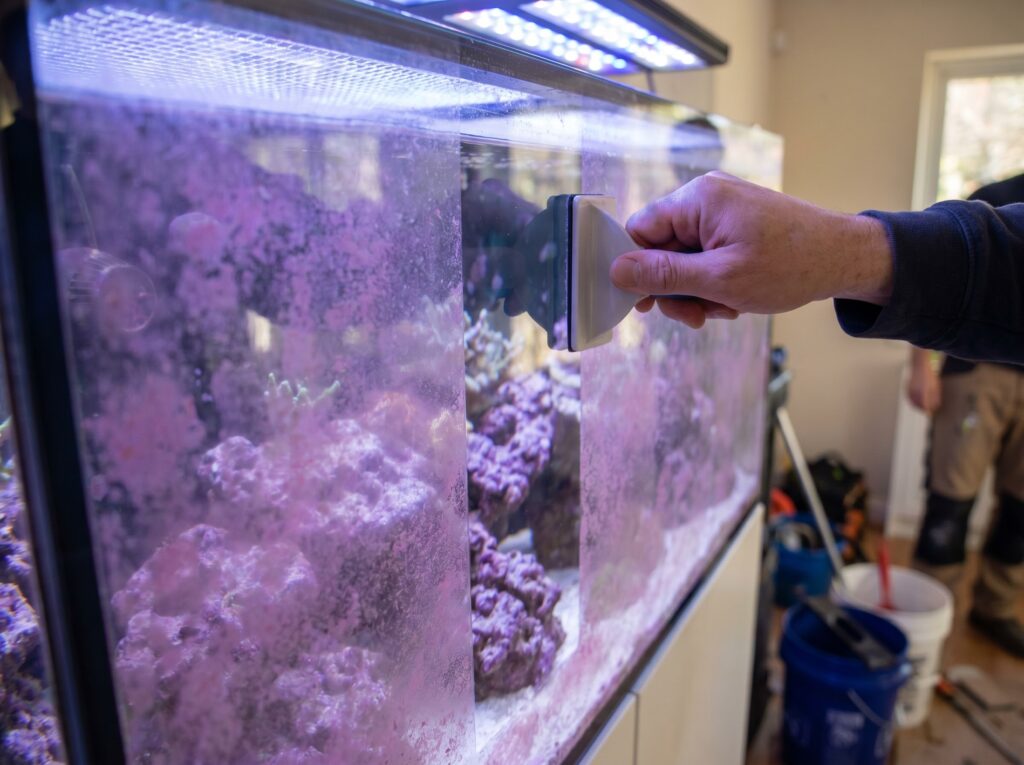
Once coralline establishes, it will grow on every surface - glass, powerheads, overflow boxes, heaters, and the back wall. The back and sides look intentional and add to the mature feel of the tank. The front glass is another matter: a purple-hazed front panel blocks your view and makes the tank look dirtier than it is, not better.
Scraping only the front panel is the standard approach for a reason. Coralline on the sides and back acts as a reservoir of spores and as an established competitive surface that helps suppress nuisance algae. Scraping everything defeats much of the biological benefit. A plastic scraper or razor blade on the front glass, used carefully during weekly maintenance, keeps the view clear while leaving the rest intact. Coralline grows slowly enough that a weekly or bi-weekly wipe is easy to keep up with. The scraped fragments that fall to the substrate are harmless and sometimes re-establish on nearby rock.
Frequently asked questions
How long does coralline algae take to appear?
With a good spore source and stable water chemistry, small pink or purple dots typically appear within four to eight weeks. Full encrustation of the rockwork takes longer - expect six to 12 months in a well-maintained tank. The timeline is heavily influenced by parameter consistency: a tank that holds calcium and alkalinity steady every day grows coralline noticeably faster than one that swings.
Can coralline algae grow on equipment and powerheads?
Yes, and it does. It will colonize heaters, powerhead housing, overflow boxes, and return pipes given time. Most reefers leave it alone on equipment - it does no harm and contributes to the established look. If it begins to clog intake screens or impellers, remove those parts during maintenance and scrub them separately.
Is the white stuff on my rock dead coralline?
Almost certainly yes. Coralline that dies bleaches to chalky white while the calcium carbonate skeleton remains. The usual causes are a sharp parameter crash (calcium or alkalinity dropping rapidly), a temperature spike, or physical damage. The white patches can re-colonize if the underlying cause is fixed and viable spores are still circulating in the water.
Does coralline algae directly harm corals?
It does not harm established corals and will not overgrow healthy coral tissue. It may slowly encroach on the base of a frag plug, but it stops at living tissue. Some aquarists gently scrape the plug bases during frag maintenance to keep the coral skeleton clear.