The best salt mix for a reef tank (matched to what you keep)
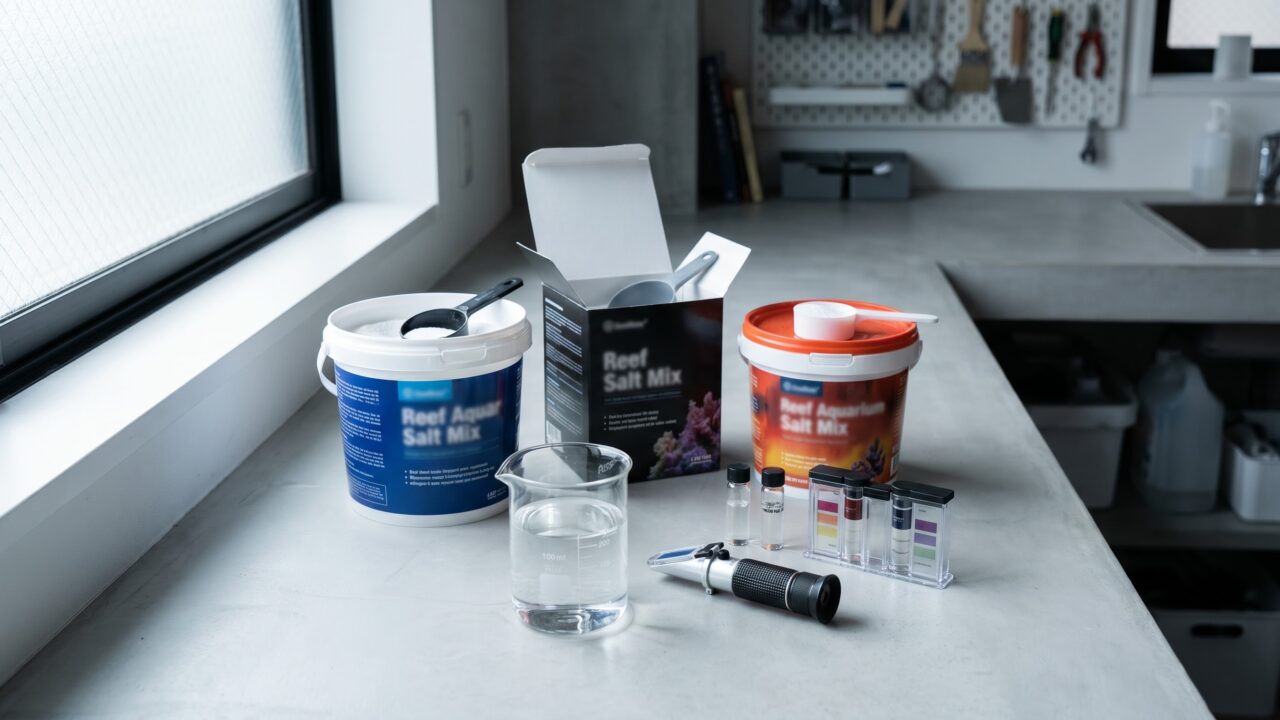
Pick any two popular reef salts and mix them both to 1.025 specific gravity - you will get water with noticeably different alkalinity, calcium, and magnesium readings. That gap is the only thing that truly matters when choosing a salt mix. Everything else (packaging, brand loyalty, marketing language about "reef-ready formulas") is mostly noise. Match the mix's big-three chemistry to the livestock you keep and the dosing habits you have, and you will spend far less time chasing numbers.
The broad split is simple. Fish-only and soft-coral tanks do fine on a natural seawater (NSW) level mix - roughly 7-8 dKH alkalinity, 400 mg/L calcium, 1,260-1,320 mg/L magnesium. Mixed reef and stony coral tanks, especially those running LPS or SPS, benefit from mixes that start elevated - 8-12 dKH alkalinity, 420-480 mg/L calcium - so that water changes themselves replenish what corals consume and reduce how aggressively you need to dose. Below is the full breakdown by category, including what each costs per typical water change.
What "the big three" actually means in a salt mix
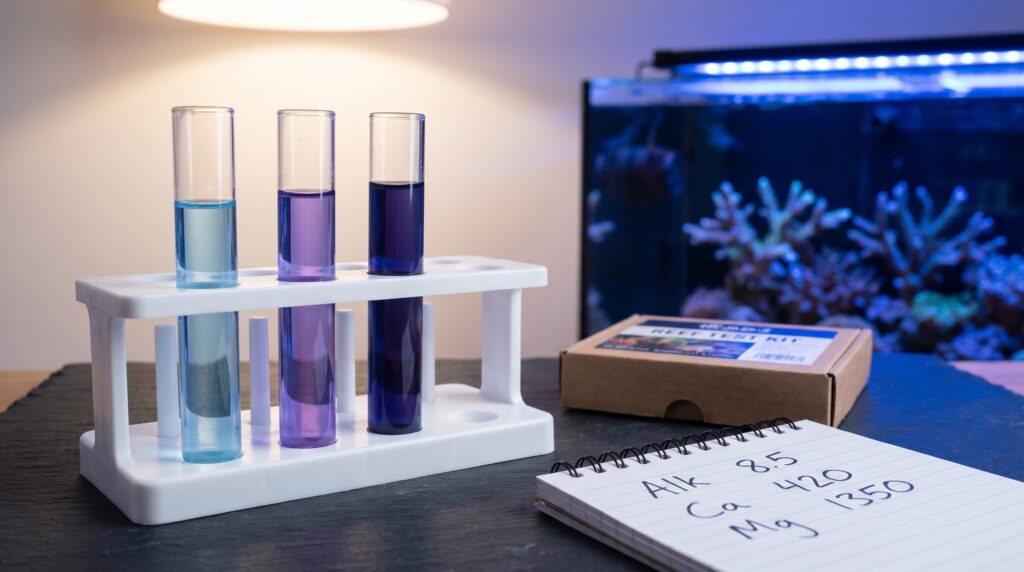
Alkalinity, calcium, and magnesium are the three elements stony corals use fastest and in largest quantity to build calcium carbonate skeletons. Natural open-ocean seawater carries roughly 400-411 mg/L calcium, 1,262-1,350 mg/L magnesium, and alkalinity around 100-130 mg/L as CaCO3 (roughly 6-7 dKH), according to published seawater chemistry data. Those are the baseline numbers every salt manufacturer references.
A fish-only or softie system does not consume these elements at a rate that demands anything above NSW levels. A mature SPS tank, on the other hand, pulls alkalinity and calcium down every day - sometimes fast. A salt that delivers elevated starting levels means each water change puts back a meaningful chunk of what the corals have burned, so your dosing system only needs to top up the gap rather than carry the whole load.
Magnesium underpins both numbers. It prevents calcium carbonate from precipitating out of solution, so if magnesium runs low, neither calcium nor alkalinity will hold steady no matter what you dose. The roughly 3:1 ratio of magnesium to calcium in seawater (around 1,300 mg/L to 400 mg/L) is not arbitrary - it is the balance the reef chemistry naturally maintains. A well-formulated salt preserves that ratio. Checking whether your chosen mix does this is worth five minutes with a test kit on your first bucket.
For a deeper look at how these three numbers interact inside your tank, the full water parameters guide covers the mechanisms and troubleshooting in detail.
Salt mix categories: who each one suits
The table below maps the main parameter profiles to tank types, with representative brands from each category and an approximate cost per 10-gallon water change - a common weekly exchange on a mid-size reef. Prices are for 200-gallon bucket formats, which offer the best per-gallon value.
| Category | Alkalinity | Calcium | Magnesium | Best suited for | Example brands | Approx. cost per 10-gal WC |
|---|---|---|---|---|---|---|
| NSW-level | 7-8 dKH | 400-422 mg/L | 1,260-1,340 mg/L | Fish-only, FOWLR, soft corals; advanced SPS keepers who dose heavily and want a neutral base | Instant Ocean Sea Salt, Aquavitro Salinity, Tropic Marin Pro-Reef | ~$2.50-4.50 |
| Moderate-elevated | 8-10 dKH | 420-450 mg/L | 1,250-1,400 mg/L | Mixed reef with LPS and softies; beginners building toward stony corals; anyone who does not dose regularly | Red Sea Salt (blue bucket), Fritz RPM, Instant Ocean Reef Crystals, Tropic Marin Classic | ~$2.50-5.00 |
| High-alkalinity / reef pro | 11-12.5 dKH | 430-480 mg/L | 1,280-1,430 mg/L | Active SPS or frag tank; fast-growing stony coral systems; anyone who wants water changes to do heavy lifting on replenishment | Red Sea Coral Pro Salt | ~$4.50-8.00 |
A few clarifications on how to read this table. The cost ranges reflect both brand differences and purchasing format (larger buckets cut cost per gallon significantly). "Approx. cost per 10-gal WC" assumes 10 gallons of new saltwater mixed per water change - a common exchange volume for tanks in the 40-90 gallon range. Scale it linearly for your tank: a 20-gallon exchange doubles the number, a 5-gallon halves it.
The alkalinity column matters most for deciding which category applies to you. If you run a two-part dosing system or a calcium reactor and already dial in your chemistry daily, a NSW-level salt is perfectly reasonable for a stony tank - you have the dosing to compensate. If you change water weekly and do not dose between changes, a moderate-elevated or high-alkalinity mix gives your tank a more consistent chemistry floor.
How to calculate your real cost per water change
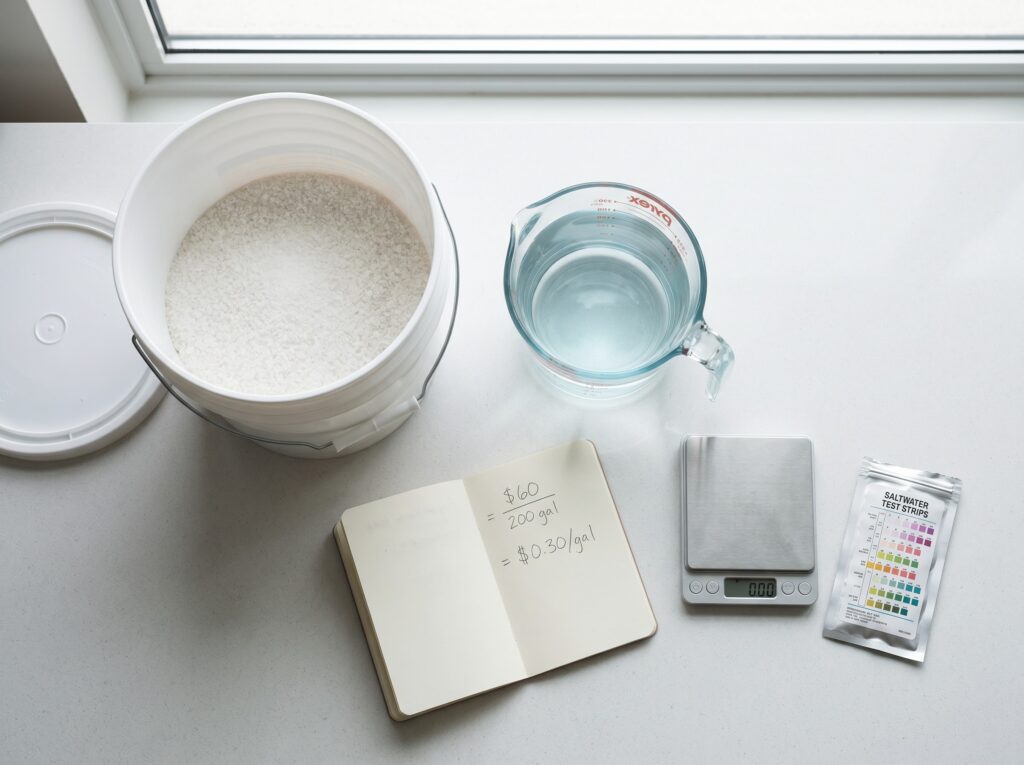
Salt mix marketing nearly always quotes cost per gallon, not cost per water change - which is what you actually spend every week. Here is the straightforward math:
Step 1. Divide the bucket price by the number of gallons it makes. A $60 bucket that makes 200 gallons = $0.30 per gallon.
Step 2. Multiply by the gallons you change per session. If you swap 10 gallons weekly, that is $0.30 x 10 = $3.00 per water change.
Step 3. Multiply by annual frequency. 52 water changes x $3.00 = $156 per year for that bucket format.
The price difference between a budget NSW-level mix at ~$0.25/gallon and a premium reef-pro mix at ~$0.70/gallon works out to roughly $94/year extra on a 40-gallon tank doing 10% weekly water changes (about 4 gallons per change), or roughly $235/year on a 100-gallon system at the same exchange rate. Whether that gap is worth it depends entirely on what corals you keep and how much you want the salt itself to buffer your chemistry between doses. For a fish-only setup, the premium is hard to justify. For a dense SPS system with fast growth, many experienced reefers consider it the cheapest insurance against parameter swings.
For the mechanics of actually mixing saltwater safely and consistently, see the guide on how to mix saltwater for a reef tank.
Brand profiles: what the specs actually look like
Rather than ranking brands by preference, the more useful lens is understanding what each one delivers so you can match it to your system.
Instant Ocean Sea Salt
A genuine NSW-level mix. At SG 1.026 it targets 400 mg/L calcium and 1,320 mg/L magnesium - numbers drawn directly from natural seawater data. Instant Ocean documents these targets explicitly: "engineered to closely match natural seawater." Alkalinity lands around 7-8 dKH in clean RODI water. It is the lowest-cost major brand, widely available, and entirely appropriate for fish-only and soft-coral systems. For a stony coral tank it works fine if you dose the difference.
Instant Ocean Reef Crystals
Reef Crystals is Instant Ocean's enriched version - the same base with boosted calcium and trace elements. Instant Ocean does not publish a specific dKH figure for freshly mixed Reef Crystals; the alkalinity of a new mix varies by batch and mixing conditions, so test your freshly mixed water before adding it to the tank. It is positioned for beginner reef tanks that want a bit more buffer without jumping to a premium price. Cost is a step up from plain Instant Ocean but still competitive, generally in the $0.42-0.50 per gallon range for the 200-gallon format.
Red Sea Salt (blue bucket)
Red Sea documents this product at 7.8-8.2 dKH alkalinity, 420-440 mg/L calcium, and 1,250-1,310 mg/L magnesium at 35.5 ppt - a moderate-elevated profile. Red Sea describes it as "ideal for all reef aquarium types" because its levels are meaningful for corals without being so elevated that they demand active management. It sits in the same general cost band as Fritz RPM.
Red Sea Coral Pro Salt (black/red bucket)
This is the high-alkalinity option from Red Sea. Alkalinity is 12 dKH (range 11.5-12.5 dKH), calcium runs 450-480 ppm at 35 ppt, and magnesium 1,350-1,430 ppm. Red Sea positions it for "mixed reefs and SPS frag tanks" - systems where fast coral growth means high consumption. At those alkalinity levels, a 10% weekly water change delivers a meaningful replenishment. The trade-off is that if you do large water changes on a low-consumption tank, you may push alkalinity higher than intended; test after changes.
Fritz RPM (Reef Pro Mix)
Fritz publishes unusually transparent QC ranges: 400-450 ppm calcium, 1,300-1,400 ppm magnesium, 8.0-9.0 dKH alkalinity. The specification note that "RPM parameters reflect Fritz Aquatics' QC pass ranges, the median is targeted" is a reasonable degree of honest batch disclosure. It sits firmly in the moderate-elevated category and is priced competitively with Red Sea Salt.
Aquavitro Salinity
Seachem's reef-focused brand publishes precise targets: 422 mg/L calcium (range 400-443), 1,336 mg/L magnesium (range 1,269-1,403), and 3.2-3.8 meq/L alkalinity (approximately 9-10.5 dKH). The manufacturer lists a freshly mixed pH of 8.4-8.6, though in a running reef system pH is governed by gas exchange and biology, not the salt - a freshly mixed bucket reading above 8.4 will settle once water enters the tank. It is formulated to match the midpoint of global ocean data for each element. This falls in the moderate-elevated category with a slight edge toward the higher end of alkalinity.
Tropic Marin Classic and Pro-Reef
Tropic Marin makes two formulations worth knowing. Classic is described as a 9-10 dKH salt manufactured from pharmaceutical-grade salts - the company notes it has been used in public aquariums and scientific institutions for decades. Pro-Reef targets a lower 7-8 dKH alkalinity per the manufacturer's guidance, with calcium and magnesium in line with other NSW-level products, intended for advanced reef systems where the keeper handles element replenishment precisely. The reversed logic (Classic higher, Pro-Reef lower) surprises beginners: the "pro" label here means "you are doing the fine-tuning yourself, not relying on the salt."
Consistency beats brand-hopping
The single most common salt-related mistake is switching brands every few months in search of the "best" mix. Different brands calibrate their formulas differently. Moving from an 8 dKH salt to a 12 dKH salt in one water change can spike alkalinity fast enough to cause coral stress and polyp retraction. The opposite jump - from 12 to 7 dKH - drops the buffer and may destabilize pH overnight.
If you decide to switch, do it gradually over three to four water changes, blending old and new salt at increasing proportions while testing after each change. Most tanks stabilize quickly once the transition is complete. What they do not handle well is repeated abrupt swings - the kind that happen when a reefer buys whichever brand is on sale each month. Always use RODI water when mixing any salt; tap water carries its own calcium, carbonate hardness, and trace contaminants that vary by region and will distort the final reading.
Consistency also matters within a brand. Test a fresh batch of your usual salt before using it, particularly if the bucket sat in storage for a long time or came from a different production run. Alkalinity is the parameter most sensitive to variation between batches.
For context on what stable parameters should look like in a running system - and what "stable" actually means for alkalinity, calcium, and magnesium - the reef tank maintenance guide covers the full routine.
A practical decision path
Three questions narrow the choice quickly:
- Fish-only or FOWLR? Any NSW-level mix is fine. Spending more for elevated parameters is unnecessary.
- Mixed reef with softies and some LPS? Moderate-elevated is the right category. Reef Crystals, Red Sea Salt, or Fritz RPM all fit. Pick one and stay with it.
- Active SPS or frag tank? Either a high-alkalinity mix like Coral Pro or a NSW-level mix paired with a robust dosing system. If you already run two-part or a calcium reactor, alkalinity starting point matters less than consistency - go NSW and dose the difference. If you do not dose, the high-alkalinity option lets water changes carry more of the load.
One thing all three paths share: use RODI water, mix thoroughly (24 hours with a powerhead is the practical standard), match temperature and salinity before adding new water to the tank. The salt brand matters far less than the discipline around how you mix and when you test. A mediocre salt used consistently outperforms an excellent salt used carelessly every time.
Frequently asked questions
Does using a high-alkalinity salt mean I do not need to dose?
Not entirely. High-alkalinity salts like Red Sea Coral Pro (12 dKH) replenish more with each water change, but a densely stocked SPS tank will still consume alkalinity and calcium faster than weekly 10% water changes can replace. You may need to dose less, but probably not stop entirely. Test regularly and let the numbers guide you.
Can I use a reef salt mix in a fish-only tank?
Yes, it will not harm fish. The elevated parameters in a reef salt are only significant relative to what stony corals consume. In a fish-only system you are just spending more per gallon than you need to. Use a NSW-level mix and save the difference.
How much does source water affect the salt's final parameters?
Significantly, which is why the guide emphasizes RODI water. Tap water carries calcium, magnesium, and carbonate hardness of its own - levels that vary by region. Mixed into a salt, tap water inflates or distorts the final readings unpredictably. RODI water starts at effectively zero, so your salt's documented parameters reflect what you actually get.
How long should I mix salt before using it?
Most manufacturers recommend mixing until fully dissolved with good circulation - typically 24 hours. Some salts dissolve faster, but 24 hours ensures full saturation and allows pH and alkalinity to stabilize. Do not add freshly mixed salt immediately after combining dry salt and water; let it equalize first.