The best light for a nano reef tank: fixtures, PAR targets, and how to choose for your corals
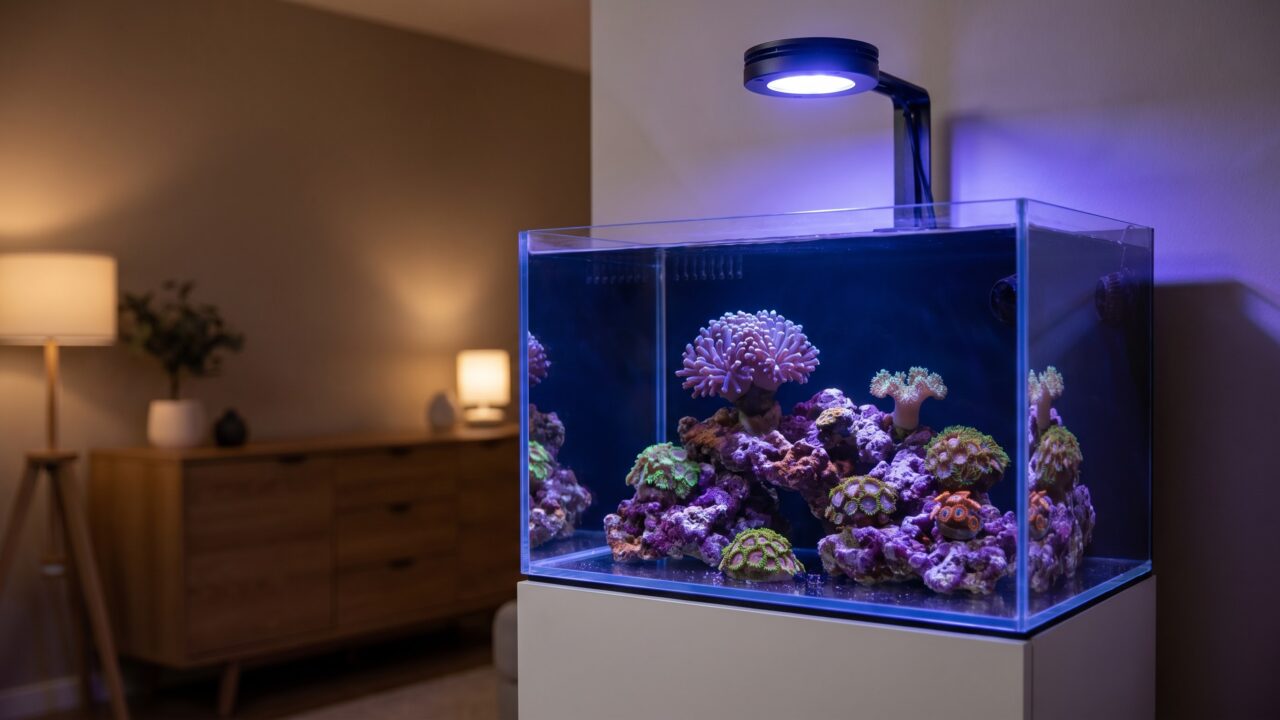
Pick the wrong light and your corals tell you immediately - bleached patches within days, or slow browning that makes every polyp look defeated. Pick the right one and a 15-gallon tank can look like a slice of the Indo-Pacific. The tricky part is that "right" means something different depending on whether you are growing softies or chasing SPS frags, and the small water volume of a nano reef adds two constraints a larger system does not face: footprint matters, and heat from an oversized fixture can destabilize temperature in a tank with almost no thermal mass.
This guide covers what nano reefs actually need from a light, how the popular fixtures compare on the specs that matter, and - most practically - which fixture makes sense for which goal. If you want the background on PAR itself, our PAR explainer covers how to measure it and what the numbers mean.
What a nano reef needs from a light (and what it does not)
Coral photosynthesis depends on two things: intensity (measured as PAR, in µmol/m²/s) and spectral quality. Research published in the Journal of Experimental Biology on Stylophora pistillata established that blue and violet wavelengths (roughly 400-500 nm) drive higher zooxanthellae density, chlorophyll a content, and photosynthesis rates than red-dominated light - which is why good reef LEDs are heavy on royal blue and violet channels, with white added for rendering and color pop. The same research showed that depth zonation on natural reefs "is largely driven by the amount of downwelling PAR absorbed by the symbiotic algae of corals," with both intensity and spectral quality setting the floor for what can live where.
For a nano reef, translate that science into three practical requirements:
- Adequate PAR at depth. A shallow 12-15 gallon cube with 10 inches of water needs a fixture that reaches its sand bed with useful light. An underpowered clip-on often delivers 20-40 PAR at substrate level - fine for mushrooms, insufficient for anything else.
- Low heat output. A 95-watt fixture over a 10-gallon tank is a problem even if it produces spectacular growth in a 30-gallon. The small water volume heats up fast, and chasing a stable 76-78°F becomes a constant battle.
- A footprint that fits. Most nano tanks are 12-18 inches wide. A 7×7-inch puck light is reasonable; a 24-inch bar fixture designed for a 90-gallon is not.
What a nano reef does not need: the highest PAR per dollar on the market. Overshooting PAR is a genuine problem. A 2024 PLOS One study measuring irradiance on natural reef corals at just 3 meters depth found horizontal surfaces received ~735 µmol/m²/s at noon - but that same study found vertical and shaded surfaces received as little as 71 µmol/m²/s. The corals work with a range, and zooxanthellate species adapt their photosynthetic machinery to local conditions. In captivity, a PAR above roughly 500 can bleach corals within days, particularly when they have not been acclimated gradually.
PAR targets by coral goal
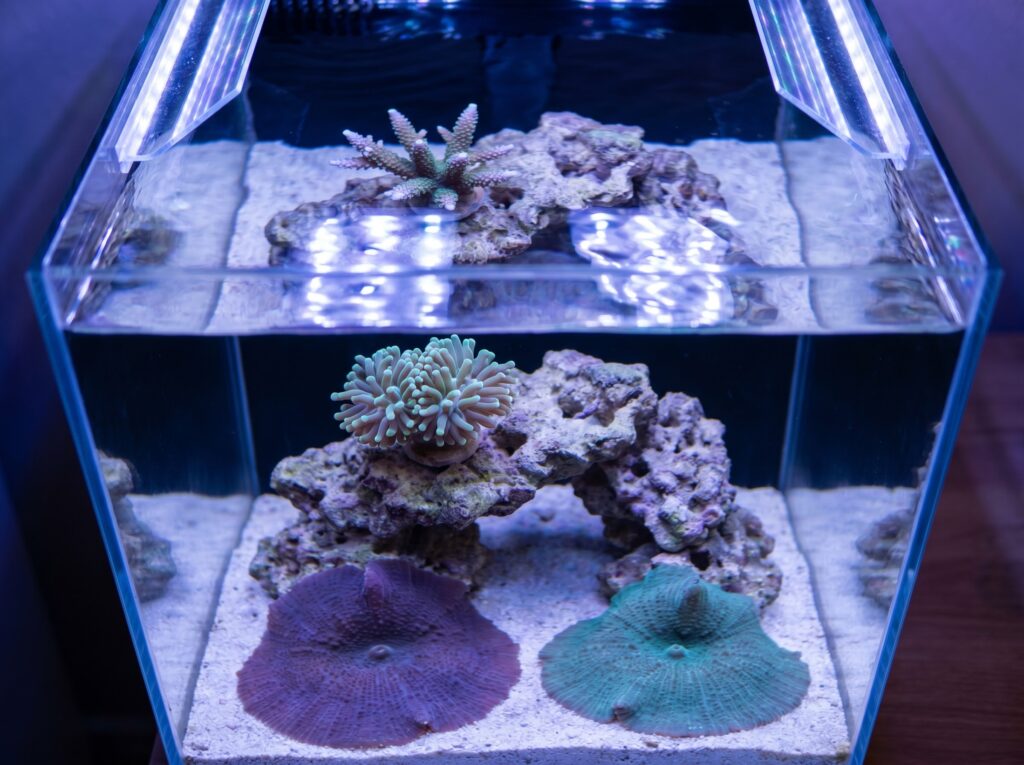
Before comparing fixtures, know your target. Veterinary and reef-husbandry references consistently group corals into three light demand tiers:
- Low demand (50-100 PAR): mushroom corals (Discosoma, Rhodactis), most Ricordea.
- Moderate demand (100-200 PAR): soft corals (leathers, toadstools, xenia), zoanthids, most LPS (hammer, frogspawn, torch, brain corals).
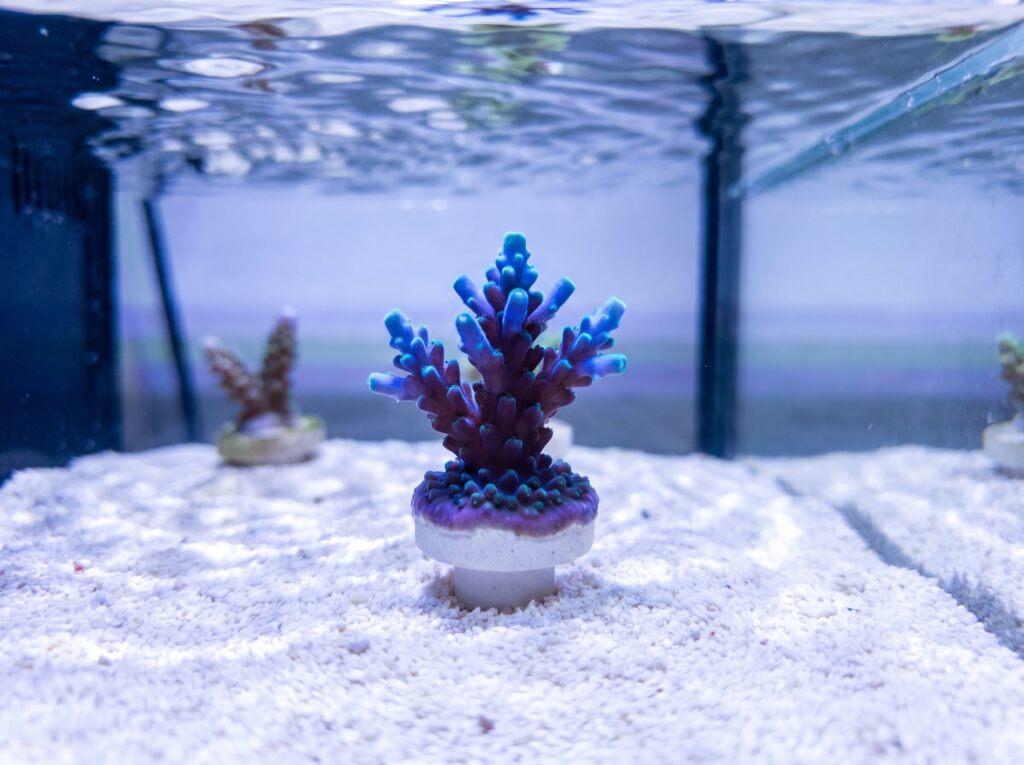
- High demand (200-400+ PAR): SPS - Acropora, Montipora, Pocillopora, Seriatopora.
A softie-and-mushroom nano is the most forgiving setup you can run under a light. An LPS nano needs a fixture with enough output to sustain 100-200 PAR consistently at mid-column, maybe 8-10 inches below the surface. An SPS nano is a different beast entirely - Acropora species in particular are demanding enough that most coral vendors recommend at minimum 40 gallons for a stable display, specifically because parameter swings in smaller volumes are hard to prevent, and Acropora "does not tolerate well" the resulting instability. That does not mean SPS is impossible in 20 gallons, but it does mean the light is the least of your challenges, and starting with softies or LPS is a more sensible path if you are building your first nano reef. For more on which corals suit a nano build, see our nano reef build guide.
These targets are also where you measure, not where the fixture is rated. A light advertising "300 PAR" typically measures that value directly at the glass surface or at some shallow test depth. At 12 inches of water depth in a real tank, the number is considerably lower. The only way to know your actual PAR at coral placement is to measure it - the Apogee MQ-510 (spectral range 389-692 nm, ±5% calibration uncertainty) is the standard tool, and many local reef clubs and online vendors offer rentals.
Mounting types: clip-on, arm, and hood
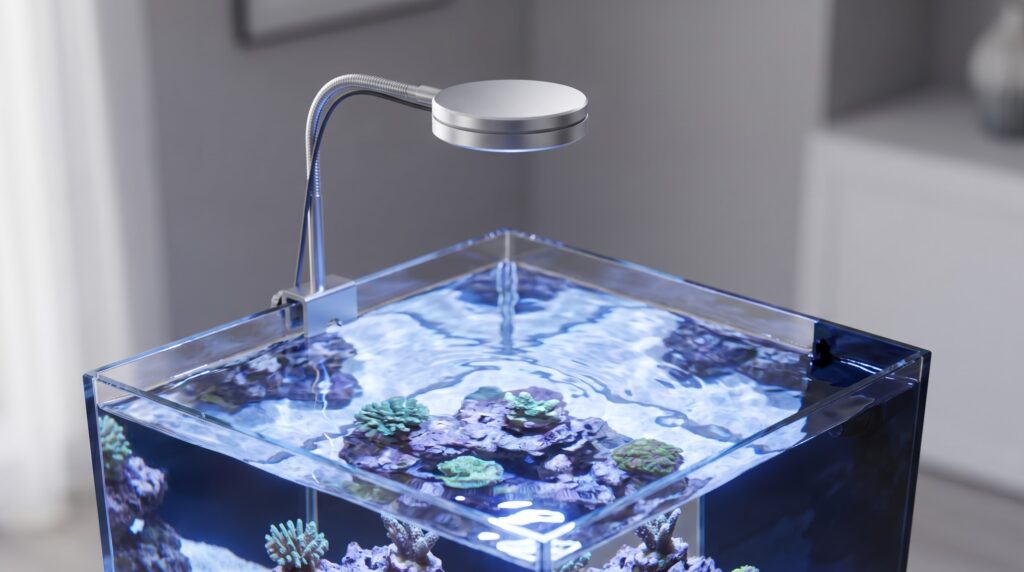
How a fixture mounts to your tank shapes the entire experience of owning it, and nano reef lighting comes in three main configurations.
Gooseneck / flex-arm clip-on. The gooseneck mount clamps to the tank rim and lets you swing and tilt the fixture over the water. The arm rotates side-to-side and can be angled back away from the glass for maintenance access. These fit rimless tanks up to about half an inch thick and are easy to reposition - lift the arm, reach in, done. The downside is limited height range: most nano goosenecks max out around 8-12 inches above the water surface, which constrains how wide the beam spreads before it hits the glass walls. Good for pico tanks and AIO nano tanks where hood access is tight.
Hanging arm / adjustable stand. Fixtures like the Kessil A160WE and AI Prime ship with or pair with a mounting arm that attaches to the tank's rear wall or sits on top of the rim with adjustable height. The Kessil arm lets you position the puck at 6-10 inches above water, which is the sweet spot for coverage without excessive intensity at the surface. This is the most common setup for 10-25 gallon rimless tanks because it is rigid, easy to clean around, and lets you match height to PAR target.
Integrated hood / retrofit. Many AIO nano tanks (Red Sea Max Nano, Waterbox AIO, Coralife BioCube) have a built-in lighting hood or a slot specifically for one branded fixture. The Red Sea Max Nano ships with a mounting slot for the ReefLED 50, which sits in a fixed position above the tank. This is convenient but removes the ability to fine-tune mounting height. Know the PAR map of your specific fixture-and-tank combination before committing corals to fixed positions.
The nano fixture comparison
The table below covers the fixtures most commonly used on tanks from pico size up to roughly 25 gallons. All wattage and coverage figures are from manufacturer specification pages.
| Fixture | Wattage | Footprint | Coverage (soft coral) | Coverage (mixed reef) | Mount type | App / controller | Best-fit goal |
|---|---|---|---|---|---|---|---|
| Kessil A80 Tuna Blue | 15 W | ~1" x 4.9" | 18" x 18" | 12" x 12" | Arm / gooseneck (sold separately) | Spectral controller (optional) | Pico and 5-10 gal softie reef |
| Current USA Orbit Marine Nano | 16 W | 7" x 3.5" | ~20" span | - | Gooseneck clip-on (included) | IR remote (included) | 5-15 gal softie and low-LPS; budget pick |
| Kessil A160WE Tuna Blue | 40 W | ~2.5" x 4" | 24" x 24" | 18" x 18" | Arm / gooseneck (sold separately) | Spectral controller (optional) | 10-20 gal mixed softie/LPS reef |
| AI Prime 16HD Reef | 59 W | 4.9" x 4.9" | 24" x 24" | ~16" x 16" (manufacturer guidance) | Arm (sold separately) or hung | MyAI app (Bluetooth, included) | 10-20 gal mixed reef; LPS and entry SPS |
| Red Sea ReefLED 50 | 50 W | Compact puck | 14-20" wide tanks | 14-20" wide tanks | Clip / mounting arm (arm sold separately) | ReefBeat app (Wi-Fi) | 10-20 gal; Max Nano pairing; softie to LPS |
| EcoTech Radion XR15 G6 | 95 W | 7" x 7" | 24-30" wide tanks | 24-30" wide tanks | Hanging arm (sold separately) | EcoSmart Live app (included) | 20-25 gal SPS nano; premium mixed reef |
Per-goal pick: which fixture for which reef
Softie and mushroom nano (5-15 gallons). The Kessil A80 is the cleanest choice here. At 15 W it generates almost no heat, runs silently (fanless, with the body as heatsink), and delivers enough PAR for zoanthids, leathers, and even a few easy LPS placed mid-column. The puck is tiny enough to mount above a pico tank without dominating it visually. The Current USA Orbit Marine Nano is a sensible budget alternative for tanks up to 25 gallons - it lacks per-channel programming depth, but the gooseneck is included and the dimming controls are straightforward.
Mixed softie and LPS nano (10-20 gallons). The Kessil A160WE and the AI Prime 16HD are the two fixtures most reef keepers land on at this level, and they suit slightly different preferences. The A160WE is a 40 W puck with Kessil's Dense Matrix LED array, which produces notably tight, shimmer-heavy light that many reef keepers find visually appealing. Its two-knob control (intensity and spectrum) is simple to set but limited - no per-channel scheduling without the optional controller. The AI Prime 16HD draws more power (59 W) but gives you 16 individually controlled channels via Bluetooth app, which means you can dial in precise schedules with dawn and dusk ramps. Both fixtures cover an 18-24-inch footprint at the mounting heights typical for nano tanks. The Prime edges ahead if programming flexibility matters; the A160WE wins on simplicity and shimmer.
SPS-focused nano (20-25 gallons). This is where the EcoTech Radion XR15 G6 earns its place. At 95 W with 50 LEDs across 10 channels and a 126-degree beam, it can sustain 250-400 PAR at mid-column depths on a 20-25 gallon tank - which is what Acropora and Montipora genuinely need. The caveat bears repeating: SPS success in a nano comes down to parameter stability first. The light can deliver the PAR; keeping alkalinity, calcium, and temperature stable in a small volume requires reliable dosing and top-off equipment. The Red Sea ReefLED 90 (90 W, 500 PAR at surface, 150 PAR at 50 cm depth across a 24"x24" footprint) is a strong alternative here, especially for tanks running the Red Sea ecosystem with the ReefBeat app. For more on the overall approach to building a nano reef, see our nano reef build guide and the broader reef lighting overview.
Acclimating corals to a new light
Switching lights or adding corals to a freshly lit tank is the moment most bleaching incidents start. The zooxanthellae inside coral tissue adjust their photopigments over time - a coral that lived under 80 PAR at the vendor can bleach under 200 PAR in your system, even if 200 is the right long-term target for that species.
A commonly used starting point is to run new corals at roughly 50% of your target intensity for the first two weeks, then raise output gradually - about 10% per week - until you reach your goal. Place SPS frags low in the water column first and move them up as they show good color and extension. The same approach applies when you replace an old fixture: dial the new light down to 50-60% output, hold for two weeks, then ramp up steadily. Bleaching from sudden PAR increase can occur quickly - often within days - when corals are exposed to PAR well above 500 without prior acclimation. A gradual ramp-up at the start of each photoperiod and a ramp-down at the end - a feature built into any app-controlled fixture - also reduces daily photostress on both corals and fish.
The overall daily photoperiod should fall between 8 and 12 hours. Running lights for 14 or 16 hours does not produce faster growth - it mostly feeds nuisance algae. Ten hours with a proper intensity ramp is a reliable starting point for any nano reef.
Frequently asked questions
Can I use a freshwater planted LED on a nano reef?
Generally no. Freshwater planted LEDs optimize for red (660-680 nm) and some blue, matching chlorophyll absorption for aquatic plants. Reef corals use their zooxanthellae most effectively under blue and violet wavelengths (400-500 nm). A planted LED will support some photosynthesis in soft corals, but color rendering is poor and growth rates will lag. Use a reef-specific fixture.
Do I need a PAR meter?
Not strictly, but it removes guesswork. Manufacturer PAR ratings are measured under controlled conditions that rarely match your actual setup - different water depth, mounting height, water clarity, and lens angle all shift the number. If you plan to keep LPS or SPS, renting an Apogee MQ-510 for a day (many reef clubs and vendors offer rentals) is worth the small cost to map your actual PAR before placing expensive corals.
My nano tank keeps warming up when the light runs. What should I do?
Reduce the fixture's output to 70-80% and check whether your refuge/sump area has adequate airflow. A fixture drawing 95 W over a 10-gallon tank is genuinely oversized - consider stepping down to a 40-60 W fixture. Small fans drawing air across the water surface are cheap and effective at managing heat in nano setups. Temperature stability at 76-78°F matters more than squeezing extra PAR from a hot light.
How often do LED reef lights need to be replaced?
Quality reef LEDs typically last 50,000+ hours before meaningful output degradation. At a 10-hour daily photoperiod that is roughly 13 years of use, though most reef keepers upgrade before their LEDs fail. Diodes in lower-cost fixtures can shift spectrum over 2-3 years, so periodic PAR checks catch quiet declines before corals show stress.