Reef tank lighting explained: what corals actually need and how to choose a fixture
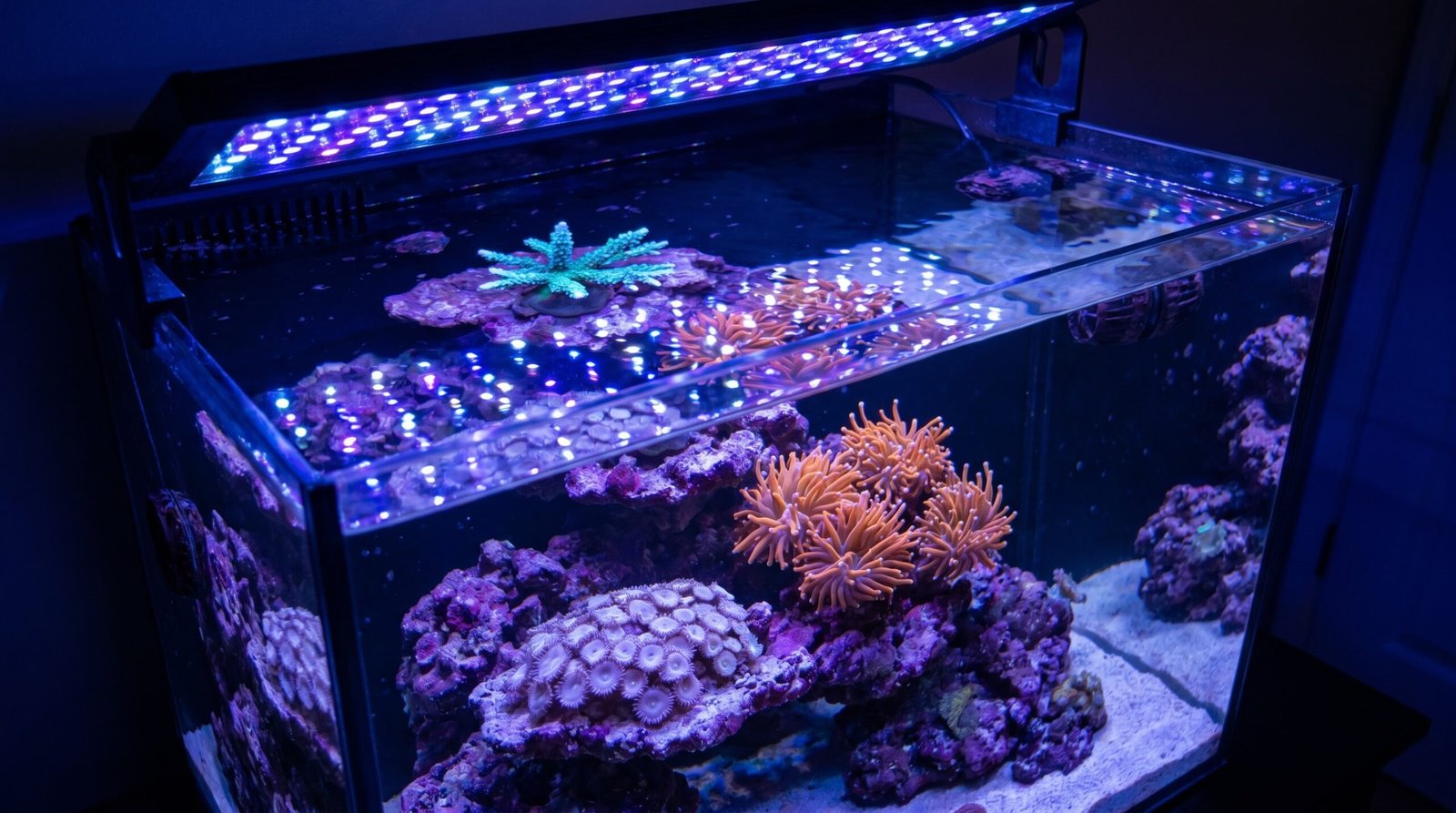
Your coral is not feeding on fish food. It is running a solar panel. Reef-building corals host millions of microscopic algae called zooxanthellae inside their own tissue, and those algae capture light and convert it into sugars that the coral uses for energy and growth. According to NOAA, as much as 90 percent of the organic material the zooxanthellae produce is transferred directly to the host coral. The light above your tank is not decoration – it is the engine that keeps your corals alive.
That single fact shapes every lighting decision you will make: fixture type, intensity, spectrum, and how many hours per day your lights run. This guide explains the science simply, gives you concrete numbers to work with, and ends with a decision table that maps your coral ambitions to the light requirements they actually carry.
Why corals need light: the zooxanthellae story
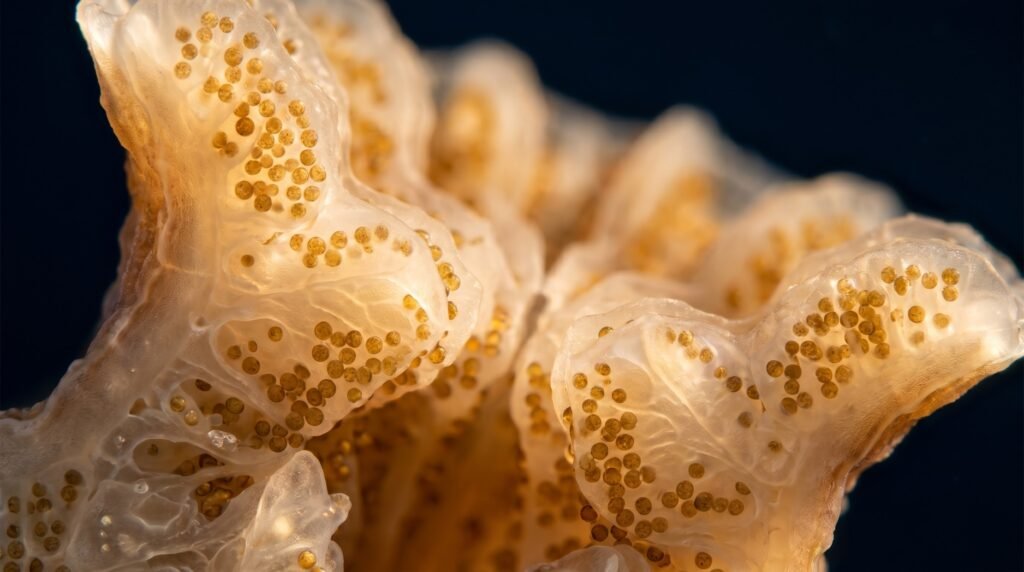
Zooxanthellae (Symbiodinium spp.) are single-celled dinoflagellates – a type of photosynthetic algae – that live within coral tissue. The coral gives them shelter, carbon dioxide, and water. In return, the algae supply oxygen, sugars, and organic compounds that power the coral’s metabolism and skeleton-building. The partnership is so tight that reef-building corals literally cannot survive long in the dark: remove the light, the algae die or leave, and the coral starves and bleaches white.
Bleaching is what happens when a stressed coral expels its zooxanthellae. NOAA describes the result precisely: “the colony takes on a stark white appearance.” Without the algae’s photosynthesis driving nutrition, most bleached corals die within weeks unless conditions improve and the symbionts return.
This is why reef tank lighting is not interchangeable with freshwater planted-tank lighting or even marine fish-only lighting. You are running a photosynthesis system, not just illuminating a display.
PAR: the number that actually matters
The reef hobby spent years chasing wattage, then Kelvin ratings, then lumen counts – none of which reliably predict whether a coral will thrive. The metric that does is PAR: photosynthetically active radiation, specifically the photon flux in the 400-700 nanometer band that corals and their zooxanthellae can actually use for photosynthesis.
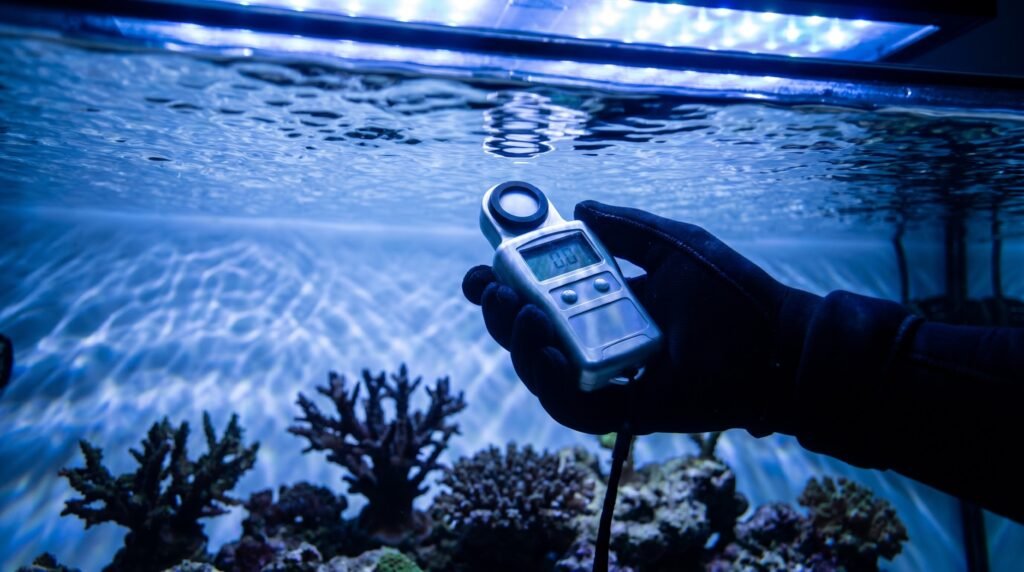
PAR intensity is measured in micromoles of photons per square meter per second, written as μmol m⁻²s⁻¹ or sometimes just “μmol.” A dedicated instrument – a quantum PAR meter – is the only accurate way to measure it at your coral’s actual position underwater. LI-COR, one of the instrument manufacturers whose sensors are used in both research and aquarium applications, defines the measurement unit as “micromoles of photons per square meter per second (μmol/m²/s)” and the relevant wavelength window as 400-700 nanometers. That window is what matters for photosynthesis.
Why does PAR beat watts or lumens? Watts measure electricity consumed, not photons delivered to the water. Lumens are weighted toward the green wavelengths the human eye sees best – not toward the blue and violet wavelengths corals absorb most efficiently. Two fixtures with identical watt draws and lumen outputs can deliver dramatically different PAR numbers at the coral surface, and it is the photons hitting the coral that drive zooxanthellae photosynthesis.
For a deeper look at measuring PAR in your own tank, the sibling article PAR explained and how to measure it covers quantum meters, rental programs, and how to build a PAR map of your aquarium.
Spectrum: why reef lights look so blue
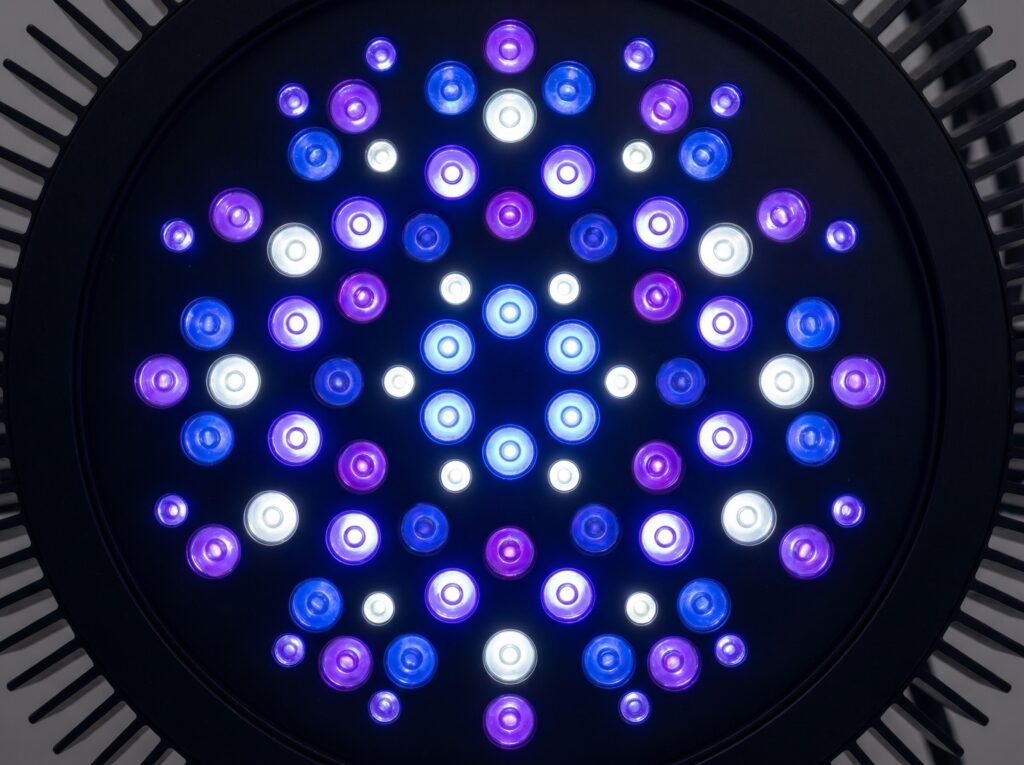
Walk into any fish store with a reef display and you will notice the same thing: the lights are strikingly blue-heavy, sometimes bordering on purple. This is not an aesthetic choice. It reflects the absorption preferences of the pigments inside zooxanthellae.
Research published in PMC (“The engine of the reef: photobiology of the coral-algal symbiosis”) identifies three primary light-harvesting pigments in Symbiodinium:
- Chlorophyll a, which absorbs most strongly around 435-440 nm (violet-blue) and again at 670-680 nm (deep red).
- Chlorophyll c2, which peaks near 450-460 nm (blue).
- Peridinin, a carotenoid unique to dinoflagellates, with maximum absorption at roughly 480-500 nm (blue-green).
Peridinin is especially important because it broadens the usable spectrum. The research notes it “expands the range of photosynthetically usable light of Symbiodinium because it has maximum absorption of blue-green light (~480-500 nm).” Together these three pigments explain why blue and violet diodes dominate quality reef fixtures: that is where most of the photosynthetically useful action happens.
Hobbyists sometimes hear the term PUR, meaning photosynthetically usable radiation. PUR is a subset of PAR that describes only the wavelengths corals actually absorb well – roughly 400-550 nm and 620-700 nm. A fixture with high PAR but poor spectrum can deliver lots of photons in the green range (500-600 nm) that bounce off coral tissue largely unused. This is why premium LED manufacturers tune their diode mixes toward blue and violet rather than simply cranking up white LEDs.
One side effect worth noting: heavily blue lighting makes many corals fluoresce brilliant greens, oranges, and pinks. That fluorescence is a real biological phenomenon – corals produce fluorescent proteins that may serve photoprotective roles – but it is only made visible by the blue excitation light your fixture provides.
Photoperiod: how long the lights should run
On a natural tropical reef, corals experience roughly 10-14 hours of light per day, with intensity rising and falling in a gradual arc. Aquarium practice follows the same principle. Most reef keepers run their main lights for 8-10 hours, with additional ramp-up and ramp-down periods at the start and end of the day that simulate dawn and dusk. Peak intensity sits in the middle of the day, with the fixture fading in and out over 30-60 minutes at each end.
There are two reasons ramping matters. First, abrupt full-intensity light can stress corals, especially newly introduced frags. Second, a natural photoperiod cues coral behavior – polyp extension, spawning cycles, and the rest-like darkness that follows peak light. Research on Goniopora columna conducted under controlled conditions found that as few as 6 hours of blue or violet light daily was sufficient to support coral growth and survival, suggesting that quality of the light window counts as much as raw duration.
A common beginner mistake is running lights too long in an attempt to compensate for low intensity. Excess photoperiod does not substitute for adequate PAR and tends to encourage nuisance algae. The better fix is to address PAR at the coral’s position – either by raising the light, increasing intensity, or choosing a more powerful fixture.
For a ready-to-use schedule template, including moon cycle settings, see reef tank lighting schedule.
Fixture categories: matching hardware to your situation
Reef lighting hardware has consolidated around four practical categories. Each has a different price point, capability ceiling, and typical use case.
AIO hood lights
All-in-one reef tanks (like the Red Sea Reefer Nano, Nuvo Fusion, and similar) usually ship with proprietary hood lighting built in. These lights are sized and tuned for the tank they come with, which is their main advantage: plug in, run the default schedule, and you are in business. Their PAR output is calibrated for the tank depth and footprint, so beginner-friendly soft corals and many LPS will do fine without any adjustments. The tradeoff is little room to grow – if you later want demanding SPS, you will likely need to replace or supplement the hood.
Budget LED fixtures
Fixtures in the roughly $50-200 range (brands like Current USA Orbit Marine, Nicrew HyperReef, and similar entry-level saltwater LEDs) offer programmable or at minimum adjustable intensity. PAR output is typically sufficient for soft corals and easy LPS at moderate tank depths. They generally lack the multi-channel spectrum control of premium units and may struggle to hit SPS-range PAR in tanks deeper than about 15 inches. For a beginner starting with easy corals, they are a reasonable entry point.
See best light for a nano reef tank if you are working with a tank under 20 gallons.
Premium LED fixtures
This is where the technology gets genuinely impressive. The flagship LED units – EcoTech Marine Radion G6, AquaIllumination Hydra, Kessil A360X, Orphek Atlantik – combine high PAR output with multi-channel spectrum control, programmable schedules, and app connectivity. The Radion XR30 G6 draws 215W and covers nearly four feet of tank with even PAR distribution. The AquaIllumination Prime 16HD draws up to 59W and covers a 24″ x 24″ area with a peak PAR of 100 μmol at 24 inches depth. The Kessil A360X runs 90W and has a coverage footprint of 24″ x 24″ for mixed reef or 20″ x 20″ when pushing SPS.
These fixtures can grow with your coral ambitions. Start at lower intensity for beginners, dial up gradually as the tank matures and your coral collection climbs the difficulty ladder. The price premium is real – expect $300-700 per fixture – but the ceiling is high enough to support full SPS systems.
A detailed comparison of current models is in best LED lights for a reef tank.
T5 fluorescent and T5/LED hybrid
T5 high-output fluorescent tubes were the gold standard of reef lighting before LED matured, and a significant portion of experienced reefers still run them – or run hybrid systems that combine T5 tubes with LED fixtures above the tank. Giesemann’s PowerChrome T5 lineup, for example, offers dedicated reef tubes including a Super Actinic at 421 nm for deep blue and an Aquablue Coral at roughly 15,000 K for a natural white-blue daylight spectrum.
T5’s strength is even, edge-to-edge coverage with excellent color blending – no hot spots under individual LEDs. The weakness is running cost: tubes must be replaced roughly every 12 months to maintain their spectrum output (PAR drops before the tube visibly dims), and you pay for electricity continuously across all tubes regardless of what you are trying to achieve at a given time of day. T5/LED hybrids split the difference: LEDs handle the programmable spectrum and intensity control while T5 tubes fill the coverage and color-blending gaps.
Coral goals and light requirements: a decision table
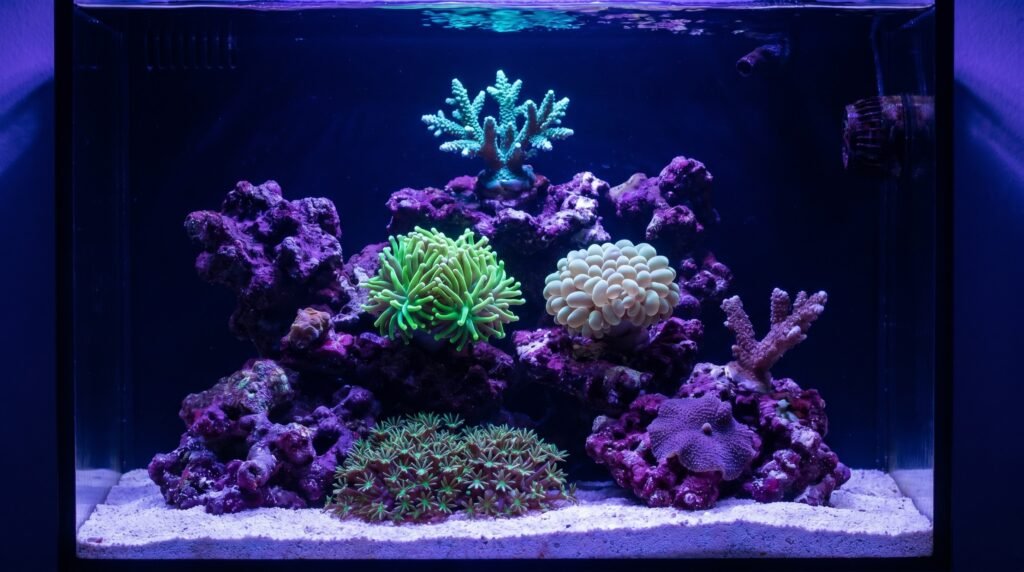
Every coral type has a preferred PAR range at its surface. The table below pairs those ranges – drawn from manufacturer guidance and aquaculture research – with the fixture tier likely to hit them and the placement strategy that works. Use it when choosing a new light, deciding where in the tank to place a coral, or deciding whether your current fixture can support your next purchase.
| Coral goal | Typical PAR range at coral surface | Spectrum priority | Fixture tier | Placement note |
|---|---|---|---|---|
| Soft corals only (mushrooms, leathers, zoanthids) | 25-125 μmol m⁻²s⁻¹ | Any quality reef spectrum works; blue-white mix fine | AIO hood, budget LED, or premium LED at low output | Mid-tank to substrate; avoid high-flow bright zones |
| Mixed reef – soft corals + easy LPS (hammer, frogspawn, bubble) | 50-200 μmol m⁻²s⁻¹ | Blue-dominant; some violet helps fluorescence | Budget LED (upper range) or premium LED at moderate output | LPS mid-tank; softies can go lower; avoid direct blasting |
| Demanding LPS (Acanthophyllia, Trachyphyllia, Blastomussa) | 50-150 μmol m⁻²s⁻¹ | Moderate blue; these corals often prefer less intense light than most people expect | Premium LED at 30-50% output | Bottom third of tank; test with PAR meter before final placement |
| Mixed reef with SPS (Montipora, easier Acropora) | 150-300 μmol m⁻²s⁻¹ at frag position | Strong blue and violet; quality spectrum essential | Premium LED at moderate-high output, or T5/LED hybrid | Upper third of tank; acclimate gradually from lower position |
| Dedicated SPS / Acropora dominant system | 250-400 μmol m⁻²s⁻¹ at coral surface | High-quality blue-violet-dominant; UV diodes beneficial | Premium LED at full output (XR30, A360X, AI Hydra 64) or T5/LED hybrid | Upper tank, near surface; test every position with PAR meter |
A few practical notes on using this table:
- PAR at the coral surface is what matters, not what the manufacturer claims at some nominal distance above water. Measure it with a PAR meter in your tank.
- The ranges are starting points. Individual coral colonies acclimate to conditions, and the same species can look very different at 80 vs 150 μmol depending on where it came from. Move slowly when changing light conditions.
- SPS corals, particularly fast-growing Acropora, are slow to photoacclimate. Research on Acropora millepora found they needed over 20 days to adjust to a new light regime. Do not judge a coral’s response in a week.
- Too much light causes bleaching just as surely as too little. Under excessive PAR, zooxanthellae suffer photoinhibition – the rate of incoming photons exceeds the coral’s ability to process them – which can trigger the same expulsion response as thermal stress.
For guidance on where physically to place corals based on both light and water flow, see coral placement: light and flow.
Getting the right light for beginners: three practical rules
Most beginner lighting problems fall into one of three patterns. Here is how to avoid them.
Buy for your coral ambition, not just today’s corals. A fixture that handles soft corals comfortably might not have the output for the hammer coral you will want in six months, let alone the Acropora you will eventually consider. Premium LEDs cost more upfront but seldom need replacement when your ambitions grow. AIO hood lights often do.
Acclimate new corals to your light, do not just drop them in. A coral from a store tank running 80 μmol placed directly under a fixture putting out 300 μmol will bleach. Start new arrivals in a shaded spot or at significantly reduced fixture intensity and raise the exposure over two to four weeks.
Measure, do not guess. Fixture manufacturers publish PAR numbers at specific test distances in air, under ideal conditions. Real tanks with water, glass, and varying fixture heights deliver different numbers. Renting or borrowing a PAR meter for a day – many reef clubs offer this – gives you the actual map of your tank and removes the guesswork about why a coral is browning out or bleaching.
Frequently asked questions
Do I need a PAR meter, or can I go by coral color?
Coral color gives clues but lags behind reality by weeks. Brown coloration often means too little light (zooxanthellae density increasing to capture more photons); pale or white patches mean too much. A PAR meter tells you the number immediately so you can adjust before the coral is visibly stressed. Many reef clubs lend them for free or a small fee.
How long should I run my reef lights each day?
Most established reef tanks do well on 8-10 hours of peak output, plus a ramp-up period of 30-60 minutes at dawn and a corresponding ramp-down at dusk. Running lights significantly longer than 10 hours tends to favor nuisance algae rather than coral growth. See reef tank lighting schedule for a sample 24-hour program.
Can I use a freshwater planted tank light on my reef?
Generally no. Planted tank lights are designed to produce a full-spectrum white output that looks natural over freshwater, and many emphasize red wavelengths (around 660-680 nm) to drive plant photosynthesis. Reef corals need a heavy concentration of blue-violet output in the 400-500 nm range – far more than any planted light delivers. A planted light will likely look yellowish-white over a reef and underdeliver the blue photons zooxanthellae depend on most. Reef-specific LEDs exist for a reason.
My corals are browning. Is my light too low?
Browning is the most common sign of insufficient PAR – the coral is increasing its zooxanthellae density to capture more photons, which shifts color toward brown. Check PAR at the coral’s position. If it is below the range for that coral type, raise the fixture, increase intensity, or reposition the coral higher in the tank.
The SteadyReef team
We write calm, plain-English reef-keeping guides. Every claim is checked against the marine-science and manufacturer sources listed above before publishing.