How many fish can you put in a reef tank? A practical guide by tank size
Most beginners ask “how many fish can I keep?” and get told one inch of fish per gallon. That answer is wrong for reef tanks, and using it is one of the fastest ways to crash a system you spent months setting up. The real number depends on four things: bioload, territory, swimming style, and your filtration capacity. Get those right, and the fish count follows naturally.
For a quick reference: a 20-gallon reef can comfortably support two small fish (three if your filtration is excellent and the species cooperate). A 40-gallon can handle four to five. A 75-gallon opens up enough space for six to eight, including one tang-class fish. The detailed breakdown by tank size is in the table below.
Why the inch-per-gallon rule fails in a reef
The rule was designed for freshwater community tanks with small, similarly shaped fish. It counts body length and ignores almost everything else that matters.
First, waste production scales with body volume, not length. A fish that is twice as long can have four to eight times the body volume – and waste output scales with that volume, not with the length measurement. A single adult tang produces far more nitrogen waste than four small gobies that happen to add up to the same total inches.
Second, the rule has nothing to say about territory. In the wild, an Achilles tang defends a feeding territory of 54 to 215 square feet. A 75-gallon tank offers roughly 4 square feet of floor space. That mismatch does not mean tangs cannot live in aquariums – they can, with appropriate tank size – but it explains why you cannot calculate a safe stocking density from body length alone. Damselfish claim entire small tanks as a single territory, then spend their energy harassing every other fish in the system rather than simply swimming around.
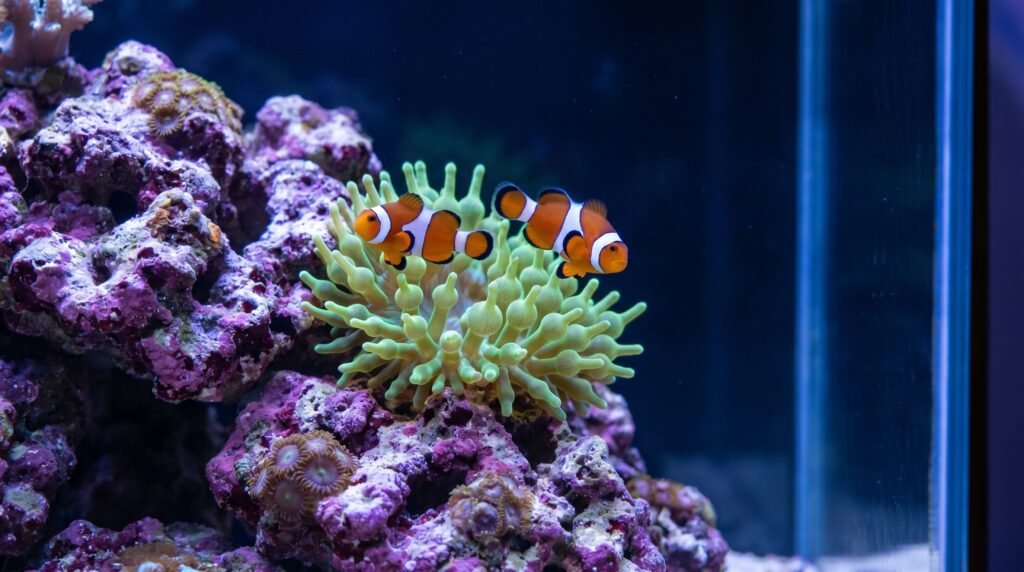
Third, swimming style matters. A blenny perches on rocks and rarely moves more than a foot or two from its chosen perch. A chromis cruises the water column constantly. A pair of clownfish rarely strays more than a few inches from their host coral. These fish have completely different space requirements even when they are the same body length.
Fourth, the rule assumes filtration that keeps pace with bioload – something no simple gallon number can guarantee. A tank with an undersized skimmer and no sump maxes out its biological capacity far below what an equivalent volume with a well-rated sump and oversized skimmer can support. LiveAquaria’s own saltwater stocking guidance uses a conservative 0.5 inches of fully grown fish per gallon as a starting ceiling, acknowledging that behavior and filtration, not just volume, set the real limit.
The four factors that actually determine your fish count
Bioload
Every fish converts food into ammonia, which your biological filter must process. The nitrogen cycle bacteria colony doubles roughly every 18 to 24 hours under good conditions, but it can only grow to meet a load that builds gradually. Add fish faster than the colony can adapt and ammonia climbs, stressing or killing everything in the tank – corals included.
Species with high metabolic rates and heavy feeding produce dramatically more waste per inch than slow, small-mouthed grazers. A single healthy tang out-wastes three or four small reef fish. Carnivores eating meaty foods also produce more ammonia per meal than herbivores eating algae, because protein metabolism releases more nitrogen. Your nitrate levels are a running score of how well your bioload matches your filtration capacity.
Territory and aggression
Marine fish are almost universally territorial to some degree. The practical consequences for stocking are significant. Two fish competing for the same rock outcrop will fight regardless of how many gallons surround them. Some combinations simply do not work under a certain tank size, no matter how good the water chemistry is.
The order you add fish matters as much as the number. Docile species should go in first and establish a routine before anything bolder arrives. An established dottyback or damselfish will attack new arrivals relentlessly in small tanks – sometimes fatally – if it was there first and already owns the territory. Introducing fish in increasing order of aggression is one of the most effective stocking tools available, and it costs nothing.
Swimming style and use of space
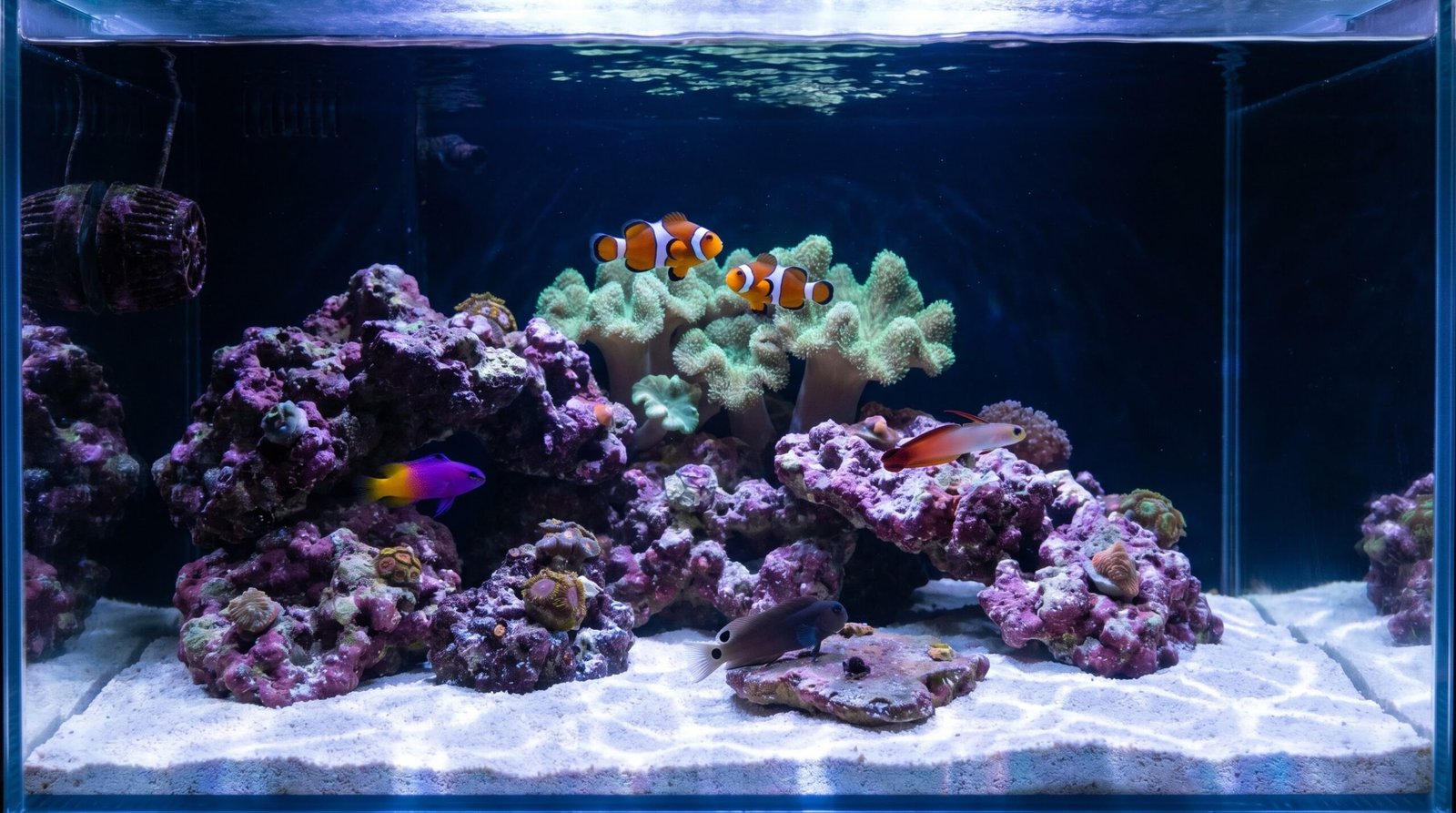
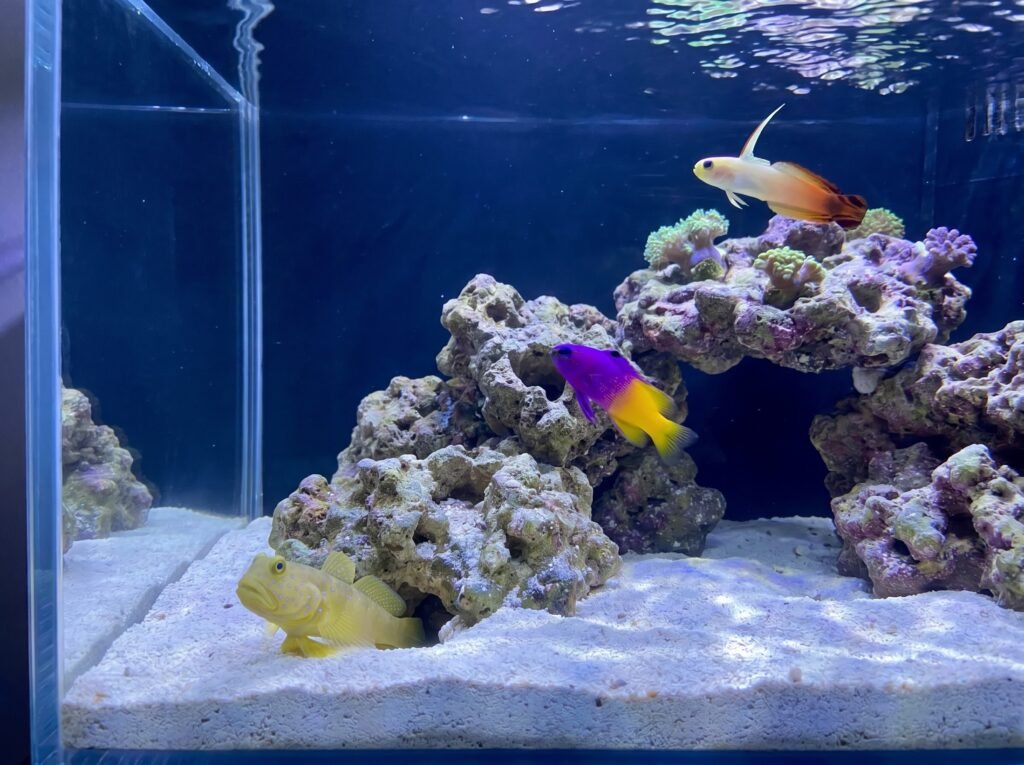
A tank’s functional capacity depends on whether the fish you choose actually use different parts of the water column. Stacking three bottom-dwelling gobies in a 20-gallon crowds the substrate even if the gallon math looks fine. A good stock list combines layers: a benthic goby or blenny on the rock/sand, a mid-water fish like a royal gramma that occupies the cave zone, and an open-water fish like a clownfish pair near the top third of the tank. Each occupies a distinct niche, and territorial pressure stays manageable.
Active, open-water swimmers need horizontal length, not just volume. A tall, narrow 30-gallon column tank is a worse fit for a firefish than a long, shallow 20-gallon because the fish need swimming lanes, not depth. Tank footprint matters alongside the volume number on the label.
Filtration capacity
Your filtration determines how much biological waste the system can process without ammonia spiking. A sump with a properly sized skimmer handles roughly double the bioload of an equivalent hang-on-back setup. Protein skimmer manufacturers size their gear on a lightly stocked assumption. If your tank is moderately stocked, you should be running a skimmer rated for at least 1.5 times your actual water volume. Heavily stocked systems need a skimmer rated at twice their volume, plus more frequent water changes to keep nitrates from climbing.
The equipment list matters when you plan your stock list. There is little point targeting six fish in a 40-gallon if the filtration was sized for two. The equipment article for reef tank equipment by tank size gives the full hardware picture if you are still building out your system.
Stocking table: 10-gallon through 90-gallon reef tanks
The numbers below reflect fish with a small to medium bioload kept in a properly cycled, well-filtered reef. They assume a hang-on-back or small skimmer setup at the low end of filtration and a sump with a properly rated skimmer at the upper end. All counts are for fully grown adult sizes – buy small, plan for adult dimensions.
| Tank size | Max fish (basic filtration) | Max fish (sump + quality skimmer) | Example stock list | What to avoid |
|---|---|---|---|---|
| 10 gallon (nano) | 1 | 2 (very small species only) | 1 tailspot blenny OR 1 small goby + pistol shrimp pair (shrimp not counted as fish) | Clownfish pair, dottybacks, any fish over 2.5 inches at adult size |
| 20 gallon | 2 | 3 | 1 pair ocellaris clownfish + 1 tailspot blenny; or 1 firefish + 1 neon goby (different genera, no territory overlap) | Tangs, large wrasses, triggers, yellow watchman goby, any fish needing 30+ gallon minimum |
| 30 gallon | 3 | 4 | 1 pair clownfish + 1 royal gramma + 1 tailspot blenny; or 1 firefish + 1 yellow watchman + 1 orchid dottyback | Tangs of any species, fish over 4 inches adult size |
| 40 gallon | 4 | 5 | 1 pair clownfish + 1 royal gramma + 1 firefish + 1 tailspot blenny; or 1 pair clownfish + 1 orchid dottyback + 1 yellow watchman goby + 1 neon goby | Tangs, large angelfish, groupers |
| 55 gallon | 5 | 6-7 | 1 pair clownfish + 1 royal gramma + 1 six-line wrasse + 1 firefish + 1 tailspot blenny; add a small school (3) of green chromis with the sump setup | Tangs (all species need 70+ gallons minimum; yellow tang needs 100+), large messy eaters (lionfish, groupers) |
| 75 gallon | 6 | 8 | 1 pair clownfish + 1 royal gramma + 1 six-line wrasse + 1 tailspot blenny + 1 firefish + 1 kole tang or tomini tang (tang added last) | Yellow tang (needs 100+ gallons); multiple tangs; dottybacks and grammas together (similar niche) |
| 90 gallon | 7 | 9-10 | 1 pair clownfish + 1 royal gramma + 1 kole tang or tomini tang + 1 tailspot blenny + 1 firefish + 1 six-line wrasse + 1 orchid dottyback (added last); plus 3-4 green chromis with sump | A second tang unless the species are known to coexist and were introduced simultaneously |
A few notes on reading the table. “Basic filtration” means a hang-on-back filter or small hang-on-back skimmer sized for the actual tank volume with no sump. “Sump + quality skimmer” means a skimmer rated at 1.5 to 2 times the display volume and a refugium or biological media section in the sump. The example stock lists are illustrative combinations – many others work. The species mentioned here are covered in more detail in the fish section of the site.
For 20-gallon tanks specifically, the combinations above reflect the most common beginner setup. The full breakdown of compatible species for that size is in the best fish for a 20-gallon reef tank guide. For any tank under 20 gallons, the best fish for a nano reef tank article covers the short list of species genuinely suited to that challenge.
How fast should you add fish?
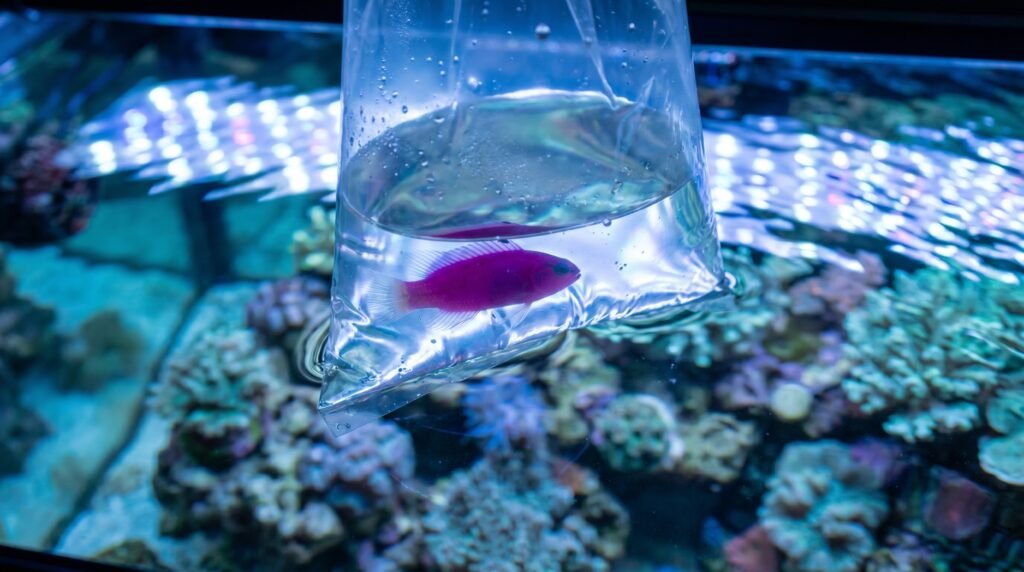
One or two fish every two to four weeks is the pace most experienced reef keepers use. The bacterial colony in your biological filter has to grow to meet each new bioload increment, and it cannot do that overnight. Adding three fish at once to an established but lightly stocked tank is a recipe for an ammonia spike that you may not catch until a coral starts bleaching or a fish goes pale and stops eating.
The sequence within that pace matters too. Stock the least aggressive species first and give them several weeks to settle in before adding anything bolder. A clownfish pair or a tailspot blenny on day one creates no territory problems for a royal gramma added four weeks later. Reverse that order and the gramma – which is intensely territorial toward cave-dwelling fish of similar shape – may be relentlessly harassed in its own cave.
A fully stocked 40-gallon reef with four or five fish will take three to five months to build at this pace. That is not a flaw in the plan – it is the plan. A tank that grows into its stocking load gradually tends to stay stable, and stable tanks are the ones that grow good coral.
Watch your water parameters after every addition. Ammonia and nitrite should stay at zero. Nitrate will tick up slightly with each new fish, which is normal, but a sudden jump points to a bioload the filtration cannot keep up with. If nitrate climbs steadily over several weeks after an addition and does not stabilize, the system is telling you something.
Signs that a tank is overstocked
The most obvious tell is persistent aggression that does not settle down after a few weeks. Fish that are constantly chasing, nipping, or hiding behind a rock are fish that do not have enough space to establish stable territories. This is a husbandry problem, not a personality problem – the same species in a larger tank often behaves perfectly well.
Water quality is the other signal. A tank that needs water changes every four or five days just to keep nitrates below 10 ppm, or that produces skimmate faster than the skimmer was designed to handle, is loaded beyond what the filtration was built for. You can run a heavy bioload if you upgrade the filtration to match – but the math has to work. Persistent high nitrates are one of the clearest indicators that something is out of balance.
Coral health is the canary. Soft corals and LPS that are normally extended and feeding will begin to retract or refuse to open when dissolved organics climb. If the coral section of a well-lit tank suddenly looks deflated for no obvious reason, check ammonia, nitrite, and nitrate before assuming a lighting or flow problem.
Frequently asked questions
Can I keep a tang in a 40-gallon reef tank?
Most experienced reef keepers say no. Tangs are open-water swimmers that need long horizontal swim lanes. Even the smallest commonly available species (kole tang, tomini tang) are typically recommended in 70 gallons minimum by specialist vendors. A 40-gallon tank is simply not long enough for a fish that may grow to 6 to 7 inches and needs sustained movement to stay healthy.
Do clownfish count against my stocking limit if they stay near one spot?
Yes, because they still produce ammonia regardless of how little they swim. A bonded pair of ocellaris clownfish count as two fish in your bioload calculation. They are among the lowest-bioload reef fish available, which is one reason they work well in 20-gallon tanks, but they still count.
I have great filtration – can I keep more fish than the table suggests?
Better filtration raises your water-quality ceiling, but it does not solve territory. You can add a sump and a large skimmer and keep nitrates in perfect check, but if two fish in a 30-gallon are fighting over the same cave structure, that is a space and aggression problem no amount of filtration fixes. The territory constraint is real regardless of water chemistry.
How many cleanup crew members affect fish stocking numbers?
Snails, hermit crabs, and most shrimp add a very small bioload compared to fish – typically negligible in stocking calculations. A cleanup crew of 15 to 20 snails and a few crabs in a 30-gallon adds less ammonia than a single small fish. Include pistol shrimp and peppermint shrimp in your stocking plan for compatibility reasons, but they rarely change the fish count.
The SteadyReef team
We write calm, plain-English reef-keeping guides. Every claim is checked against the marine-science and manufacturer sources listed above before publishing.