Reef tank sizes: pick the right one for you
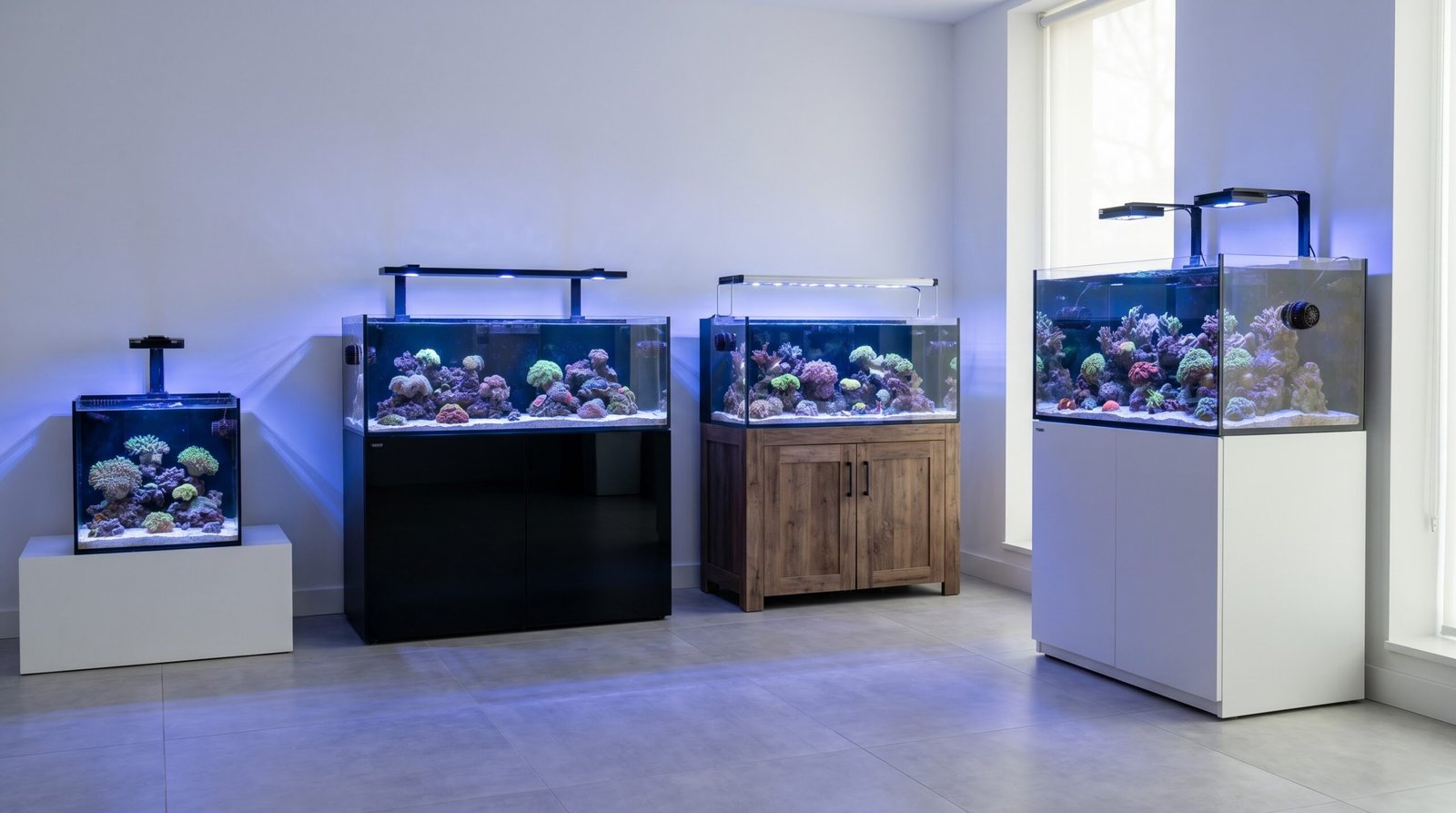
Pick a tank that is too small and you will spend every day chasing parameter swings. Pick one that is too large and it may outlast your budget or buckle your floor. The good news: there is a clear sweet spot for almost every situation, and the choice comes down to four honest trade-offs – stability, cost, space, and the time you are prepared to spend on maintenance.
Water volume is the single biggest factor in how forgiving a reef is to keep. As aquarium professionals put it, any change – a small chemical fluctuation, a fish passing away, a bit of overfeeding – is drastically magnified in a small volume of water. Bigger tanks buffer those swings. They also hold temperature more steadily: the larger the tank, the less the temperature will fluctuate, which matters enormously because even a 1-2°F daily swing stresses corals and can trigger browning.
The size tiers, plainly described
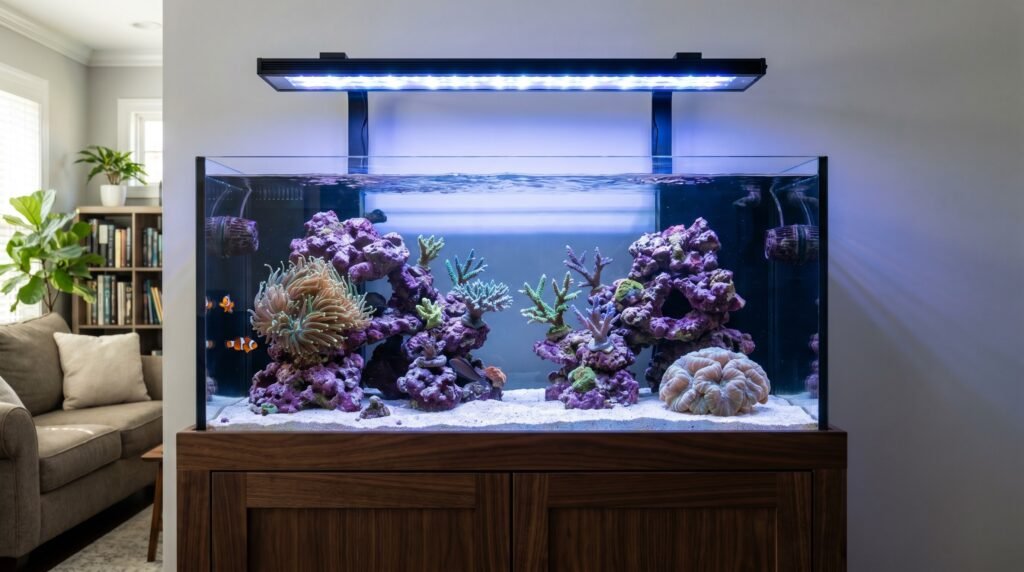
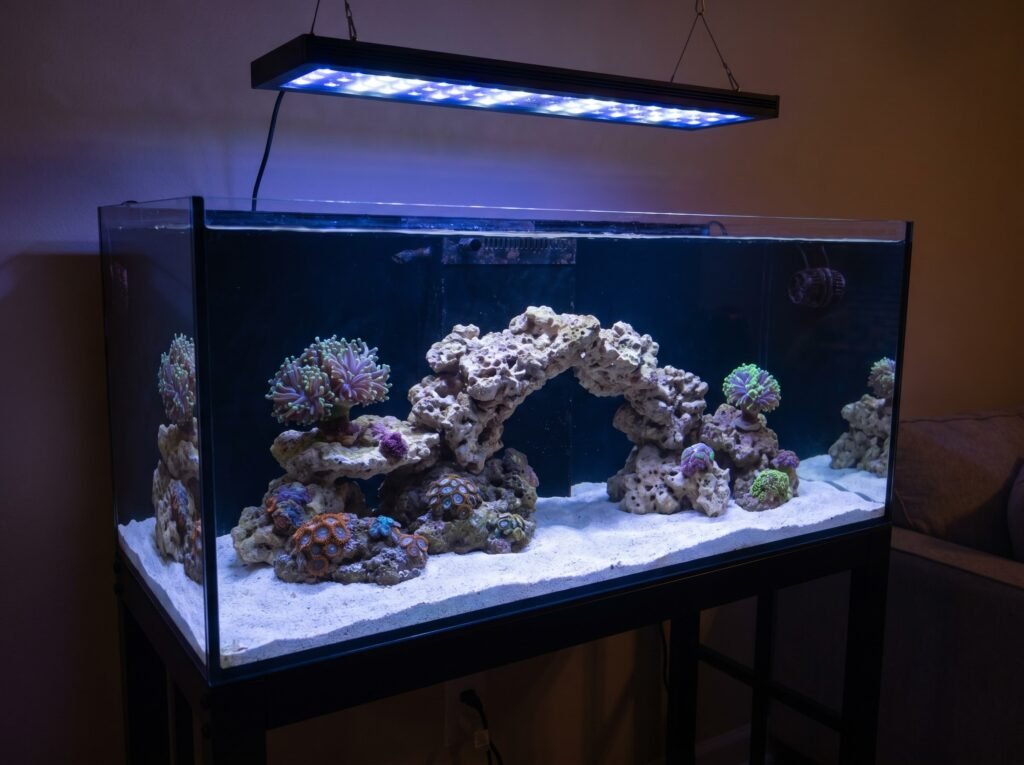
Reef tanks fall into four practical tiers. Each has a home in this hobby; none is universally “best.”
Pico and nano: under 20 gallons
A nano reef tank – generally anything under 20 gallons – is the most photogenic entry on the shelf and the hardest to keep stable. You are working with a thin margin: evaporation alone removes roughly 1% of the system volume every day, and since salt does not evaporate, only water does, even a missed top-off sends salinity climbing. On a 10-gallon tank that is about 0.1 gallons gone before you notice. The proportional salinity rise is the same regardless of tank size – but a nano tank gives you far less total water to absorb any correction error, and its higher surface-area-to-volume ratio can push evaporation well above that 1% estimate on a warm day.
That said, a well-planned nano in the 10-20 gallon range – especially an all-in-one (AIO) unit with a built-in rear filtration chamber – can thrive. The AIO design keeps the pump, heater, and media tucked away in the back, so you get sump-like separation without drilling or plumbing. What you cannot skip is an auto top-off (ATO) unit to replace evaporation automatically, and a consistent hand with water changes. The nano reef build guide walks through the full equipment list for this tier. For tanks under 5 gallons, read the pico reef guide first – that is genuinely expert territory.
A 10-gallon tank filled with saltwater, rock, and sand weighs roughly 110-120 lbs. A 20-gallon long (30 x 12 x 13 inches) comes in at around 230-250 lbs fully loaded (water, rock, and sand – add another 50-80 lbs if you count the stand). Both sit comfortably on a dedicated stand over a standard residential floor.
20-40 gallons: the beginner sweet spot
Most experienced reef-keepers recommend starting somewhere between 20 and 40 gallons if you are new to salt water. The water volume is large enough to buffer the accidental feeding spike or the day you forget a top-off, but small enough that water changes and equipment costs stay manageable.
The 20-gallon long (30 x 12 x 13 inches, roughly 230-250 lbs fully set up with water, rock, and sand) gives you enough footprint for a small cleanup crew, a pair of clownfish, and a selection of soft and LPS corals. It fits on most desks and shelves. The 20-gallon build guide covers the exact equipment you need.
The 40-gallon breeder (36 x 18 x 16 inches) is the next step up and is widely considered the single best beginner tank. The wider 18-inch front-to-back dimension gives you real aquascaping room – you can build a proper rock structure with swim-through arches and still leave flow lanes. Fully loaded (water, rock, sand, stand) expect 500-580 lbs. That is well within the 40 psf live-load design rating of a standard residential floor, distributed across the stand footprint. The 40-gallon breeder build guide has the details.
Startup costs for this tier run roughly $500-$1,000 for a 20-gallon AIO kit with basic equipment, or $1,500-$3,000 for a 40-gallon system with a proper sump, skimmer, and LED lighting.
75 gallons: the classic reef
The 75-gallon (48 x 18 x 21 inches) has been the standard reef size for decades, and for good reason. At this volume the parameters buffer so well that a beginner’s mistakes rarely become catastrophes. You can keep a wider range of fish, grow large LPS colonies, and keep small to medium SPS colonies once your chemistry is dialed in.
The 75-gallon is also where weight starts to demand attention. Empty, the tank weighs around 140 lbs. Fully loaded – water, rock, sand, sump, stand – the total can reach 900-1,000 lbs. Spread over a 48 x 18-inch stand footprint (6 square feet), that is roughly 150-167 lbs per square foot: well above the 40 psf design live load that residential wood-frame floors are built to. This does not mean the floor will fail. Wood-frame floors carry dead loads continuously; span tables account for load distribution, joist spacing, and span length, not just a uniform psf figure. But it does mean you should place the stand against or very near a load-bearing wall, orient it so its long axis runs perpendicular to the floor joists if possible, and – for tanks above 75 gallons – consider consulting a structural engineer or at minimum check with a knowledgeable contractor.
Startup costs for a 75-gallon system start around $3,000 and climb to $6,000 or more depending on lighting quality and whether you run a full sump setup.
100 gallons and up: committed territory
Tanks over 100 gallons offer the most stable environment possible in a home setting. Parameter swings that would crash a nano take weeks to develop at this scale. You can keep tangs, larger angels, and a broad mix of coral types.
The trade-offs are real. Water changes become a serious logistical exercise (a 20% change on a 125-gallon system means mixing and moving 25 gallons of saltwater). Equipment costs scale up: you may need two or three LED fixtures, a larger sump, a more powerful return pump, and a chiller in warmer climates. And floor loading becomes a genuine engineering question for anything over 125 gallons on a wood-frame floor above a basement.
The size decision table
This table summarizes the four tiers across the factors that matter most to a new reefer. “Stability” reflects how well the tank buffers chemical and temperature swings. “Maintenance intensity” accounts for how often parameter checks and top-offs are needed relative to tank size.
| Size tier | Typical volume | Footprint (L x W) | Loaded weight (approx.) | Stability | Startup cost (USD) | Maintenance intensity | Best for |
|---|---|---|---|---|---|---|---|
| Pico / nano | 2-20 gal | 12-30 x 10-13 in | 25-225 lbs | Low – swings fast | $300-$1,000 | High (daily top-off essential) | Desk display; experienced keeper or well-automated setup |
| Beginner mid-range | 20-40 gal | 24-36 x 12-18 in | 230-580 lbs | Moderate – forgiving with care | $500-$3,000 | Moderate (weekly checks, bi-weekly water changes) | First reef tank; apartment or smaller room |
| Classic reef | 75 gal | 48 x 18 in | 900-1,000 lbs | High – very forgiving | $3,000-$6,000 | Moderate (larger water changes; more equipment to monitor) | Mixed reef with fish and diverse corals; dedicated hobbyist |
| Large system | 100-200 gal | 60-72 x 18-24 in | 1,200-2,500 lbs | Very high – slow to drift | $5,000-$20,000+ | Lower per-gallon, but high absolute volume and complexity | Experienced reefer; dedicated fish room; SPS-dominant systems |
Weight and floor placement – what you actually need to know
Saltwater weighs about 8.55 lbs per gallon. Add the tank glass, stand, rock (roughly 1 lb per gallon of live rock is a common starting point), and sand, and the rule of thumb used by most aquarium installers is to budget around 10-12 lbs per gallon of total system capacity as a working estimate. So a 75-gallon system sits at roughly 750-900 lbs before you account for a sump and its water.
The International Residential Code (IRC) designs residential living-area floors for a live load of 40 psf. A 75-gallon tank on a 48 x 18-inch stand covers 6 square feet – that works out to roughly 150-167 lbs/sq ft when loaded, which exceeds the uniform design assumption. This is why placement matters:
- Orient the stand so its long axis runs perpendicular to the floor joists – this spreads the load across more joists rather than concentrating it along one or two.
- The closer to a load-bearing wall, the shorter the joist span and the stiffer the floor.
- Concrete slab floors (ground level, basement) handle any home aquarium without concern.
- For any tank over 125 gallons on a wood-frame floor, have a contractor check joist size, species, and span before you fill it.
A 20-40 gallon tank on a proper stand poses no realistic floor concern in a typical home. The concern scales up with the tank.
Nano reef tanks: the honest picture
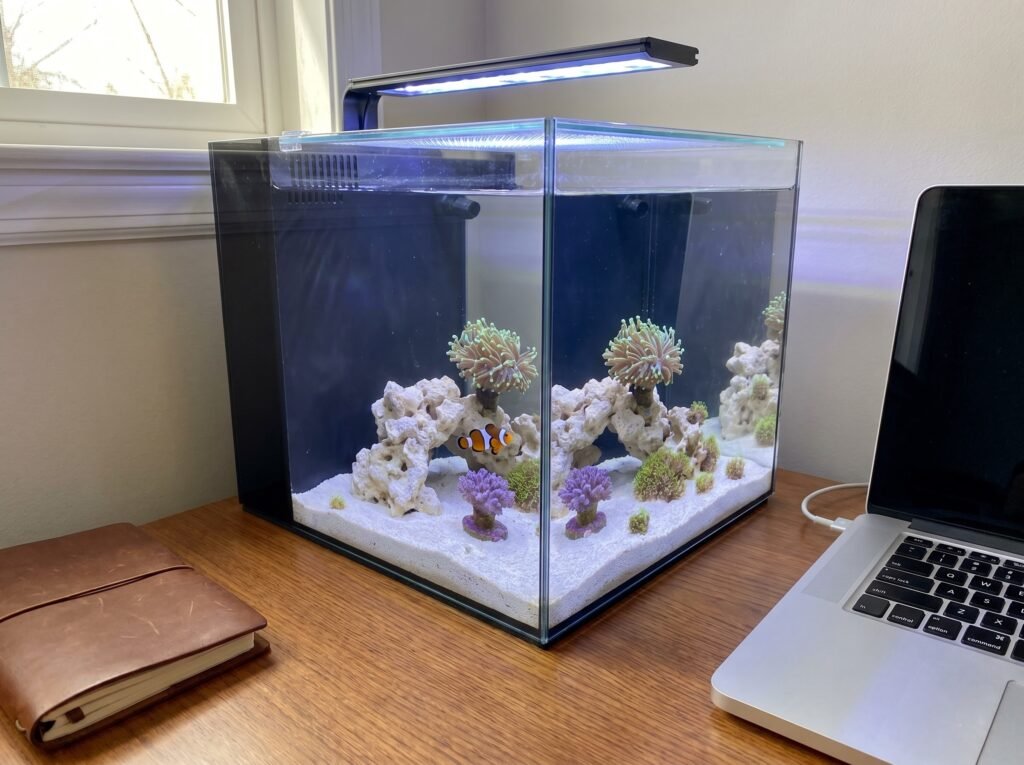
A nano reef tank gets more beginner attention than almost any other size, partly because the all-in-one units look stunning at retail. They are genuinely achievable – but not because they are easy. They work when the keeper runs an ATO, does small frequent water changes (roughly 10-15% weekly works well at this scale), keeps stocking light, and accepts that one skipped maintenance session can shift parameters faster than in a larger tank.
The specific challenge with nanos comes down to thermal and chemical buffering. NOAA Coral Reef Watch data shows that temperatures just 1°C (1.8°F) above the usual summertime maximum are enough to stress corals – and sustained stress leads to bleaching. In a 10-gallon tank, a summer afternoon near a window or a heater malfunction can move the needle that far in an hour or two. A 75-gallon tank with its much greater thermal mass changes temperature far more slowly, giving you time to catch and correct the problem.
If a nano is what your space allows, the AIO reef tank guide explains which systems include enough built-in filtration to give you a real chance at success, and what upgrades are worth adding. The best fish for a nano reef covers stocking limits honestly.
Starting somewhere: the practical path
For most people reading this, the 20-40 gallon range is the right starting point. The 20-gallon AIO on a desk is achievable with discipline and automation. The 40-gallon breeder on a stand in the living room is forgiving enough for a genuinely relaxed first year. The 75-gallon is where most hobbyists eventually want to be.
Whatever size you choose, the fundamentals stay the same: RODI water only, a proper nitrogen cycle before any livestock, and parameters kept stable rather than chased to perfection. Alkalinity at 8-11 dKH, calcium at 400-450 ppm, magnesium at 1,250-1,350 ppm, salinity at 1.025 SG, temperature at 75-78°F – stable. The full equipment checklist covers everything you will need to buy before your first fish arrives, sized to your tank choice.
Frequently asked questions
What is the easiest reef tank size for a beginner?
The 40-gallon breeder is the most forgiving starting point. Its 36 x 18-inch footprint gives enough aquascaping room and water volume to buffer beginner mistakes, while keeping water-change volumes and equipment costs manageable. A 20-gallon AIO is a reasonable second choice if space is limited, but demands more consistent daily attention.
Can a nano reef tank work for a beginner?
Yes, with the right setup and realistic expectations. A nano reef tank in the 10-20 gallon range requires an auto top-off unit to manage evaporation, frequent small water changes, and light stocking. The margin for error is smaller than in a 40+ gallon system, so a beginner needs to be consistent rather than hands-off.
How much does a full 75-gallon reef tank weigh?
Fully loaded with water, rock, sand, and stand, a 75-gallon reef system typically weighs 900-1,000 lbs. Saltwater runs about 8.55 lbs per gallon, and rock, sand, glass, and sump add the rest. Place the stand near a load-bearing wall and check floor joist orientation before filling.
Is it cheaper to run a small tank or a large one?
Small tanks cost less to buy and stock initially, but the per-gallon equipment cost (lighting, skimmer, ATO, heaters) is not always lower. A 40-gallon breeder with proper equipment runs $1,500-$3,000 to set up. A nano AIO can start under $1,000. Large systems (75g+) start around $3,000 and scale up significantly with quality equipment.
The SteadyReef team
We write calm, plain-English reef-keeping guides. Every claim is checked against the marine-science and manufacturer sources listed above before publishing.